

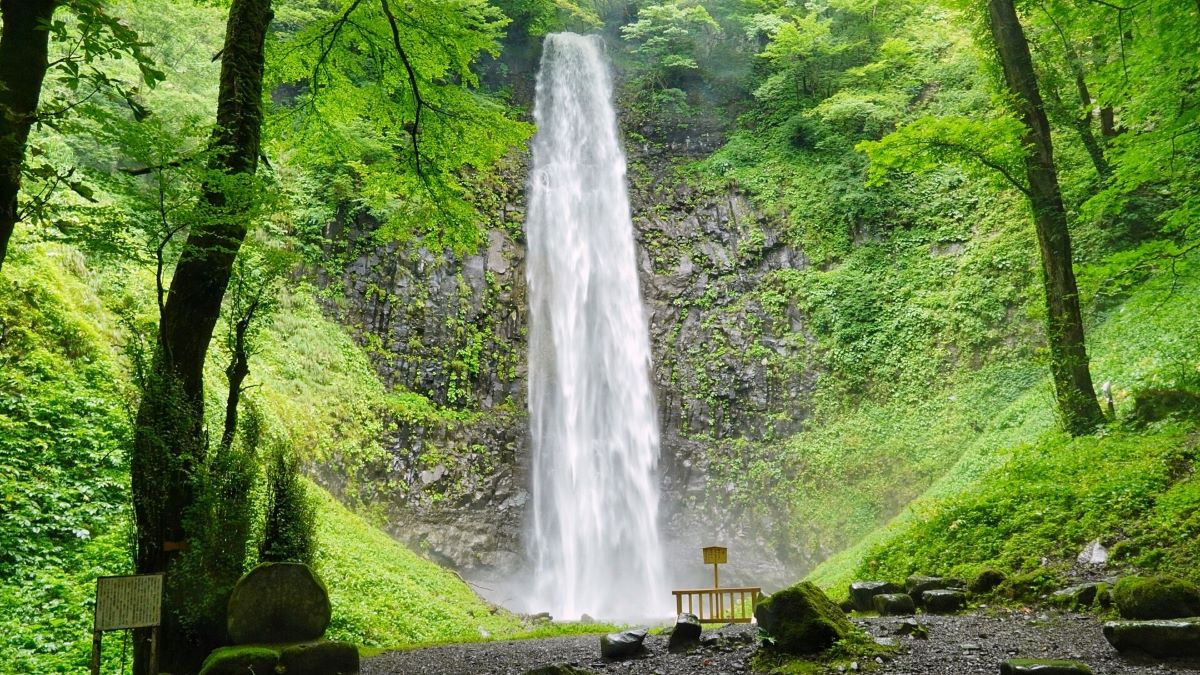
[Yamagata Prefecture] 3 Famous Springs in Yamagata Prefecture! Yamagata Prefecture is blessed with springs of water created by snow, mountains, and forests

Yamagata Prefecture, home to many famous mountains such as Mt. Chokai, Mt. Zao, and the Dewa Sanzan (Mount Gassan, Mt. Haguro, and Mt. Yudono), boasts the largest area of natural beech forests in Japan, and these mountains and forests, with their abundant snowfall, become endless sources of water and bring about abundant harvests
The prefecture is the number one producer of wild plants such as bracken and taro, and fruits such as cherries and pears in Japan, and it is also home to delicious rice and the brewing of sake and wine, all of which are thanks to the prefecture's abundant water
What is a "famous water"?

Japan has many springs, rivers, and groundwater with good quality and abundant water, which supports people's lives by providing drinking water, water for daily use, and water for agriculture
Among these, the particularly refreshing water sources are called "famous water sources."
There is no clear definition or standard for what constitutes a famous spring, but what all of these springs have in common is that they are carefully protected by the local community to ensure that they remain pure water
"Top 100 Famous Waters" and "Top 100 Famous Waters of the Heisei Era" selected by the Ministry of the Environment
In 1985, the Environment Agency at the time selected the "100 Famous Waters" with the aim of selecting particularly excellent water environments from rivers and springs across the country and preserving them for the future
In 2008, the "100 Best Waters of the Heisei Era" was released, which included rivers, springs, irrigation water, and groundwater, and a total of 200 water sources were selected, with 12 in each of the Tohoku regions making up a total of 24 water sources
A famous water source from Yamagata Prefecture, selected as one of the "100 Famous Waters Selected by the Ministry of the Environment"
The selected springs are located in Bandai-Asahi National Park, at the foot of Mt. Gassan, one of Japan's 100 most famous mountains, and the Omi River, which is part of the Mogami River system
Gassan foothills springs: Nishikawa Town, Nishimurayama District
Gassan is famous for its deep snow, which means that it is perpetually covered with snow that does not melt even in summer, making it perfect for summer skiing. Its abundant water source is stored in a vast primeval beech forest, and over the course of 400 years, it has gushed forth in various places around the foot of the mountain
The water is delicious, neutral, soft water rich in carbon dioxide, oxygen, and minerals, and is kept at a temperature of 5°C throughout the year, so it is sold as mineral water
Gassan is famous for its deep snow, which means that it is perpetually covered with snow that does not melt even in summer, making it perfect for summer skiing. Its abundant water source is stored in a vast primeval beech forest, and over the course of 400 years, it has gushed forth in various places around the foot of the mountain
The water is neutral, soft, and delicious, rich in carbon dioxide, oxygen, and minerals. The water temperature is kept at 5°C throughout the year, and it is sold as mineral water
INFORMATION
- Facility name: Gassan foothills springs
- Location: Shizu, Nishikawa-cho, Nishimurayama-gun, Yamagata Prefecture
- Phone number: 0237-74-2112 (General Affairs and Planning Division, Nishikawa Town, Yamagata Prefecture)
- URL:Nishikawa Town Official Website
GOOGLE MAP
Omigawa: Higashine City
The Otomi and Hanyu districts, located on an alluvial fan where underground water from the Ou Mountains flows, are an area where clean water springs up when you dig. The call people use to dig a well, "Dokkoisho," is a corrupted expression, and these wells are called "Dokkomizu" or "Donkomizu."
Although the water pressure has weakened compared to the past, the "Donko Water" still gushes out from the well. The water temperature remains fairly constant at 11-13°C, so it is carefully managed by the locals as a spring that is cold in the summer and warm in the winter
Additionally, the Omi River is home to the endangered Japanese thornfish, which is designated as a natural monument of Yamagata Prefecture, and conservation efforts are underway to protect it along with other aquatic animals
INFORMATION
- Facility name: Omigawa
- Location: Higashine City, Yamagata Prefecture
- Phone number: 0237-42-1111 (Higashine City Department of Civil Life, Living Environment Division)
- URL:Higashine City Official Website
GOOGLE MAP
A famous water source from Yamagata Prefecture, selected as one of the "Top 100 Water Sources of the Heisei Era" by the Environment Agency
The Tachiyazawa River, a tributary of the Mogami River system that flows through the northern part of the prefecture, was once known as "the cleanest river in the Tohoku region" and is the only river in Yamagata Prefecture with famous water
Tachiyazawa River: Shonai Town, Higashitagawa District
The Tachiyazawa River basin, once a bustling main approach to the inner pilgrimage to the Dewa Sanzan mountains, has its source in the meltwater from Mt. Gassan
In summer, sweetfish and cherry salmon swim upstream, and in winter, salmon swim upstream. In addition, char and mitten crab are farmed here, and the river provides drinking water and water for daily use for residents of the river basin, as well as agricultural water for the Shonai Plain
The area where it joins the Mogami River is the origin of high-quality rice varieties such as Sasanishiki and Koshihikari, and is the region where Kamenoo, which is considered ideal for sake brewing, is produced
INFORMATION
- Facility name: Tachiyazawa River
- Location: Shonai Town, Higashitagawa District, Yamagata Prefecture
- Phone number: 0234-43-0254
- URL:Shonai Town Official Website
GOOGLE MAP
Excellent spring water selected as one of the "Top 100 Village Waters of Yamagata"
71 locations selected from four regions in Yamagata Prefecture
Yamagata Prefecture has selected the best springs of water that have been cultivated in particular regions from among the springs found throughout the prefecture as the "Yamagata's 100 Famous Village Waters." As of November 30, 2022, 71 locations from four regions have been selected
- 25 locations in the Murayama area
- 10 locations in the Mogami region
- 11 locations in the Okitama region
- 25 areas within the province
These "famous village waters" are carefully protected by the local community, so please be careful not to pollute or disturb them when you visit
INFORMATION
- Contact: Yamagata Prefecture, Environment and Energy Department, Water and Air Environment Division
- Phone number: 023-630-2204
- URL:Yamagata Prefecture Official Website (Sato no Mizu - Yamagata 100 Selections)
The mysterious underground water that springs up on Kamaiso Coast
Kamaiso Beach in Yuza Town, facing the Sea of Japan, is a popular swimming spot in the summer, but fresh water, not seawater, springs up from the sands of this beach, creating a unique marbled pattern of white sand mixed with black iron sand
Mysterious spring water gushes out from the sandy beach
Cold groundwater from Mt. Chokai springs up from the sandy beach, seabed, and rocks, allowing you to enjoy mysterious phenomena such as sudden changes in seawater temperature that you won't find at other swimming beaches
In this way, minerals from the mountains are delivered to the sea, allowing the oysters in the Sea of Japan to grow large and become creamy and delicious
INFORMATION
- Facility name: Kamaiso Beach
- Location: Fukiura, Yuza-machi, Akumi-gun, Yamagata Prefecture
- Phone number: 0234-72-5886 (Yuza Town Hall Planning Division)
- URL:Yamagata Prefecture Official Tourism Website
GOOGLE MAP
"Delicious Yamagata Water" is now on sale!
Tap water taken from a water purification plant operated by the Yamagata Prefectural Enterprise Bureau is bottled in 500ml plastic bottles and sold for 100 yen (tax included) per bottle
It can be purchased at the Yamagata Prefectural Office shop, at each branch office shop, and at the antenna shop "Oishii Yamagata Plaza" in Ginza 1-chome, Tokyo
- Contact: Yamagata Prefecture Public Enterprise Bureau, Waterworks Division
- Phone number: 023-630-2345
- URL:Yamagata Prefecture Official Website (Delicious Yamagata Water)
summary
Yamagata Prefecture, which is covered in deep snow and has many mountains and forests, is also rich in clean rivers and springs, and this delicious water is used to grow agricultural products such as rice, brand beef such as Yamagata beef and Yonezawa beef, and to brew sake and wine
Additionally, each region of the prefecture has many hidden springs and wells that are known only to those in the know, and by exploring them you will learn how much the local people treasure this blessed water
Tohoku Famous Water Series



I'm a former Edoite (Tokyoite) who loves Morioka and the six prefectures of Tohoku, and I'm a big fan of history, gourmet food, travel, sports, alcohol, and choral singing.
I'll introduce you to interesting things, delicious food, and great places in Tohoku!
Please support NEFT's article creation!
NEFT gathers and publishes articles about the history, culture, and tourism information of various regions in Tohoku
If you enjoyed this article, we would be grateful if you would consider supporting our future interviews, article creation, and website management
*Clicking "Tip" will open the tip sending screen for the external service "codoc"
Other articles

What is Akita's famous sake "Shirakami-Sanchi no Shiki"? Even locals don't know much about it...

[Akita Prefecture] Enjoy the taste, scenery, and leisure at Nikaho...

The only surviving building that still retains traces of the Boshin War, the "Kyu-Takizawa Honten".

[Nihonmatsu City, Fukushima Prefecture] Mount Adatara, home to the "real sky"...

We asked the staff at Morioka's soul food shop, Fukuda Pan...

Four historical sites related to Katakura Kagetsuna, a famous vassal of Date Masamune, and the Katakura family.

[Mt. Chokai-Tobishima Geopark: Nikaho (1)] Alongside Matsushima...

[Miyagi] Enjoy seasonal flower fields from spring to autumn! 3 recommended spots

The legend of the buried gold treasure of the Fujiwara clan of Oshu! What is Mount Kinkei in Hiraizumi? [Rock...

[Fukushima] Adachi, where you can gaze at the "real sky" and soak in hot springs...

[Towada City, Aomori Prefecture] An oasis of art that resonates with the future!.
