


Arahagihaba Shrine in Tagajo | Was it the guardian deity of the Tagajo government office, created to repel the Emishi (indigenous people of northern Japan)? [Miyagi Prefecture]

The mysterious ancient god"Arahabaki"...
This mysterious deity is said to have been worshipped mainly in the Tohoku and Kanto regions, but even today, the most famous shrine bearing its namethe Arahagihaba Shrine.
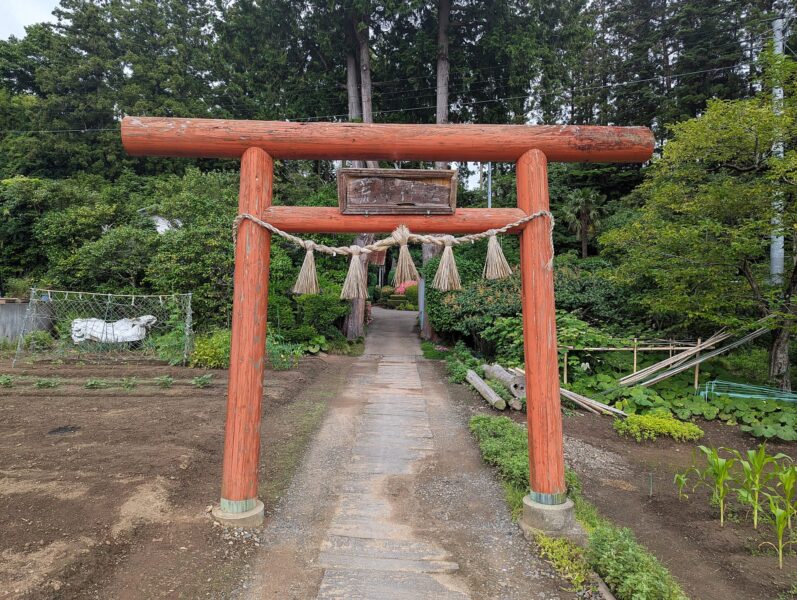
This article delves into the mystery of the Arahaba Shrine in Tagajo and the enigmatic ancient deity "Arahaba."
Who is the ancient god "Arahabaki"?
"Arahabaki"is a deity that was worshipped mainly in the Tohoku and Kanto regions of Japan. It is believed to have existed since ancient times, butit does not appear in Japanese mythology (Kojiki and Nihon Shoki).
Therefore, it is thought to be a deity originating from the local beliefs of ancient Japan, from the Tohoku region to the Kanto region. However, because it is so ancient and, as mentioned above, not mentioned in any documents, its true identity and origin remain unknown to this day
From the Middle Ages onward, the name appears in shrine histories and records using various spellings such as "荒脚巾," "荒覇吐," "荒吐," and "荒波々幾." However, it is highly likely that these are kanji characters that were assigned later, and it is considered most appropriate to refer to it using the katakana spelling "ARHABAKI."
There are various theories regarding "what kind of god it is." Some of them are listed below
The legend of the god of feet and travel
This theory suggests that it originated from the fact that the kanji characters "脚巾" were later assigned to "habaki" (leg guards)
Habaki refers to the practice of wrapping straw or cloth around the shins and tying it with string to allow for easier movement during travel or work. It is believed that this is why the deity came to be worshipped as a god associated with "feet."
The term "feet" is sometimes broadly interpreted as "lower body," and the deity is identified with "Konsei-sama" (金勢様/金精様) , a god modeled after the male phallus
Snake God Theory
in "Arahabaki"an archaic word for snake, and "hahaki" means either "snake tree" or "dragon tree."
Furthermore, this is linked to the "Hahaki-no-kami" enshrined in the southeast of the Inner Shrine of Ise Grand Shrine , and there is a theory that the prefix "to manifest" was later added to "Hahaki-no-kami, " resulting in "Arahabaki-no-kami ."
The theory of the guardian deity
At the Arahagihaba Shrine in Tagajo City, Miyagi Prefecture,the "Sai no Kami theory"is told.
Sai no Kami refers to " a god of folk belief enshrined at village boundaries and crossroads to prevent disasters, epidemics, and evil spirits from entering a territory," and is also known as Dosojin .
This theory suggests that "Arahabaki" was enshrined in Tagajo, which was a base for the imperial court to subdue the Emishi, in order to protect Tagajo from Emishi invasions
The Emishi God Theory
One theory that stems from the "Sai no Kami theory" of Tagajo is the "Emishi (Ainu) god theory."
The traditional policy of the imperial court to govern the Emishi was said to be "to control the Emishi with the Emishi," and it is also said that the intention was to demoralize the Emishi by enshrining their god, "Arahabaki," as a guardian deity protecting Tagajo Castle along the Emishi invasion routes.
The theory that he is the ancestral deity of ironmaking
"ara"is an archaic word for iron, and that mountain ascetics who practiced iron production using mountain iron sand and collected other minerals incorporated the worship of the Arahabaki deity.

I'm not sure if this is related to this theory, but in Aizuwakamatsu City, Fukushima Prefecture, there is an Arahabaki Shrine whose name is written as "荒鎺神社" with the kanji characters for "metal" and "ancestor"
The theory of sexual deities related to the ancient Ainu language
This theory, told by an Ainu chief in Kutchan (a town in Abuta District, Hokkaido), originates from the fact that in the ancient Ainu language, "Kunato" means male genitalia and "Arahabaki" means female genitalia
The Arahaba-ki = Shakoki Dogu is a false image that spread from forged documents
If you search for "Arahabaki" on the internet, you will find several descriptions stating that the Shakoki Dogu (goggle-eyed clay figurine ) unearthed from sites such as the Kamegaoka ruins in Tsugaru City , Aomori Prefecture, is the figure of Arahabaki. However, the root of this information lies in the descriptions in an ancient historical text called the Tsugaru Sotosangunshi.
However, this "Tōtsugaru Gaisan-gunshi" is considered to be a forgery , and the image of the Shakoki Dogu (goggle-eyed clay figurine) being Arahabaki, which spread based on this description, is also incorrect
In other words, its appearance, origin, and even what kind of god it isall unknown, and"Arahabaki"has been passed down to the present day.
Contents written on the explanatory sign at Arahagihaba Shrine in Tagajo
An explanatory sign is installed at the site, providing information about the origins and other details of the Arahagihaba Shrine

The following is a transcription of the contents of the above photo
Explanation of Arahagi Shrine in Tagajo
Arahagi Shrine
Arahabaki Shrine, located in Ichikawa, Tagajo City, is known as the god of feet and was deeply revered by people praying for safe travels
The exact date of its founding is unknown, but the local history of Ichikawa Village, compiled in 1774, mentions it as one of the subsidiary shrines of Shiogama Shrine, and the Date clan, the lords of the Sendai domain, also donated land to protect it
The name of the company, Habaki, refers to a cloth that is wrapped around the shins when traveling, and in the past, many Habaki offered as votive offerings when prayers were answered were enshrined here
Currently, the shrine is believed to be effective not only for foot ailments but also for diseases below the waist, attracting the faith of people suffering from sexually transmitted diseases and gynecological problems. To the left of the main shrine is the Taishi Hall, and to the right is the Yosan Shrine, where many pairs of scissors are offered as votive offerings, based on the belief that they cut the root of illness
Tagajo City Board of Education,
October 2008
According to this explanation, Arahagihaba Shrine has long been revered as the deity associated with the aforementioned "god of feet and travel."
However, the exact year of its founding is unknown, and the local history of Ichikawa Village, which is said to have been created in 1774, appears to be the first and only source of information about this shrine
The Shiogama Shrine, described as "one of the subsidiary shrines of Shiogama Shrine," is located in Shiogama City, adjacent to Tagajo City. It is the head shrine of all Shiogama (Shiogama, Shiogama, Shiogama, Shiogama, Shiogama, Shiogama) shrines throughout Japan and is a historically significant shrine designated as the "Ichinomiya (first-ranked shrine) of Mutsu Province."


The Arahagihaba Shrine in Tagajo contains the possibility of various "theories"
The aforementioned information board at the site explained the "god of feet and travel" theory , but upon visiting the site, you realize that it encompasses a complex interplay of various possible "theories."
The following is a description of the situation on the ground

The strangely twisted cedar tree at the entrance to the path leading to Arahaba Shrine. While it might be a bit of a stretch, it"Arahaba Shrine = Snake God Theory"...

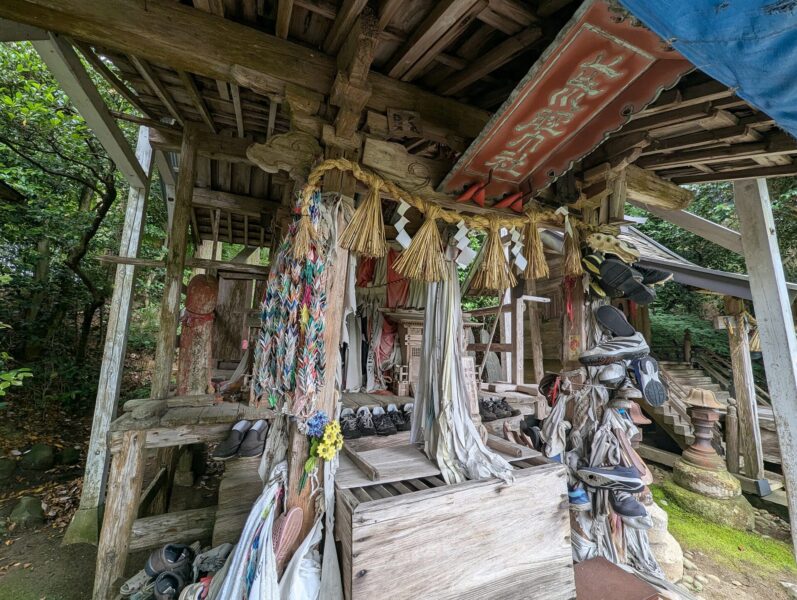
This is the shrine of Arahagihaba Shrine.the "god of feet and travel" theory,many "shoes" and "cloth" reminiscent of shin guards have been offered as votive offerings. To the left is the Taishido Hall, and to the right is the Sericulture Shrine.

In front of the shrine sits a stone monument inscribed with "Suikinjin." It is likely that this represents two deities, Suijin (water god) and Konjin ( metal god)金神
Suijin (水神) is, as the name suggests, a god who controls water, while Konjin (金神) is a directional god in Onmyodo (Japanese esoteric cosmology). Any action taken in relation to the direction in which Konjin resides is considered "unlucky," and actions that disturb the earth (construction, repair, relocation) and travel are especially forbidden. It is said that violating this direction will bring death to seven family members, and if there are not seven family members, the neighbors will also be killed, resulting in a "seven deaths" phenomenon known as "nanasatsu ." This god has been feared since ancient times.
I suspected a connection to the "theory of the ancestral deity of ironmaking," but it seems to be unrelated, and it's possible that it's enshrined in front of the shrine because it cannot be moved for the reasons mentioned above
Taking this speculation a step further, perhaps they enshrined Konjin-sama to protect the Arahagihaba Shrine from being demolished or relocated..

As explained on the information board, many pairs of scissors were offered as votive offerings at the adjacent sericulture shrine, based on the belief that they "cut the root of illness."

The plaque at Arahagihaba Shrine

In the inner part of the shrine, a Konsei (phallic deity) , which seems to be related to the expanded interpretation of the "god of feet and travel" to include the lower body , can also be enshrined, making it impossible to rule out the possibility of a "sex deity theory related to ancient Ainu language."
Furthermore, the plaque inside bears"Dōsojin" (roadside deity).
"Dōsojin" is another name for "Sai no Kami," and is enshrined at village boundaries, crossroads, and mountain passes. It is considered a guardian deity of boundaries that prevents evil spirits, plagues, and other calamities from entering from the outside. This is the core of the "Sai no Kami theory" of Arahagihaba Shrine in Tagajo, and at the same time, it is a very plausible possibility that it is an "Emishi (indigenous people) deity theory."
lastly
The Arahagihabaki Shrine in Tagajo is dotted with countless possible "theories." At this point, it almost seems as though all of these "theories" might be correct
Even in this modern age, when every corner of the world has been explored, the ancient god"Arahabaki". If you're curious, please go and see for yourself.
Arahagi Shrine <Information>
- Name: Arashibi Shrine
- Address: 44 Ichikawa Ihoishi, Tagajo City, Miyagi Prefecture 985-0864
- Phone number:
- Official URL:
Google Map

Traveling around the Tohoku region, I enjoy drinking delicious sake and exploring the local history, traditions, and customs. I write articles based on my interests. I'm currently interested in folk performing arts, local toys, and folk beliefs
Please support NEFT's article creation!
NEFT gathers and publishes articles about the history, culture, and tourism information of various regions in Tohoku
If you enjoyed this article, we would be grateful if you would consider supporting our future interviews, article creation, and website management
*Clicking "Tip" will open the tip sending screen for the external service "codoc"
Other articles

Eating flowers used in the Imperial crest is "absolutely unacceptable"...

[Akita Prefecture] 5 Recommended Beaches in Akita! Sunsets over the Sea of Japan...

Aomori Gyosai Center: The originator of Aomori's famous Nokkedon! Let's eat...

[Yonezawa City, Yamagata Prefecture] Snow Lantern Festival | A mystical experience unique to snow country...

[Iwate Prefecture] Jomon Flame: Fujisawa Noyaki Festival 2022 to be Held! Original...

[Nihonmatsu City, Fukushima Prefecture] Enjoy a day trip to Dake Onsen | Recommended...

[Sendai City, Miyagi Prefecture] Important Intangible Cultural Property "Seiko Sendaihira" is a hakama fabric...

[Oga Peninsula, Akita Prefecture] Full of Viewpoints. A Place Created by the Earth...

[Miyagi Prefecture] 4 Famous Waters of Miyagi Prefecture! Sendai, the City of Forests in Michinoku...

What is IGR Iwate Galaxy Railway? A line loved by locals for its unique features...

Five unique soft-serve ice creams to try at roadside rest areas near Morioka City...
