This site is an online media that delivers all sorts of trivia about the six Tohoku prefectures, from sightseeing and gourmet spots to local customs, history, and more
Arahaba Shrine in Iwadeyama | Has it been enshrined for 2,000 years? A shrine dedicated to the mysterious ancient god Arahaba, whose name is even inscribed in the place name [Miyagi Prefecture]
Arahaba Shrine in Iwadeyama | Has it been enshrined for 2,000 years? A shrine dedicated to the mysterious ancient god Arahaba, whose name is even inscribed in the place name [Miyagi Prefecture]
Here you'll find a shrine dedicated to the mysterious ancient deity "Arahabaki," who is said to have resided here for two thousand years
Arahagi Shrine (Iwadeyama, Osaki City)
What's amazing about this shrine is its address
164 Iwadeyama Shimoichikuri Arahagihaba, Osaki City, Miyagi Prefecture
...And the name "Arahabaki" is even inscribed in the place name. This article delves into the mystery of the Arahabaki Shrine in Iwadeyama and the enigmatic ancient god "Arahabaki."
Who is the ancient god "Arahabaki"?
"Arahabaki"is a deity that was worshipped mainly in the Tohoku and Kanto regions of Japan. It is believed to have existed since ancient times, butit does not appear in Japanese mythology (Kojiki and Nihon Shoki).
Therefore, it is thought to be a deity originating from the local beliefs of ancient Japan, from the Tohoku region to the Kanto region. However, because it is so ancient and, as mentioned above, not mentioned in any documents, its true identity and origin remain unknown to this day
From the Middle Ages onward, the name appears in shrine histories and records using various spellings such as "荒脚巾," "荒覇吐," "荒吐," and "荒波々幾." However, it is highly likely that these are kanji characters that were assigned later, and it is considered most appropriate to refer to it using the katakana spelling "ARHABAKI."
There are various theories regarding "what kind of god it is." Some of them are listed below
The legend of the god of feet and travel
Snake God Theory
The theory of the guardian deity
The Emishi God Theory
The theory that he is the ancestral deity of ironmaking
The theory of sexual deities related to the ancient Ainu language
Furthermore, a search for "Arahabaki" on the internet reveals several mentions that the Shakoki Dogu (goggle-eyed clay figurine ) unearthed from sites such as the Kamegaoka ruins in Tsugaru City, Aomori Prefecture, represents Arahabaki. However, the source of this information is the description in an ancient historical text called the Tsugaru Sotosangunshi, which is widely considered a forgery , and its reliability is questionable.
In other words, its appearance, origin, and even what kind of god it isall unknown, and"Arahabaki"has been passed down to the present day.
Details of each theory are explained in the following article
Deities worshipped: Based on the three gods of heaven, earth, and water as ancestral deities, the sun (sun, moon, and stars) is considered the father god, and the earth and water (mountains and seas) that nourish all things are considered the mother god. It is a nature worship deity that has been enshrined here for two thousand years.
Origin: This shrine was originally dedicated to the ancestral and guardian deities of the ancient indigenous people (Arabaki tribe/Arahagihabaki tribe). According to one document, there were over 600 such shrines in the Tohoku and Kanto regions in ancient times. After the Former Nine Years' War, when the Nanbu Koromogawa and Abe clans are said to be descendants of the Arabaki-related royal family during the Heian period, the shrine suffered the misfortune of being altered or merged with other shrines. Currently, the only Arahagihabaki shrines remaining in the prefecture are this shrine and a few others.
Year of the ritual: It is uncertain, but it is said that the Arabaki tribe moved the site of their royal castle from Asago, Yoneyama Town before the Common Era, to Tagajo after the Common Era, and then to Miyazawa, Furukawa City (302 AD). If this is the evidence, it is presumed that at some point during this period, a group of people in this area sought a place of peace and worshipped this deity as their guardian.
Divine Power: Due to long-standing religious experiences, this deity has come to be known as the god of "molluscum contagiosum" and is considered the most powerful. Furthermore, as the god of "eyes, ears, and nose," and as the tutelary deity who grants wishes, this deity has been enshrined for 2000 years (unclear) and continues to be revered by countless worshippers.
Festival day: 29th day of the 9th month (old calendar) at Arahagi Shrine
First of all, what's surprising is the founding date.it is "a local tutelary deity that has been enshrined for 2,000 years"is true, then it means that it has been enshrined in this place since around the turn of the millennium.
Furthermore,it was "worshipped as the ancestral and guardian deity of the ancient indigenous people (Arahabaki tribe/Arahabaki tribe)"suggests that Arahabaki referred not to a god, but to the indigenous people themselves. It should be noted that the theory that the Oshu Abe clan worshipped it as their family's guardian deity is also found in descriptions of other Arahabaki shrines.
"The Arabaki tribe's royal castle was moved from Asago in Yoneyama-cho before the Common Era, to Tagajo after the Common Era, and then to Miyazawa in Furukawa City (302 AD),"although the address has changed due to mergers and other reasons, it is thought that this refers to the area around Asago Shrine in Yoneyama-cho, Tome City, Tagajo refers to Tagajo City, and Miyazawa in Furukawa City refers to Miyazawa in Furukawa, Osaki City.
If true, these would all be surprising descriptions representing new discoveries... However,the ancient indigenous people (Arahaki tribe/Arahagi tribe)the aforementioned"Tōtsugaru Gaisan-gunshi," which raises some doubts about its authenticity.
The appearance of Arahagi Shrine in Iwadeyama
Arahagihaba Shrine is located in a rural area right next to National Route 108, which runs from Osaki City to Naruko Onsen
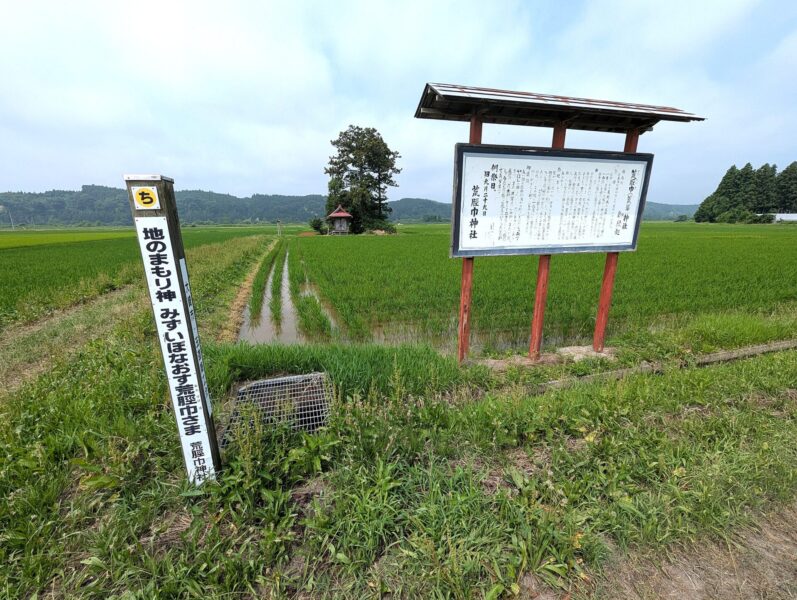
The shrine and explanatory sign of Arahagihaba Shrine (Iwadeyama, Osaki City)
At the entrance to the path leading to the shrine, there is an explanatory sign and a marker post proclaiming the deity of "water warts"..
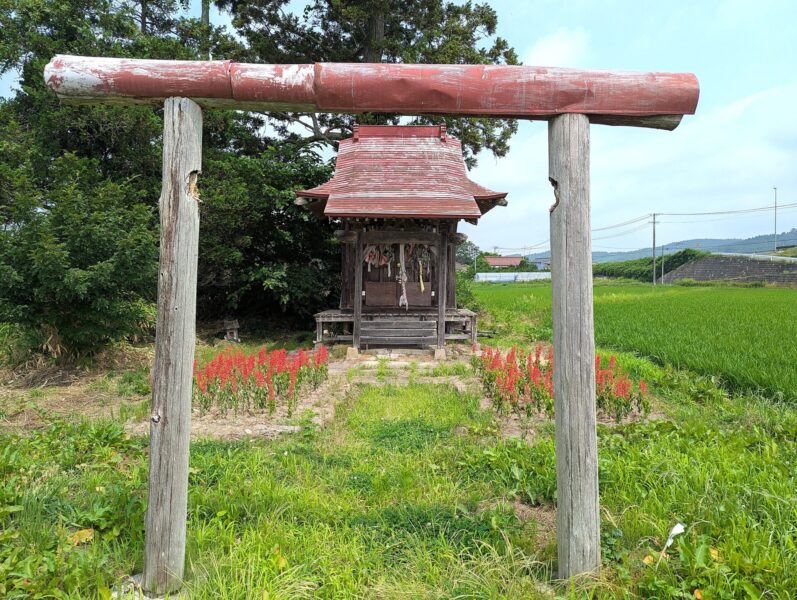
Arahagi Shrine
Both the torii gate and the shrine itself show considerable age, but they are by no means dilapidated, and the grounds are beautifully maintained with flowers planted throughout. Incidentally, the road visible on the right in the photo above is National Route 108
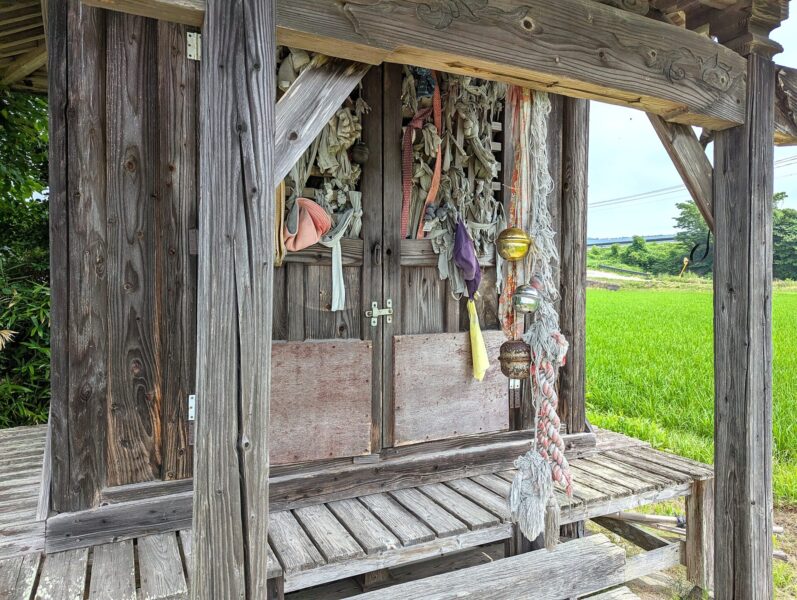
The company has a large amount of scraps of cloth tied to it
Many scraps of fabric are tied to the shrine, which I imagine are offerings of leg coverings related to the aforementioned "theory of the god of feet and travel."
Some of the fabric pieces resemble human-shaped dolls (around the upper right of the photo)
Some of them appeared to be human figures made of cloth. I had no idea what they meant..
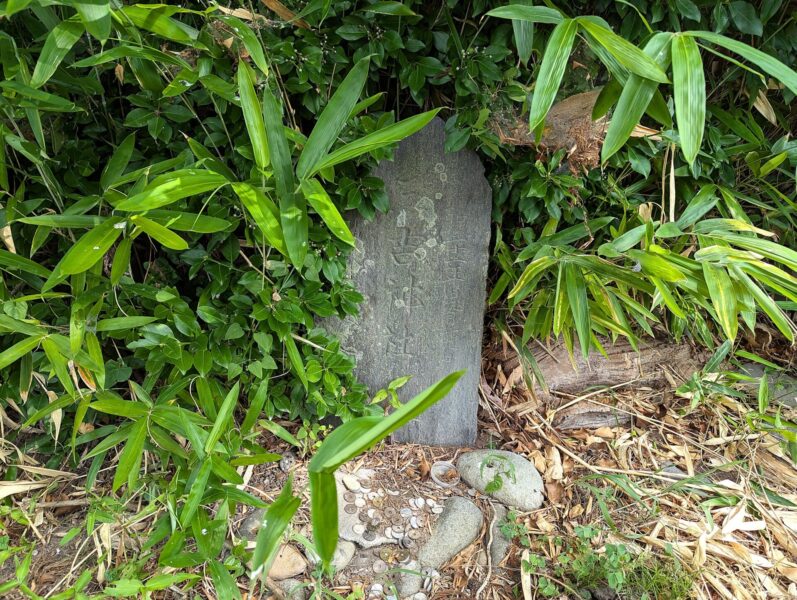
A stone monument inscribed with "Miyoshi Shrine"
Behind the shrine is a stone monument inscribed with "Miyoshi Shrine." It is likely a monument donated as a memento of a visit
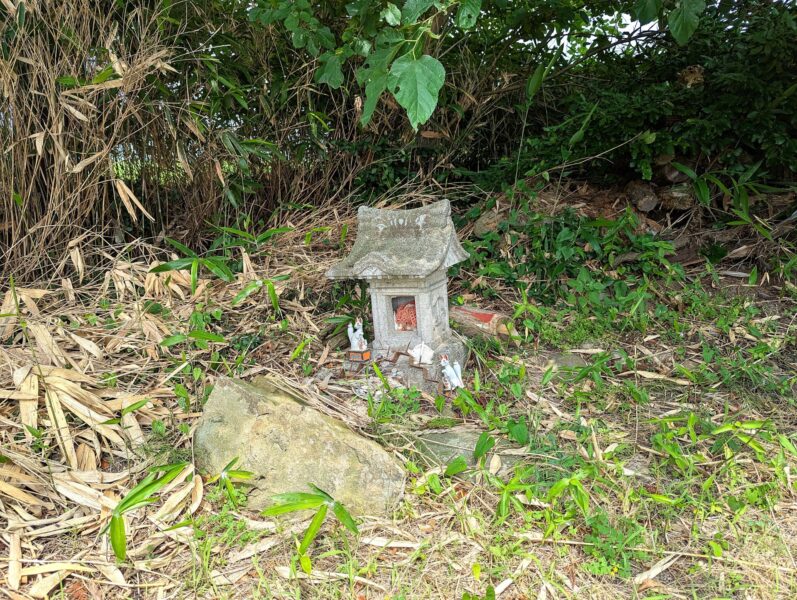
A stone shrine that appears to be dedicated to Inari (the fox deity)
To the left of the shrine was a stone shrine that appeared to be dedicated to Inari, the fox deity. The custom of offering money was quite wild, as it was simply placed on the ground
lastly
From the moment I learned of the existence of the ancient god Arahabaki, I became interested and have visited Arahabaki shrines throughout the Tohoku region. However, in most cases, there was only the fact that the god was "worshipped," with almost no explanations or explanations
However, there are detailed explanations here, which really spark the imagination..
The exact date the explanatory sign was installed is unknown, but its degree of weathering suggests it was placed sometime between the Showa and Heisei periods
Therefore, it cannot be ruled out that the content of the "History of Ichiura Village, Materials Edition" (a three-part series) published by Ichiura Village, Kitatsugaru District, Aomori Prefecture (now Goshogawara City, Aomori Prefecture) between 1975 and 1977 , which caused a great stir with both praise and criticism, is now almost certainly considered a "forgery," and may have been embellished based on it.
For the reasons stated above, we cannot confirm the veracity of the information provided, but this is a shrine that anyone who feels a sense of romance in the mysteries of ancient Tohoku should definitely visit!
Arahagi Shrine <Information>
Name: Arashibi Shrine
Address: 164 Arahagihaba, Shimoichikuri, Iwadeyama, Osaki City, Miyagi Prefecture 989-6404
Traveling around the Tohoku region, I enjoy drinking delicious sake and exploring the local history, traditions, and customs. I write articles based on my interests. I'm currently interested in folk performing arts, local toys, and folk beliefs