


Arahabaki Shrine near "Jusan-minato," the former base of the Abe clan of Oshu [Goshogawara City, Aomori Prefecture]

The Tsugaru region is located in the western part of Aomori Prefecture
This region, which boasts the vast Tsugaru Plain and is said to have prospered through trade, including the Kitamae-bune ships, centered around Tosa-minato, a port that developed around the coastal brackish lake "Jusan-ko," has several shrines in this area that are said to be related to the mysterious ancient god "Arahabaki."
Who is the ancient god "Arahabaki"?
"Arahabaki"is a deity that was worshipped mainly in the Tohoku and Kanto regions of Japan. It is believed to have existed since ancient times, butit does not appear in Japanese mythology (Kojiki and Nihon Shoki).
Therefore, it is thought to be a deity originating from the local beliefs of ancient Japan, from the Tohoku region to the Kanto region. However, because it is so ancient and, as mentioned above, not mentioned in any documents, its true identity and origin remain unknown to this day
From the Middle Ages onward, the name appears in shrine histories and records using various spellings such as "荒脚巾," "荒覇吐," "荒吐," and "荒波々幾." However, it is highly likely that these are kanji characters that were assigned later, and it is considered most appropriate to refer to it using the katakana spelling "ARHABAKI."
There are various theories regarding "what kind of god it is." Some of them are listed below
- The legend of the god of feet and travel
- Snake God Theory
- The theory of the guardian deity
- The Emishi God Theory
- The theory that he is the ancestral deity of ironmaking
- The theory of sexual deities related to the ancient Ainu language
Details of each theory are explained in the following article


Furthermore, in the area surrounding Goshogawara City,"Arahabaki is the ancestral deity of the Tsugaru Ando clan (Abe clan)"is widespread.
Who is the Tsugaru Ando clan (Abe clan)?
The Tsugaru Ando clan was a family of samurai who held power in the northern parts of Mutsu and Dewa provinces, and whose original surname was "Abe." They claimed to be descended from Abe no Yoritoki and Abe no Sadato, a father and son who played an active role in the Zenkunen War , a conflict that took place in the Tohoku region during the late Heian period

It is believed that the clan originated with Ando Takaaki, the second son of Abe Sadato, who fled north after the defeat in the Former Nine Years' War, and that they expanded their influence from Akita County in Dewa Province in the west to the Shimokita Peninsula in the east, centered in the Tsugaru region

The area around Lake Jusanko in present-day Goshogawara City, Aomori Prefecture, was known as "Tosaminato" and flourished as a port city that served as one of the strongholds of the Abe and Ando clans
Based on the above, there are various theories, but the lineage of the Abe family is
Abe > Ando > Akita
It is believed that this tradition was passed down through generations

The epicenter of the Tōtsugaru Gaisan-gunshi (a historical record of the three outlying districts of Tōtsugaru) is "Goshogawara City"
An inseparable part of pursuing the mystery of Arahabaki is the "Tsugaru Sotosangunshi, " one of the ancient historical records and legends discovered here in Goshogawara .
To avoid any misunderstanding, let me state upfront that the series of documents collectively known as the Wada Family Documents , including the Higashitsugaru Gaisan-gunshi, are now considered to be forgeries.
The story began when Ichiura Village in Kitatsugaru District, Aomori Prefecture (now Goshogawara City, Aomori Prefecture), which received this collection of documents from the supposed discoverer, Kihachiro Wada , published the contents as "History of Ichiura Village: Materials" (a three-part series) between 1975 and 1977, which caused a huge stir at the time, with both praise and criticism.
However,the view that it was a forgery only became widely accepted after the death of its discoverer, Kihachiro Wada, in 1999.Therefore, it is believed that this information was somehow mixed into local traditions and the histories of shrines that have been renovated or repaired during the approximately 25 years since then, and these descriptions have survived to the present day.
Specifically, it is described as follows:
An example of a description found in the Higashitsugaru Gaisan-gunshi (History of the Three Outer Districts of T
- The Yamatai Kingdom, located in Kinai Yamato (present-day Nara Prefecture), was ruled by the brothers Abihiko and Nagasunehiko, who lived in peace
- The brothers Abihiko and Nagasunehiko were defeated by Emperor Jimmu and fled with their family to the Tsugaru region, where they intermarried with the local peoples and called themselves the "Arahato tribe."
- The Shakoki Dogu (goggle-eyed clay figurine ) unearthed from the Kamegaoka ruins in Tsugaru City, Aomori Prefecture, is believed to represent Arahabaki.
- After Emperor Jimmu's death, Tegimimi-no-Mikoto, of the Arahato lineage, came to rule Yamato
For people from the Tohoku region, the idea that "a powerful family once existed in their area" is exciting and something they can be proud of and readily accept. Even while the veracity of the story remains uncertain, it cannot be denied that it may have been added to their traditions and legends
For these reasons, there are aspects of the origins and legends surrounding the Arahabaki Shrine that cannot be taken at face value
Arahabaki Shrine near Lake Jusan
For the reasons stated above, there are several Arahabaki shrines around Lake Jusan and within Goshogawara Citythe ancestral deity of the Ando clan (Abe clan). However, there are no shrines that actually bear the name "Arahabaki," and in most cases, only legends stating that the area "was once called Arahabaki" are told.
Araisaki Shrine
Located on the coast in the Wakimoto district of Goshogawara City, in the northern part of Lake Jusan, the Arahaba-ki Shrine is said to have once enshrined the deity Arahaba-ki, and it is the only shrine in the surrounding area for which there is "physical evidence" of this, as it is mentioned on an explanatory sign .


Currently, it appears that Ōnamuchi-no-Mikoto and Sukunahikona-no-Mikoto are enshrined as the deities, and the description in the "History" section is as follows:
Arai Isozaki Shrine"History"
It is said to be a shrine dedicated to Arahaki-no-kami, the ancestral deity of the Abe and Ando clans. It is also said that a Yakushi-do (hall dedicated to the healing Buddha) was built in 1274 by the Tendai sect monk Kenshobo
Before the Meiji era, it was called Yakushido or Yakushi-gu, and the worship of Yakushi (the Medicine Buddha) was thriving. On the eighth day of the fourth month of the lunar calendar, the Yakushi Festival was held, and it is said that the temple was bustling with worshippers carrying white flags from the surrounding area, a tradition that continued until the separation of shrines and temples
In April of Meiji 6 (1873), following the decree separating Shinto and Buddhism, the shrine was renamed Arai Isozaki Shrine and designated a village shrine
The shrine was renamed Arisozaki Shrine in 1873 (Meiji 6), and it is said that before that it was called Yakushido or Yakushigu. However, since that was after 1274, it is likely that it was called Arahabaki Shrine before that

The main hall is simply constructed, but the grounds are very well maintained, suggesting that it still attracts many worshippers


Behind the main shrine, there are two large rocks, which show no signs of having any inscriptions carved into them, resting on a mound of earth that resembles a pedestal
It has an atmosphere that makes you wonder if it's a remnant of rock worship. Perhaps this is the sacred object of worship

The temple grounds offer a spectacular view of Wakimoto Beach. It's beautifully maintained and boasts a magnificent landscape... it was a wonderful place where I felt a positive energy throughout my visit
Incidentally, there are also shrines named "Arai-Isozaki" in Kizukuri, Tsugaru City and Fujisaki Town, Minamitsugaru District, and there seems to be a legend that these were once "Arahaba-ki Shrines." This is pure speculation, but perhaps "Arai-Isozaki" is a code word for "Arahaba-ki"...?
However, the Wakimoto area is the former Ichiura Village, which was the subject of the publication of "Ichiura Village History: Materials Edition," based on the Higashi-Tsugaru Outer Three Counties Chronicle , so that's the only thing that's a little puzzling.
Arai Isozaki Shrine <Information>
- Name: Arai-sozaki Shrine
- Address: 7-1 Wakimotonowaki, Goshogawara City, Aomori Prefecture 037-0405
- Phone number: 0173-62-2216
- Official URL:
Google Map
Aiuchi Shinmei Shrine
The Shinmei Shrine , located in the Ainai district of Goshogawara City , is also a place where legend remains that it was once a shrine dedicated to Arahaba-ki, and it is even labeled as "Shinmei Shrine: Arahaba-ki Shrine" on Google Maps

However, there is no concrete physical evidence, and there are no particular traces at the site to indicate this

Shinmei Shrine is also famous as the shrine where the "insects" of the "Ainai Insect Extermination" folk event in the Ainai district, which has a history of over 450 years, are offered.
Along the approach to the shrine,"mushi" (insects)that have been sent off after the insect-repelling ceremony are hung on trees, and it is believed that they watch over the safety of the fields and farms throughout the year.

After climbing the path that resembles a small hill, the main shrine comes into view, but... there's a somewhat unapproachable atmosphere about it

Although no traces have been found, the grounds of this Shinmei Shrine"Osedou Shell Mound,". Excavations conducted during the Taisho era unearthed pit burials (burials where bodies were buried in holes dug directly into the ground), human remains believed to belong to the Jomon people, stone tools, and pottery.
If Arahabaki, considered an ancient deity, has existed since the Jomon period, then it cannot be ruled out that this area was a kind of ritual site, a sacred place where Arahabaki was worshipped, which has been passed down through generations and is now a shrine

If there's any lingering doubt, it's that this Ainai district was oncevillage of Ichiura...
Shinmei Shrine<Information>
- Name: Shinmei Shrine: Arahabaki Shrine
- Address: 190 Ainai Tsuyukusa, Goshogawara City, Aomori Prefecture 037-0401
- Phone number:
- Official URL:
Google Map
Ishitoyama Oyamazumi Shrine
This shrine is located in the mountains along Prefectural Road 26 (Tsugaru Asunaro Line), which connects Aomori City and Goshogawara City
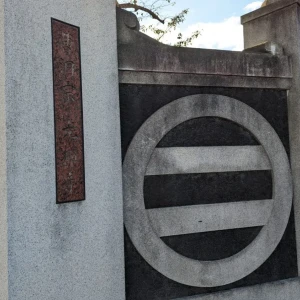
Unfortunately, I haven't visited the site yet, but according to records from visitors, there is a signpost at the entrance to the approach that reads "Ishitoyama Arahaba Shrine Approach," and there is a stone monument inscribed with "For the repose of the ancestors of the Abe, Ando, Akita, and Asai clans."
It appears that in 1987, the late Prime Minister Shinzo Abe and his wife Akie visited this place along with their parents, Shintaro Abe and his wife, and the artist Taro Okamoto, to pay respects to their ancestors, as recorded in the book "Shintaro Abe's Glorious Political Life" (published by the Shintaro Abe Biography Editorial Committee)
However, the basis for identifying this site as the Arahabaki Shrine is the description in the "Tōtsugaru Gaisan-gunshi" (History of the Three Outer Districts of Tōtsugaru), and it appears that the aforementioned stone pagoda was erected by the author of the same book, Kihachirō Wada
Oyamazumi Shrine <Information>
- Name: Ishitoyama Oyamazumi Shrine
- Address: 037-0002 Goshogawara City, Aomori Prefecture
- Phone number:
- Official URL:
Google Map
Isozaki Shrine
There is a theory that Isozaki Shrine in Kanagi-cho, Goshogawara City, was once called Arahabaki Shrine
I haven't visited the site yet, but it seems there aren't any traces of anything noteworthy
Isozaki Shrine <Information>
- Name: Isozaki Shrine
- Address: 151 Nakakashiwagi Yoroiishi, Kanagi-cho, Goshogawara City, Aomori Prefecture 037-0205
- Phone number:
- Official URL:Aomori Prefectural Shrine Association – Isozaki Shrine
Google Map
summary
The Arahabaki Shrine in the vicinity of Goshogawara City is often the source of suspicion and uncertainty about which information to trust, given that it is the epicenter of the "Tōtsugaru Gaisan-gunshi" (a historical record of the three outer districts of Tōtsugaru)
However, the existence of Shinto shrines such as Shinmei-gu, which are adjacent to Jomon period ruins, strongly suggests the possibility that they developed from ancient ritual sites into Shinto shrines
Regarding the descriptions in the "Tōtsugaru Gaisan-gunshi," interpretations vary depending on whether it "created something from scratch" or "embellished something from 50-70 to 100"..
For now, I think that recording and saving the information I have might be useful someday...and with that in mind, I will continue to pursue the mystery of "Arahabaki"!

Traveling around the Tohoku region, I enjoy drinking delicious sake and exploring the local history, traditions, and customs. I write articles based on my interests. I'm currently interested in folk performing arts, local toys, and folk beliefs
Please support NEFT's article creation!
NEFT gathers and publishes articles about the history, culture, and tourism information of various regions in Tohoku
If you enjoyed this article, we would be grateful if you would consider supporting our future interviews, article creation, and website management
*Clicking "Tip" will open the tip sending screen for the external service "codoc"
Other articles

The Shirayuki express train that connected Kanazawa and Aomori in 12 hours
The deceased's descendant, Lord Mogami Yoshimitsu, who established the largest territory of the Mogami clan, with 570,000 koku of land in Dewa.

New Year's Cuisine in the Tohoku Region | Preserved Foods for Festivities Developed by Heavy Snowfall

The newly reborn Tsuchiyu Onsen! A fun spot recommended for seasonal travel...

What is Shindo Bee Farm's "Cherry Honey"? [Yamagata Prefecture]

[Part 2] The Date family's "food" strategy! Masamune's legacy passed down...

Not just rice paddy art! "Winter rice paddy art" drawn with footprints in the snow...

Its history dates back to 1900!? A historic shrine with a long history dating back to the Yamato Imperial Court...

[Morioka City, Iwate Prefecture] What is the history and types of Morioka Sansa Odori? Guine...

[Iitate Village, Fukushima Prefecture] The most beautiful village blessed with nature...

[Aomori Prefecture] 6 Recommended Beaches in Aomori Prefecture! The Pacific Ocean and the Sea of Japan...
