


Coal transport, bypass routes, recovery from unprecedented disasters...the role the Joban Line has played

The railway line that runs along the Pacific coast of Fukushima Prefecture's Hamadori region and southern Miyagi Prefecture is the JRJoban Line. Its name, "Joban," is derived from a combination of "Hitachi," the former name of Ibaraki Prefecture, and "Iwaki," which corresponds to eastern Fukushima Prefecture and southern Miyagi Prefecture.
This article introduces the changing role of the Joban Line, which was originally opened primarily to transport coal produced in the Joban coalfield, over time
What is the Joban Line?

TheLineis a railway line operated by JR East. It connects Nippori Station in Arakawa Ward, Tokyo, to Iwanuma Station in Iwanuma City, Miyagi Prefecture, covering a distance of 343.7 km. It is the longest JR line that does not have "Main Line" or "Shinkansen" in its name.
Along the way, the route passes through Chiba, Ibaraki, and Fukushima prefectures, stopping at stations in the Hamadori region of Fukushima Prefecture, such as Iwaki Station in Iwaki City, Haranomachi Station in Minamisoma City, and Soma Station in Soma City. Even after entering Miyagi Prefecture, it continues to travel along the Pacific coast
There are no regularly scheduled passenger trains (trains that run daily) that originate or terminate at Nippori Station and Iwanuma Station, which are the stations at either end of the Joban Line
Trains that pass through Nippori Station use tracks exclusively for Joban Line trains and continue all the way to Ueno Station,making Ueno Station effectively the starting point of the Joban Line. Alternatively, some trains extend even further, continuing to Shinagawa Station as part of the Ueno-Tokyo Line.
All trains that pass through Iwanuma Station also run on the Tohoku Main Line to Sendai Station in Aoba Ward, Sendai City .
Therefore, itcustomary to refer to the section between Ueno Station and Sendai Station, or between Shinagawa Station and Sendai Station, as the Joban Line, even beyond the strictly defined section between Nippori Station and Iwanuma Station. In this article, we will also treat the section between Shinagawa Station/Ueno Station and Sendai Station as the Joban Line as necessary.
In Fukushima and Miyagi prefectures, which make up the Tohoku region, most Joban Line trains are local trains that stop at every station. As of 2026, there are generally 1 to 2 local trains per hour. However, the section from Hirono Station (Hirono Town, Futaba District, Fukushima Prefecture) to Haranomachi Station has a somewhat less frequent schedule, with only 11 round trips per day compared to other sections
The limited express train service includes three round trips a day of the " Hitachi, " which runs the entire length of the Joban Line between Shinagawa Station and Sendai Station . In addition, there are 12 round trips a day of the "Hitachi" connecting Shinagawa Station to Iwaki Station. South of Iwaki Station, there are 15 round trips of the "Hitachi" running at approximately one-hour intervals, making the Joban Line one of the most popular limited express routes among current JR lines.
It initially opened as part of a line connecting Tochigi Prefecture and Ibaraki Prefecture
The first section of the Joban Line to open was a very small part within Ibaraki Prefecture. In 1889 (Meiji 22)the Mito Railwayopened the line from Oyama Station in Tochigi Prefecture to Mito Station in Ibaraki Prefecture. Most of this line is now the JR Mito Line, but the section from Tomobe Station (a station that opened in 1895 after the Mito Railway opened) to Mito Station, which is at the eastern end, later became the Joban Line.
The Mito Railway line was operated as a branch line of the Tohoku Main Line, passing through Oyama Station. At the time, the Tohoku Main Line itself was not known by that name; it was the main line of a railway company called Nippon Tetsudo (Japan Railways)


Since the Mito Railway was merged into the Nippon Railway in 1892, the Mito Railway line became a branch line of the Nippon Railway in both name and reality, and is called the Mito Line
The Japan Railway's main line and the Mito Line were connected by through train service between Ueno Station and Mito Station. However, going via Oyama Station was a roundabout route, so there was a need for a direct line connecting Tokyo and Mito
Therefore, in 1895, the Nippon Railway opened the "Tsuchiura Line" from Tsuchiura Station in Ibaraki Prefecture to Tomobe Station, and in 1896, it further extended the line from Tabata Station in Tokyo to Tsuchiura Station
The Iwaki Line was opened to transport coal from the Joban coalfield
Meanwhile, in the region stretching from northern Ibaraki Prefecture to Fukushima Prefecture, coal mining began in the latter half of the 19th century, and the coal mines in this region were collectively known as the Joban Coalfield
Transporting coal from the Joban coalfield relied on ships, which had the drawback of being dependent on weather conditions. Therefore, a railway line was planned that would run "from Mito through Taira (present-day Iwaki) to Iwanuma," and it opened by 1898 as the Iwaki Line of the Nippon Railway, connecting Tabata Station to Iwanuma Station by rail . The Iwaki Line and Tsuchiura Line would play an important role in the stable transport of coal, which was the main energy source at the time, to the Tokyo area.
In 1925, the section from Ueno Station to Taira (present-day Iwaki) Station was double-tracked (increasing the number of tracks from one shared by both northbound and southbound trains to two, one for each direction). This was, of course, to meet the demand for operating a large number of trains carrying coal
Furthermore, the reason why Tabata Station was initially the starting point of the Tsuchiura Line on the Tokyo side was because the line focused on freight transport, particularly coal. Tabata Station had a marshalling yard for rearranging freight trains, and it was also advantageous because freight trains could run directly onto the Yamanote Line and then on to the Tokaido Main Line
On the other hand, passenger trains and other trains entering and leaving Ueno Station had to change direction at Tabata Station, which was inconvenient. However, with the establishment of a route that went to Nippori Station in 1905, the need to change direction was eliminated. This completed the current Joban Line route, which connects Ueno Station and Sendai Station via the Hamadori region of Fukushima Prefecture
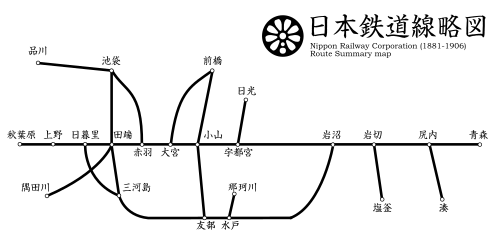
Soren Bradley – Own work. Reference: Japanese National Railways, "The Story of the Tohoku Main Line History," Japanese National Railways Sendai Branch Office, 1971. p106, doi:10.11501/12065860, CC0 , https://commons.wikimedia.org/w/index.php?curid=161112841
The coastline, and then named the Joban Line
To backtrack a bit, in 1901, the Japan Railway Company named the Tsuchiura Line, a section of the Mito Line, and the Iwaki Line—all lines corresponding to the current Joban Line— collectively the "Coastal Line."
In November 1906, the Nippon Railway was acquired by the government, and the coastal line became part of the national railway. Then, in 1909, the line that had been the coastal line was named the Joban Line
On the Tohoku Main Line bypass
The Joban Line was initially primarily built for coal transport, but it also came to serve as a bypass for the Tohoku Main Line between Ueno Station and Sendai Station
In April 1906, the first express train service began operating between Ueno Station and Aomori Station in Aomori Prefecture. This train ran via the Joban Line (then known as the coastal line) between Ueno Station and Iwanuma Station, rather than the Tohoku Main Line
The "Hatsukari," the first limited express train in the Tohoku region, which began operating between Ueno Station and Aomori Station in 1958 after the war, also initially ran via the Joban Line when it was operated by a steam locomotive . Even after being replaced by KiHa 80 series diesel railcars in 1960, it continued to run via the Joban Line until it was changed to electric train operation in 1968.


by KiHa 80 series: Wikipedia
author: vvvf1025, CC BY-SA 3.0
The Joban Line runs along the coast, so much of the terrain is flat,an easy route for steam locomotives to pull passenger and freight cars. On the other hand, the Tohoku Main Line had many difficult sections, including mountain passes within Fukushima Prefecture. Also, as mentioned earlier, the Joban Line was double-tracked south of Taira at an early stage, so although the Joban Line was slightly longer than the Tohoku Main Line, itmore advantageous for high-speed, high-capacity transportation.
Furthermore, the Tohoku Main Line is a route where the number of trains tends to be excessively high. In the section south of Omiya Station in Saitama Prefecture, there are also trains that connect Tokyo with the Shin'etsu and Hokuriku regions. In addition, in the section south of Fukushima Station, there are trains that depart for and arrive in Yamagata and Akita prefectures via the Ou Main Line
On the other hand, since the Joban Line does not have any major trunk lines branching off from it,to increase the number of trains by focusing on travel between Tokyo and Sendai or areas north of Sendai. In addition to the limited express "Hatsukari," other trains such as the express "Michinoku," the sleeper limited express "Yuzuru," and the overnight express "Towada" also ran on the line. A little later, trains such as the limited express "Hitachi" and "Michinoku," and the express trains "Soma," "Morioka," and "Tokiwa" began to run on the Joban Line, and the Joban Line became a major route for limited express trains.

The Joban Line didn't just connect the Kanto and Tohoku regions.At Aomori Station, where limited express and express trains such as "Hatsukari" and "Michinoku" arrived, the Seikan Ferry awaited passengers crossing the Tsugaru Strait to Hakodate Station in Hokkaido. The fact that the Joban Line was a major route for trains connecting Tokyo with areas north of Sendai means that it also played a significant role for people traveling between Tokyo and Hokkaido.

The changing role of the Joban Line
From the 1960s onward, the Joban coalfield was forced to close its mines due to the decline in coal demand brought about by the energy revolution. The Joban Line also lost its original purpose
You can learn about the history of the Joban coalfield at the " Iwaki City Coal and Fossil Museum Horuru " located in Iwaki City . Please visit if you have the opportunity.

Furthermore, once the electrification (the installation of facilities to supply power for electric trains) and double-tracking of the Tohoku Main Line are completed,the number of long-distance trains using the Tohoku Main Line will increase. This is because electric trains and electric locomotives have greater output than steam locomotives and diesel railcars, and the gradients of the Tohoku Main Line will not pose much of a problem for them.
In addition, the Joban Line was at a disadvantage compared to the Tohoku Main Line because it was longer and still had single-track sections. The Joban Line's position as a bypass route for the Tohoku Main Line was gradually lost
However, overnight trains connecting Ueno Station and Aomori Station still largely consisted of trains that ran via the Joban Line, such as the limited express "Yuzuru" and the express "Towada," in order to avoid congestion on the Tohoku Main Line

The opening of the Tohoku Shinkansen between Omiya Station and Morioka Station in 1982 drastically changed the role of the Joban Line。
With the introduction of the Shinkansen, the Shinkansen became the primary mode of transport for travel between Tokyo and areas north of Sendai. Therefore, in the November 1982 timetable revision, all limited express and express trains that ran beyond Sendai Station to Morioka and Aomori via the Joban Line were abolished, except for overnight trains.The Joban Line trains lost their role in connecting Kanto with northern Tohoku and Hokkaido, and instead focused solely on transportation within the Joban Line itself.
In 1987, the Japanese National Railways (JNR), which operated railways nationwide, was dismantled, and the various JR companies were established. The operation of the Joban Line was taken over by JR East. In 1989, JR East debuted the new 651 series train for limited express services, and the limited express trains on the Joban Line operated by the 651 series were given the nickname " Super Hitachi ."

The 651 series surpassed the 485 series trains previously used for the "Hitachi" service in both speed and interior amenities. It can be said that it was a train that heralded the arrival of a new era on the Joban Line
On the other hand, the "Yuzuru," which was a representative of the Joban Line's overnight trains, became a seasonal train in 1993 and was completely discontinued the following year, 1994
Long-term disruption due to the Great East Japan Earthquake
The longest route the "Super Hitachi" operated was from Ueno Station to Sendai Station, covering the entire length of the Joban Line. However, there is limited demand for trains whose starting and ending stations are both on the Tohoku Shinkansen line. In December 2010, JR East announced that the "Super Hitachi" service would be shortened to run between Ueno Station and Iwaki Station, and a new limited express train would be operated between Iwaki Station and Sendai Station
Just then,on March 11, 2011, the Great East Japan Earthquake struck. The Joban Line suffered extensive damage, including the tsunami sweeping away the Shinchi Station building (Shinchi Town, Soma District, Fukushima Prefecture) along with a train that was stopped at the station.
While many other railway lines in the Kanto and Tohoku regions suffered significant damage in the Great East Japan Earthquake, the situation that the Joban Line faced was unique compared to any other line. Due to the accident at the Tokyo Electric Power Company's Fukushima Daiichi Nuclear Power Plant, located along the line between Ono Station (Okuma Town, Futaba District, Fukushima Prefecture) and Futaba Station (Futaba Town), itwas initially impossible to even assess the extent of the damage in the sections of the line running near the plant, resulting in an extremely long period before operations could resume.
The limited express "Super Hitachi" also had its service shortened to Iwaki Station due to factors completely unrelated to JR East's intentions before the earthquake. During the period when the service continued to terminate at Iwaki Station, the rolling stock was changed to the new E657 series trains, and the name was changed to "Hitachi."
The Joban Line gradually resumed operations, with service resuming between Ueno Station and Yotsukura Station, and between Watari Station and Iwanuma Station by the end of April 2011. In May, service resumed between Yotsukura Station and Kunohama Station, in October between Kunohama Station and Hirono Station, and in December between Haranomachi Station and Soma Station (a section that had been operating in a detached state for five years, as the tracks were not connected to the other sections that had resumed service)
The remaining sections will take time to restore service due to the extensive damage and the fact that access is restricted due to the Fukushima Daiichi nuclear power plant accident. First, in March 2013, service resumed on the one-station section between Hamayoshida Station and Watari Station. In June 2014, service resumed on the section between Hirono Station and Tatsuta Station
In July 2016, train service resumed between Odaka Station and Haranomachi Station, and in December, service resumed between Soma Station and Hamayoshida Station. The section between Komagane Station and Hamayoshida Station, which is part of the latter section, suffered extensive damage from the tsunami, solarge-scale construction workwas carried out to lay new tracks further inland than before the disaster.
The remaining sections that were out of service will gradually resume operation as evacuation orders related to the nuclear accident are lifted. In April 2017, service resumed between Namie Station and Odaka Station, and in October, between Tatsuta Station and Tomioka Station
In April 2019, J-Village Station opened between Hirono Station and Kido Station, coinciding with the reopening of J-Village, a sports training facility
The last remaining section of the line to be shut down, between Tomioka Station and Namie Station, resumed operation on March 14, 2020, coinciding with the JR Group's timetable revision, after a hiatus of nine years and three days. This marked the latest full-line resumption of service among all lines that have been affected by the Great East Japan Earthquake.
With the full resumption of service on the Joban Line, three round trips of the limited express "Hitachi," which previously terminated at Iwaki Station, will now extend their service to Sendai Station. This marks the return of the train that ran the entire length of the Joban Line, a service that continued from 1898, when the line was fully opened, until 2011, after a nine-year hiatus.
Joban Line after full service resumption

Prior to the earthquake, it had been announced that express trains on the Joban Line would terminate at Iwaki Station, but that announcement was effectively reversed, and express trains now run the entire length of the Joban Line once again. One reason for this is that the "Hitachi" express train, which departs from and arrives at Sendai Station, has been given the role of symbolizing the full resumption of service on the Joban Line
However, aside from that, there will undoubtedly be a certain number of users who benefit from the existence of this train, for example, those traveling from the Tokyo metropolitan area to the Hamadori region, or from Sendai or the Hamadori region to Ibaraki Prefecture
Furthermore, since the full resumption of service on the Joban Line, the Tohoku Shinkansen has frequently experienced service suspensions due to earthquakes and equipment problems. In such cases, in addition to the "Hitachi" trains that depart from and arrive at Sendai Station, the "Hitachi" limited express trains that depart from and arrive at Iwaki Station are also extended to Sendai Station, playing a partial backup role for the Tohoku Shinkansen
The Joban Line, which has resumed operations, is expected to play new roles, such as promoting recovery from the earthquake, revitalizing travel in the Hamadori region, and providing backup for the Tohoku Shinkansen

A former railway engineer and current freelance writer who has loved trains since childhood, his dream is to make train travel his career
Please support NEFT's article creation!
NEFT gathers and publishes articles about the history, culture, and tourism information of various regions in Tohoku
If you enjoyed this article, we would be grateful if you would consider supporting our future interviews, article creation, and website management
*Clicking "Tip" will open the tip sending screen for the external service "codoc"
Other articles

It's not just Babahera ice cream! A roadside station with a wide variety of offerings...

It's been a year since the SL Ginga's last run. "Thank you SL Ginga...

Sendai Anpanman Children's Museum & Mall

Shark fins, sunflowers, and the Blue Impulse... at a roadside station in Miyagi...

Kintaro? What is the EH500 electric locomotive that mainly runs on the Tohoku Main Line?

Kinoshita Koma – One of the three great horses in Japan, worn on the chest of a horse presented as a tribute...

The legend of the demon-slaying brothers Iwajiro and Iwasaburo of Akiu Onsen [Miya...

[Miyagi Prefecture - Yamagata Prefecture] The only road directly connecting Sendai City and Yamagata City...

Lake Hibara, Fukushima's outdoor leisure mecca

[Motomiya City, Fukushima Prefecture] Fukushima's famous confectionery that even the British Prime Minister is impressed with! Confectionery shop "Nu...

Staying overnight on the former Japanese National Railways sleeper express train "Blue Train Akebono"...
![Daito-ryu Aikijujutsu [Part 2]](https://jp.neft.asia/wp-content/uploads/2026/01/aiki_tkd02-300x300.jpg.webp)