


A pilgrimage to the family temples of the Tsugaru clan, lords of Hirosaki Domain: "Kakushu-ji Temple," "Chosho-ji Temple," and "Takateru Shrine" [Aomori Prefecture]

When I visit a city known as a castle town, in addition to the castle itself, I also like to visitthe burial grounds and family temples of the castle lord's family.
Although one might imagine that family burial grounds are concentrated in one place, they are sometimes scattered across multiple locations. For example, the Date family of the Sendai Domain have burial grounds at Kyogamine (Sendai City) and Dainenjiyama (Sendai City), the Matsudaira (Hoshina) family of the Aizu Domain have burial grounds at Tsuchitsu Shrine (Inawashiro Town) and Innai Gobyō (Aizuwakamatsu City), and the Katakura family , who were important retainers of the Sendai Domain and lords of Shiroishi Castle, also have burial grounds at Kessanji Temple (Shiroishi City) and Atagoyama (Shiroishi City)
There were various reasons, but it seems that the founder of the domain or a heroic figure of the family was given special treatment, or that later lords divided or moved the burial grounds due to reburials accompanying the development of the castle town
The Tsugaru family , the ruling family of the Hirosaki Domain, which was based at Hirosaki Castle (Hirosaki City, Aomori Prefecture) , now famous as a cherry blossom viewing spot, is another example of a family whose burial grounds are scattered across Kakushu - ji Temple, Chosho -ji Temple , and Takateru Shrine
Who is the Tsugaru family?
There are various theories regarding the lineage of the Tsugaru clan, but the most widely accepted theory is that their ancestor was Nanbu (Oura) Mitsunobu, a member of the Nanbu Kuji clan, a branch family of the Nanbu clan that ruled the northern Oshu region during the Muromachi and Sengoku periods.
According to the "Tsugaru Ittōshi," an official history book compiled by the Hirosaki Domain , in 1491, Mitsunobu was stationed at Taneri Castle in Tsugaru Nishihama (present-day Ajigasawa Town, Nishitsugaru District) from Kuji to deal with the rebellion of the remnants of the thirteen Ando clans.
Later, in 1502, Mitsunobu built Oura Castle (present-day Kata, Hirosaki City, Godai) and entrusted its defense to his adopted son, Oura Morinobu. It is believed that he changed his surname to "Oura" around the time he established his base at this castle
Time passed, and in 1567, the fifth head ofthe family, Tamenobu, was adopted as a son-in-law from the Kuji clan. This Oura (Tsugaru) Tamenobu would significantly change the course of events.

On May 5, 1571 (Genki 2), Tamenobu suddenly captured Ishikawa Castle, the residence of Ishikawa Takanobu , the uncle of Nanbu Harumasa, the head of the Sannohe Nanbu family, the main branch of the Nanbu clan, thus instigating a so-called gekokujo (overthrowing one's superior ). He continued to capture surrounding castles one after another, and by the Tensho era, he had completely gained control of the Tsugaru region and declared independence.
In 1589, he sent his retainer, Yagihashi Bicchu, to Kyoto, where he presented Toyotomi Hideyoshi with a famous horse and a falcon through Ishida Mitsunari. During Hideyoshi's siege of Odawara, he was granted an audience with Hideyoshi before the Nanbu clan, gaining recognition as an independent daimyo. It is said that he rejected the Nanbu clan's complaint that "Tamenobu's actions violated the general peace decree" and received official confirmation of his territory
It is believed that he began using the name "Tsugaru" around the time he became an adopted son of the Konoe family , who were courtiers (a child born when two people who are not biologically related become father and son), and at this time he was bestowed with the family crest of apricot leaf peony , which is based on the peony of the Konoe family crest
This series of events left a deep-seated animosity between the Tsugaru and Nanbu families, and even more than 200 years later,the "Soma Daisaku Incident"have occurred.


Kakushu-ji Temple, the family temple of Tsugaru Tamenobu, the first lord of the Hirosaki Domain
Tsugaruyama Kakushuji Templeis a temple located in Fujishiro, Hirosaki City, and is said to have been built by Tsugaru Tamenobu, the first lord of the Hirosaki domain, in honor of his Zen master, Kakuo Zenji, the eighth head priest of Choshoji Temple.

Tamenobu died in Kyoto in 1607, and his remains were brought to the second lord of the domain, Nobuhira. A funeral service was held with Zen Master Kakuo as the officiant, and Kakushu-ji Temple was designated as his mausoleum

The main hall of Kakushūji Temple
On the main ridge of the roof, the "Manji" crest, which has been the family crest of the Tsugaru family since the Sengoku period, is placed in the center, and on either side of it are the " Apricot Leaf (Tsugaru) Peony" crests bestowed by the Konoe family
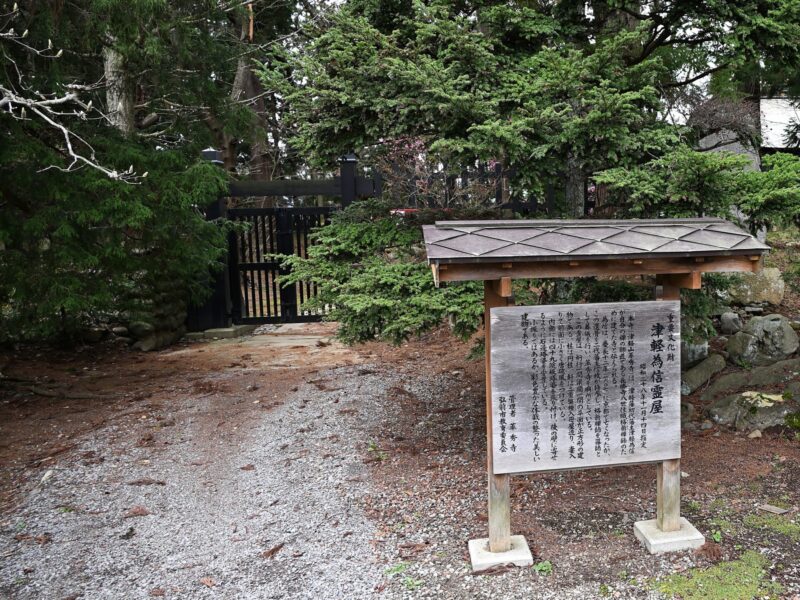
The Tsugaru Tamenobu Mausoleum, designated as an important cultural property of the prefecture, is closed to the public during the winter months, and even at other times, advance reservations are required for visits.
Kakushūji Temple <Information>
- Name: Tsugaruyama Kakushuji Temple
- Address: 1-4-1 Fujishiro, Hirosaki City, Aomori Prefecture 036-8373
- Phone number: 0172-32-7460
- Official URL:Hirosaki City Official Website – Kakushuji Temple Main Hall and Tsugaru Tamenobu Mausoleum
Google Map
Choshoji Temple, the family temple of the Tsugaru clan for generations
Taiheizan Choshoji Templeis a temple located in Nishishigemori, Hirosaki City. It is said to have been founded in 1528 (Kyoroku 1) when Oura Morinobu invited Kikusen Bonju to establish the temple in Taneri (present-day Taneri-cho, Ajigasawa-machi, Nishitsugaru-gun) to pray for the repose of his father, Mitsunobu.

Subsequently, it moved along with the shifting bases of the Tsugaru clan, first to Oura Castle (present-day Kata, Hirosaki City) and then to Horikoshi Castle (present-day Horikoshi Kashiwada, Hirosaki City). In 1611 (Keicho 16), coinciding with the completion of Hirosaki Castle during the time of Tsugaru Nobuhira, the second lord of the Hirosaki Domain, it was moved to its current location

This temple boasts numerous cultural treasures, including the Tsugaru family mausoleum , the main gate , the bronze bell , the priests ' quarters, the main hall , and the Mikage-do hall where a wooden statue of the first lord of the domain, Tsugaru Tamenobu, is enshrined , all of which are designated as important national cultural properties. In addition, it has many other cultural treasures, such as a statue of Yakushi Nyorai and paintings designated as important prefectural cultural properties.

The main hall has an unusual design, with no visible entrance
Visitors can tour and worship the temple by passing through the corridor that connects the inside of the temple's living quarters to the main hall

While the temple's living quarters, main hall, and Soryukutsu cave are open to the public,the Tsugaru family burial grounds, including the Tsugaru family mausoleum, the Mikage-do hall, and the five-tiered stupas of successive feudal lords, are separated by a wooden fence, and advance reservations are required to visit them.

Numerous religious sculptures, including the Three Buddhas, the Sixteen Arhats, and the Five Hundred Arhats, are enshrined within the Soryukutsu Cave
Zenrin-gai is a rare temple district in Japan consisting of 33 temples belonging to the same Buddhist sect
The approximately 500-meter-long straight road leading to the front of Choshoji TempleZenrin-gai, and it is a temple district that was constructed in 1615 (Genna 1) by the second lord of the domain, Tsugaru Nobuhira, by gathering 33 Soto Zen temples from within the territory.

The fact that the Kuromon gate at the entrance to Zenrin-gai is in the Korean style, which is seen in castle architecture, and that the area, including the earthen ramparts that still remain today,Choshoji-gamae, suggests that this was not merely a cluster of temples, but also played a role as a defensive base for the southwestern part of Hirosaki Castle.

Furthermore, these locations also play an important role from a feng shui perspective. It is said that Hirosaki Hachimangu Shrine acts as a guard against the northeast , which is considered the "demon's gate" of Hirosaki Castle , while Choshoji Temple , located at the very back of Zenrin-gai , acts as a guard against the southwest, which is considered the "back demon's gate ."
Choshoji Temple <Information>
- Name: Taipingzan Choshoji Temple
- Address: 1-23-8 Nishishigemori, Hirosaki City, Aomori Prefecture 036-8273
- Phone number: 0172-32-0813
- Official URL:Choshoji Temple Official Website
Google Map
The Tendai sect temple "Hoonji" and "Takateru Shrine," where the 4th lord of the domain, Nobumasa, was deified
In fact, the Tsugaru family's burial grounds have undergone other changes as well
During the time of Nobuhira, the second lord of the Hirosaki domain, he had close ties with Nankobo Tenkai , a Tendai Buddhist monk known as the "Prime Minister in Black Robes" and also credited with naming Hirosaki. As a result, during the time of the fourth lord, Nobumasa, he founded Hoonji Temple, a Tendai Buddhist temple , to commemorate the third lord, Nobuyoshi
From then on, Hōonji Temple was considered the family temple of the Tsugaru clan. However,the Tsugaru clan's burial grounds at Hōonji Temple were moved to Chōshōji Temple in 1954 (Showa 29), where they remain to this day.
Furthermore, because the fourth lord of the domain, Nobumasa, had studied under Yoshikawa Koretari, the founder of Yoshikawa Shinto, after his death, according to his will, Yoshikawa Tsugunaga, the second head of Yoshikawa Shinto, officiated a Shinto funeral ceremony, and he was deified
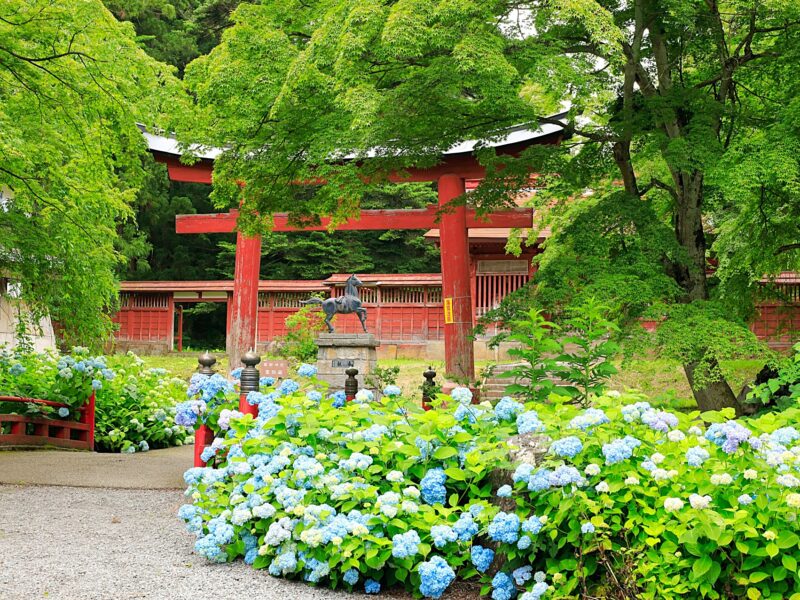
The burial site was named after "Takaoka," the old name for Hirosaki, and was called "Takateru Reisha," after the divine title that Nobumasa received from Yoshikawa Shinto
The samurai of the domain revered it as "Lord Takaoka," and in 1868 (Meiji 1), it was renamed "Takateru Shrine," which it remains to this day
Incidentally, the founder of the domain, Tamenobu, was later enshrined here and deified
Hoonji Temple<Information>
- Name: Ichirinzan Hoonji Temple
- Address: 34 Shinteramachi, Hirosaki City, Aomori Prefecture 036-8214
- Phone number: 0172-33-1382
- Official URL:Hirosaki City Official Website – Hoonji Temple Main Hall
Google Map
Takateru Shrine<Information>
- Name: Takateru Shrine
- Address: 87 Takaoka Jinmano, Hirosaki City, Aomori Prefecture 036-1344
- Phone number: 0172-83-2465
- Official URL:Hirosaki City Official Website – Takateru Shrine
Google Map
summary
The Tsugaru family's ancestral temple situation became somewhat complicated during the time of the fourth lord, Nobumasa
Since the graves from Hoonji Temple have been moved to Choshoji Temple, there are effectively three locations, but visiting all of them might take a whole day
Also, reservations are required to visit the cemeteries at Kakushūji and Chōshōji temples, so be sure to make arrangements in advance before visiting
Traveling around the Tohoku region, I enjoy drinking delicious sake and exploring the local history, traditions, and customs. I write articles based on my interests. I'm currently interested in folk performing arts, local toys, and folk beliefs
Please support NEFT's article creation!
NEFT gathers and publishes articles about the history, culture, and tourism information of various regions in Tohoku
If you enjoyed this article, we would be grateful if you would consider supporting our future interviews, article creation, and website management
*Clicking "Tip" will open the tip sending screen for the external service "codoc"
Other articles

Experience the tranquility and bustle of Sendai Toshogu Shrine! [Miyagi Prefecture]
![Aerial view of a historical village park with thatched huts and a tall wooden tower in the foreground, curving paths across green fields.]](https://jp.neft.asia/wp-content/uploads/2026/06/805113f5fa46b1d43f2abd41bf86437a-300x300.jpg.webp)
[Jomon Period Aomori ①] Aomori Prefecture, where the oldest pottery in Japan was found...
The 2025 autumn foliage season has arrived! Enjoy the autumn foliage of the Agatsuma Mountain Range in Fukushima Prefecture and the Daiji...

From one to nine, "place names with 'to' in them" [Ichinohe and Ninohe edition]...

[Aomori] Towada City Contemporary Art Center, the core facility of the Arts Towada project...

[Yamagata] Historic agricultural warehouses still in use today...

The Ani Mine, which was said to be the best in Japan during the Edo period and supported the Kubota Domain,...

Yuzawa City, Akita Prefecture, known as the "hometown of Ono no Komachi"!.

[Morioka City, Iwate Prefecture] Must-try soul food "Morioka Reimen"!.

A sushi restaurant owner? A unique glamping facility...

Recommended for rainy days! Enjoy fluffy fun at Kamo Aquarium...
