This site is an online media that delivers all sorts of trivia about the six Tohoku prefectures, from sightseeing and gourmet spots to local customs, history, and more
There was once an overnight express train called "Hamanasu"that connected Aomori Station and Sapporo Station in Hokkaido . It operated for 28 years, from 1988 (Showa 63), when the Seikan Tunnel (an underwater tunnel crossing the Tsugaru Strait between Aomori Prefecture and Hokkaido) opened, until 2016 (Heisei 28), when the Hokkaido Shinkansen opened. Ten years after its discontinuation, let's take another look at what kind of train it was.
Service began with the opening of the Seikan Tunnel
which ran nightly between Aomori Station and Sapporo Station, debutedon March 13, 1988. It began operation with the opening of the Seikan Tunnel. The train's name was chosen through a public competition. Its origin comes from the Japanese rose (Hamanasu), a plant commonly found in Hokkaido.
The Japanese rose (Rosa rugosa) is the origin of the name
The Seikan Tunnel is a railway-only underwater tunnel connecting Imabetsu Town in Higashitsugaru District, Aomori Prefecture, and Shiriuchi Town in Kamiiso District, southern Hokkaido . When it opened, it was the longest tunnel in the world, and it remains the longest tunnel in Japan and the longest underwater tunnel in the world.
Before the opening of the Seikan Tunnel,a ferry called the Seikan Ferry connected Aomori Station and Hakodate Station in Hokkaido. However, with the opening of the Seikan Tunnel, trains could now travel directly from Aomori Prefecture to Hokkaido, so the Seikan Ferry was discontinued as its role became obsolete.
The Aomori-Hakodate ferry service included overnight services. According to the November 1986 timetable, there were two services: one departing Aomori Station at 12:30 AM and arriving at Hakodate Station at 4:25 AM, and another departing Hakodate Station at 12:40 AM and arriving at Aomori Station at 4:30 AM. At Hakodate Station, passengers could transfer to the "Hokuto" limited express train, which connects Hakodate Station and Sapporo Station, allowing travel between Aomori Station and Sapporo Station by both ferry and train
The "Hamanasu" train inherited the characteristics of the overnight service of the Aomori-Hakodate ferry. According to the timetable at the time of its introduction, the southbound train departing from Aomori Station at 10:55 PM arrived at Hakodate Station at 1:13 AM, departed at 1:31 AM, and arrived at its final destination, Sapporo Station, at 6:18 AM. The northbound train departing Sapporo Station at exactly 10:00 PM arrived at Hakodate Station at 2:39 AM, departed at 2:52 AM, and arrived at its final destination, Aomori Station, at 5:17 AM.
Destination display of the "Hamanasu" train from Sapporo to Aomori (photo taken by the author)
The lines the train would take, starting from Aomori Station, were the Tsugaru Line, the Kaikyo Line, the Esashi Line (now the Donan Isaribi Railway Line), the Hakodate Main Line, the Muroran Main Line, the Chitose Line, and the Hakodate Main Line. There were no intermediate stops within Aomori Prefecture, but in Hokkaido, it stopped at stations such as Higashi-Muroran, Tomakomai, and Chitose. Later, stations such as Oshamanbe were added as stops
For example, if you boarded a southbound train from Hakodate or Oshamanbe, you could arrive at New Chitose Airport in the early morning. Northbound trains could also be used by people returning to Tomakomai or Higashi-Muroran who wanted to stay in Sapporo until late at night before heading home. These trains not only connected Aomori Prefecture and Hokkaido, but were also convenient for travel within Hokkaido
The reason for the train stopping at Hakodate Station for more than 10 minutes late at night is not for the convenience of passengers. Hakodate Station is a dead-end station, so it was necessary to change the direction of the train and also to change the locomotive pulling the train
Specifically, the train from Aomori Station to Hakodate Station was pulled by an ED79 electric locomotive, which was specially designed for passing through the Seikan Tunnel
The "Hamanasu" train is pulled by an ED79 electric locomotive
On the other hand, the section from Hakodate Station to Sapporo Station lacks power supply facilities for train operation for most of the route (it's not electrified), so the trains were pulled by DD51 diesel locomotives that run on light oil
The "Hamanasu" train is pulled by a DD51 diesel locomotive
Although the train operated across the service areas of both JR East and JR Hokkaido, only the Tsugaru Line (a section within Aomori Prefecture) was operated by JR East; the rest of the route was entirely operated by JR Hokkaido. The passenger cars and the two types of locomotives used for the "Hamanasu" were also all owned by JR Hokkaido
In the days when the Aomori-Hakodate Ferry was in operation, traveling between Aomori Station and Sapporo Station required a transfer at Hakodate Station and took about eight hours. With the introduction of the "Hamanasu" train,direct travel from Aomori to Sapporo became possible, and the travel timewas reduced to just over seven hours. Convenience improved dramatically.
A traditional overnight express-style train formation
When the "Hamanasu" first appeared, it consisted of five cars with only passenger seats, and there were no sleeping cars. All passengers spent the night sitting in their seats (if it was a non-reserved seat and the train was full, they would have had no choice but to lay down on the floor on newspaper)
However, from 1991 onwards, sleeping cars were added to the train. The number of cars also increased, eventually settling on a 7-car formation. During peak seasons, it sometimes ran as a 12-car train
The seven carriages were divided into sleeping cars and passenger cars, and the passenger cars were further divided into various types of carriages
First, cars 1 and 2 were open-type two-tiered B-class sleeping cars. The only means of ensuring privacy was the curtains provided on the berths, but this was considered standard equipment for sleeping cars at the time
B-class sleeping car
Entrance/exit to car 1, B-class sleeping car (photo taken by the author)
Cars 3 and 7 had unreserved seating. Since it was unreserved seating, there was no guarantee of getting a seat, and I imagine that during peak seasons, some passengers had to spend the night on the floor
Unreserved seat
Cars 4 through 6 were reserved seating. Car 4, in particular, was designated the " Relaxing Carpet Car ." As the name suggests, passengers could lie down on the carpet and relax, and it was a popular car because it could be used for the same price as a regular reserved seat
Stretchable Carpet Car
Cars 5 and 6 were also typically operated using vehicles known as " Dream Cars ." The seats in the Dream Cars were on par with those in Green Cars , and were clearly a cut above the unreserved seats in cars 3 and 7.
Dream Car
Additionally, some berths in car 2, some corner seats in car 4 of the "Nobinobi Carpet Car," and some seats in car 5 of the "Dream Car" were reserved for women only
In the late 1980s, overnight trains were generally limited express sleeper trains (the so-called Blue Trains) consisting entirely of sleeper cars. Anovernight train like the "Hamanasu," which had a variety of carriages,was quite unusual.
However, during the heyday of overnight trains in the Japanese National Railways era, overnight express trains with configurations similar to the "Hamanasu" were actually operated all over the country. For example, the overnight express "Tsugaru," which connected Ueno Station and Aomori Station via Yamagata and Akita, had unreserved seats, reserved seats, Green Cars, three-tiered B-class sleeping berths, and A-class sleeping berths as of 1978. It is said that for someone who traveled to Tokyo for work on an unreserved seat on the "Tsugaru" and returned home in an A-class sleeping berth was a sign of success
We also have an article featuring overnight trains like the "Tsugaru," which depart from Ueno and travel to Aomori, so please check that out as well
In 1988, a year had already passed since the dissolution of Japanese National Railways (JNR) and the establishment of the various JR companies. However, despite being a train created after the establishment of JR, the "Hamanasu" still retained some of the characteristics of the JNR era (although the locomotives and passenger cars used for the "Hamanasu" were all manufactured during the JNR era). This configuration, whichallowed it to meet the diverse needs of passengers, is considered one of the reasons why the "Hamanasu" continued to operate until 2016 while other JR overnight trains disappeared.
A train packed with rare attributes
As a result of the train, which retained a lingering scent of the Japanese National Railways era, remaining in service until 2016, the final "Hamanasu" train acquired several rare characteristics
One of its rare attributesthat it was an "express train." During the Japanese National Railways era, express trains ran all over the country. Various express trains also operated in the Tohoku region, and some of them are explained in the article, so please take a look.
However, from around the 1970s, express trains came to be seen as an ambiguous entity sandwiched between limited express trains and local/rapid trains, and a trend of upgrading them to limited express trains or downgrading them to rapid trains progressed. Of course, this trend did not change even after the establishment of JR in 1987
However, the "Hamanasu" train's role is to connect Aomori and Sapporo, a distance of approximately 480 km, in a time that is just right for spending the night on board. Therefore, it does not require the same level of speed as an express train, andan express train since its inception. It is, of course, quite rare for an express train to be newly established after the formation of JR.
Even after the introduction of the "Hamanasu," JR companies continued to reduce their express train services one after another. With the discontinuation of the "Tsuyama," operated by JR West in Okayama Prefecture in 2009, daytime express trains disappeared altogether. Subsequently, the remaining overnight express trains were also reduced, and from March 2012 onwards, the "Hamanasu" finally became "JR's last regularly scheduled express train" (a regularly scheduled train is a train that runs at a fixed time every day).
Another distinctive feature of the "Hamanasu"it was a passenger train, with a locomotive pulling passenger cars that could not move under their own power. Passenger trains are a traditional style that has continued since the opening of Japan's first railway (between Shinbashi and Yokohama) in 1872.
Japan's first railway, where a steam locomotive pulled passenger cars. Source:Wikipedia
However, passenger trains had several drawbacks, such as the need to change locomotives at the terminal to reverse direction. Therefore, Japanese National Railways (JNR) and JR actively reduced the number of passenger trains and replaced them with self-propelled electric and diesel trains. Except for special trains like steam locomotives,passenger trainsbecame almost exclusively overnight trains such as the Blue Train.
Those overnight trains were also reduced in number due to reasons such as low ridership. As a result, from March 2014 onwards, the only regular JR passenger trains were overnight trains that passed through the Seikan Tunnel, such as the "Hamanasu," and the "Hamanasu" was the last of those overnight trains to pass through the Seikan Tunnel. Therefore, the "Hamanasu" also became " JR's last regular passenger train " and " the last regular overnight train to pass through the Seikan Tunnel ."
JR passenger train
JR express trains
A night train passing through the Seikan Tunnel
described abovehave disappeared. Since then, up to 2026, ten years later, while trains of any of these attributes have been operated as special trains, there has never been a period when any regular trains of any of these attributes were scheduled. Furthermore, it is considered unlikely that they will be revived in the future.
With the opening of the Hokkaido Shinkansen, the "Hamanasu" service will be discontinued
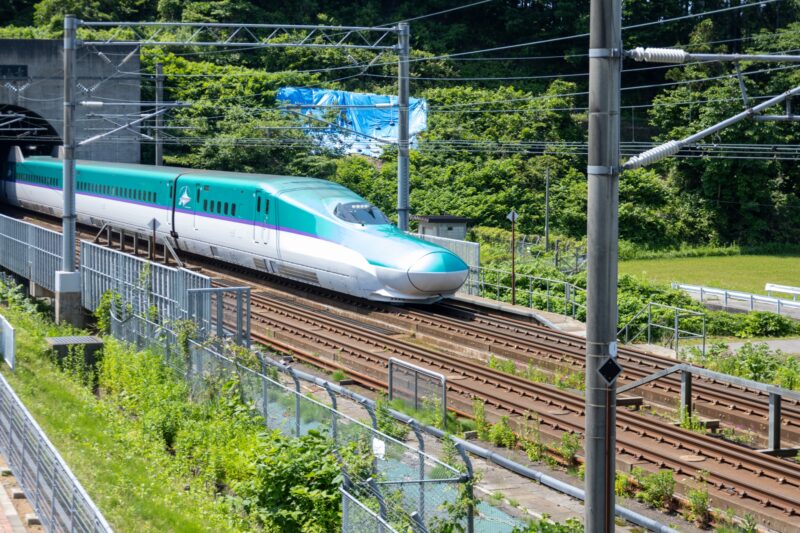
A Hokkaido Shinkansen H5 series train emerging from the Seikan Tunnel
A major factor in the discontinuation of the popular "Hamanasu" train service wasthe opening of the Hokkaido Shinkansen. The Hokkaido Shinkansen initially opened on March 26, 2016, on the section from Shin-Aomori Station to Shin-Hakodate-Hokuto Station in Hokkaido. It is planned to be extended to Sapporo Station in the future.
Because Hokkaido Shinkansen trains now pass through the Seikan Tunnel, which was previously used by the "Hamanasu" train, the tunnel's facilities were modified to meet Shinkansen specifications. Specifically, the voltage for running the trains was increased from 20,000 volts to 25,000 volts, and the ATC (Automatic Train Control) system, which prevents collisions between trains, was changed to be Shinkansen-compatible. As a result, the ED79electric locomotives that had been used to pull overnight trains through the Seikan Tunnel could no longer be used, leading to the discontinuation of overnight trains such as the "Hamanasu" (one might naturally wonder why they didn't just acquire new locomotives that could run through the Seikan Tunnel, but for various reasons, such a business decision was not made).
The last northbound train departed Sapporo for Aomori on March 20, 2016, and the last southbound train departed Aomori for Sapporo on March 21.The "Hamanasu," which was born with the opening of the Seikan Tunnel, retired with the opening of the Hokkaido Shinkansen, which also passes through the Seikan Tunnel, bringing its 28-year history to an end.
Incidentally, the passenger cars that were used for the Dream Car have been transferred to Tobu Railway in the Kanto region, and are sometimes used as passenger cars for Tobu Railway's SL trains (although they don't seem to appear very often)
The "beach rose" that appeared in the animated film
There is an anime film that features the "Hamanasu" flower. It is the movie "Love, Chunibyo & Other Delusions! -Take On Me-" which was released in January 2018. The Hamanasu flower also appears at the bottom of the movie's key visual. The Hamanasu flower had already been discontinued by the time the movie was released, but I think the setting of the film was around the early 2010s.
— "Love, Chunibyo & Other Delusions!" Official (@anime_chu_2) October 27, 2017
I won't go into detail about why the "Hamanasu" appears, as it would be a spoiler, buta way to travel from Sapporo to Aomorion the same day and at a reasonable price. Although the work itself is purely fiction, this scene clearly shows what kind of needs the "Hamanasu" met and what advantages it offered.
Conclusion
As of 2026, traveling from Aomori Station to Sapporo Station by connecting the Ou Main Line, Hokkaido Shinkansen, and the Hokkaido Limited Express "Hokuto" takes more than 5 hours. Thisis by no means a short amount of time for daytime travel, and of course, it's not possible to travel overnight while sleeping like on the "Hamanasu" (even using an airplane, it takes about 3-4 hours including travel to the airport and waiting time). It's natural to think that there was a certain demand for the "Hamanasu," and it's truly regrettable that such a popular train has been lost.
Furthermore, if the Hokkaido Shinkansen is extended to Sapporo Station in the future, it is expected that the journey between Shin-Aomori Station and Sapporo Station will take just over two hours. If this becomes a reality, I think the occasions when I feel like, "I wish we still had the 'Hamanasu' train..." will decrease
However, construction of the Hokkaido Shinkansen has been difficult, and the planned opening date has already been postponed. Currently, it is expected to open at the end of fiscal year 2038 or later. The phrase "later" implies that further delays cannot be ruled out. Moreover, with the increase in project costs, the Ministry of Finance has even suggested that the project should be canceled, making the future uncertain



![What day is it today? Tohoku Edition [0310]](data:image/png;base64,iVBORw0KGgoAAAANSUhEUgAAAJYAAACWAQAAAAAUekxPAAAAAnRSTlMAAHaTzTgAAAAaSURBVEjH7cExAQAAAMKg9U9tDQ+gAACAdwMLuAABXZHjmQAAAABJRU5ErkJggg== "[What day is it today? | Tohoku Edition] What day is March 10th?")
![What day is it today? Tohoku Edition [0310]](https://jp.neft.asia/wp-content/uploads/2026/03/0310-150x150.png.webp "[What day is it today? | Tohoku Edition] What day is March 10th?")
![What day is it today? Tohoku Edition [0313]](https://jp.neft.asia/wp-content/uploads/2026/03/0313-150x150.png.webp "[What day is it today? | Tohoku Edition] What day is March 13th?")