


The legendary pyramid that lies dormant in Kazuno City is called Kuromanta! [Akita Prefecture]

Are you aware that a pyramid actually exists in Kazuno City , which borders Aomori and Iwate prefectures ? This city was formerly written as "Kamitsuno" rather than Kazuno
The surrounding area is mountainous, with numerous mountains such as Hachimantai, Gonomiyadake, Akitayakeyama, Sanodake, Sankatadake, Shikakudake, Nakadake, Hachimori, Yamakemori, and Towariyama
Among them, there is one mountain that is so man-made that it is no exaggeration to say it may have been created artificially
That mountain is called "Kuromata-yama ," also known locally as "Kuromanta" or "Kurumanta-yama," which means "place where the gods gather" in the Ainu language. There are mountains all over the world that simply resemble pyramids in shape. So why does "Kuromata-yama" attract worldwide attention? This time, I actually visited and climbed it, and I would like to share my experience of its mystery with you!
Mt. Kuromata, where academic research was also conducted
Because of its "near-conical shape" andthat its summit has been broadly and flatly leveled, whichformed the fact some believe to be highly artificial, the "Kuromatayama Comprehensive Survey Team" of the Pacific Rim Society, primarily by members of the Doshisha University Museum Research Laboratory, conducted archaeological surveys of Kuromatayama from 1992 to 1994 using ground-penetrating radar, infrared photographs, and aerial photographs.
During the survey, stone tools, stonework, pottery, and clay artifacts were found on Mt. Kuromata, as well as iron nails and old coins. In addition, 16 stone inscribed objects made of dacite were found on the summit, slopes, and foot of the mountain
The Oyu Stone Circle , one of the Jomon archaeological sites in Hokkaido and northern Tohoku that became a World Heritage Site on July 27, 2021, is located within a 2km radius of Kuromatayama. This suggests that Kuromatayama may also have been a site for mountain religious rituals. However, the mystery of Kuromatayama does not end there.
In a 2022 TV program (Ariyoshi's Simultaneous Worldwide Broadcast: Uncovering the Mysteries of Pyramids in Japan and Around the World! Forbidden Investigation Special, TV Tokyo), an investigation using the latest radar equipment was conducted with the cooperation of Tohoku University. A cavity where someone is likely to be buried and a sarcophagus-like object were discovered 10 meters underground at the summit, and it was confirmed that the entire Mount Kuromata is made up of a terraced structure of 7 to 10 stone tiers
In other words, it is difficult to say that this mountain was formed naturally, and it is thought that it may have been created with some kind of purpose
The nearby Oyu Stone Circle is one of the largest stone circles in Japan, and although its purpose remains unclear, it is thought to be a "group tomb" and a "religious ritual site." Therefore, Kuromatayama may have been a tomb for someone of high rank or special status, and a site for "mountain religious rituals."

Time to climb Mt. Kuromata!

I visited at the end of February, so I knew it was snowing. That's right. This time, I went mountain climbing in the snow
First, there is a magnificent torii gate of Hongu Shrine at the entrance to the mountain . There is said to be a main shrine at the summit, but the founding date is unknown. According to shrine tradition, in 1659, the four villages of Nakadori built a shrine with Ōkuninushi-no-Mikoto as the enshrined deity. Another tradition says that Hongu Tokujirō, a member of the Abe Sadatō family, built a Yakushi-dō (hall dedicated to the healing Buddha), which is said to be the origin of the shrine. Incidentally, the name Hongu Shrine is said to have been adopted after the Meiji era.
I had done some research and found out that there was a Hongu Shrine on Mt. Kuromata, but my heart was set on "climbing the pyramid!", so to be honest, at this point I wasn't sure whether to pray or climb the pyramid... It was a strange feeling, a mix of Japanese and Western
Altitude 280m, let's go

It's a snowy mountain, of course, but you can faintly see the mountain path, and you can also see footprints that look like they belong to a small animal
The area is covered with cedar trees and, of course, the snow has not been removed, so the ground is very slippery. However, the mountain path is easy to follow even in the snow, so it seems to be well maintained

The gentle slope changes into a steep, zigzagging slope. Perhaps because I was imagining a pyramid as I climbed, I got the illusion that although it was steep, I was climbing at a constant angle from halfway up
After about 15 minutes of climbing, we finally arrived at the summit

As mentioned above, the main shrine of Hongu Shrine is located at the summit

Although the inscription on the plaque is unreadable, the principal image at the summit is Yakushi Nyorai. As mentioned earlier, when Tokujiro Motomiya, a doctor and member of the family of Abe Sadato, moved to Kazuno in search of a place to settle down, he carried the Abe clan's guardian deities, Kiyomizu Kannon, Hachiman Daibosatsu, and Taishakuten, on his back, and enshrined Taishakuten on Mt. Kuromata, enshrined Hachiman Daibosatsu in the Kusaki Hachiman Hall in the direction of Tatsumi, and enshrined Kiyomizu Kannon in the grounds of Daienji Temple in the direction of Ushitora. Furthermore, he dedicated his faith to Yakushi Nyorai, the guardian deity of doctors, and built a Yakushi Hall on Mt. Kuromata so that he could visit from afar
The name Hongu Shrine was first used around the Meiji period, and it was named after Hongu Tokujiro, and the Yakushi Hall was built at the top of the shrine to enshrine Yakushi Nyorai

At the top, there is also a small shrine and what appears to be a water basin, although it is hard to see due to the snow

The view is not great because of the trees around it,

It is surrounded by trees and is quiet, so you can spend a peaceful time there
After this we safely descended the mountain
My impression after climbing up was that when I was climbing the mountain path, the angle of the slope seemed constant, or maybe it was just my imagination, but there was almost no pyramid-like feeling to it
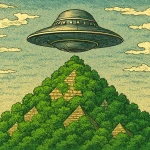
However, it is true that there have been various rumors in this area for a long time, such as sightings of unknown flying objects in the sky above Kuromatayama. And, going back even further, in 1932, Toritani Bansan , a Japanese painter born in Shichinohe, Aomori Prefecture, who was active from the Meiji to Showa periods , depicted something like a UFO flying with a tail of light in an ink painting of the sky above Kuromatayama, along with the words "Pyramid Kuromatayama, commonly called Kuromanta ."
As the saying goes, "There is no smoke without fire," this may be a mysterious place, or perhaps "something" that was built with a clear purpose
I don't know how many years it will take , but I look forward to the mystery of "Kuromatayama" being solved, along with the adjacent "Oyu Stone Circle."


As you can see in the photo, Mount Kuromata is easily identifiable from Akita Prefectural Road 66 (Northern Tohoku Romantic Road) as there is a signpost

And nearby, in addition to the World Heritage Site "Oyu Stone Circles," there is also the "Yunoeki Oyu Roadside Station," which has been the subject of many UFO sightings, just a 6-minute drive away, so we recommend stopping by there as well.


Kuromatayama <Information>
- Name: Mt. Kuromata
- Address: Towada Oyumiyanodaira, Kazuno City, Akita Prefecture, 018-5421
- Altitude: 280.7m
Google Map
Hot Spring Station Oyu <Information>
- Name: Yunoeki Oyu
- Address: 19 Nakayachi, Towada Oyu, Kazuno City, Akita Prefecture, 018-5421
- Phone number: 0186-22-4184
- Opening hours of each facility
- Oyu Engawa Shop: 9:00-17:00
- Oyu Engawa Cafe: 11:00-16:00 (last meal order 15:00)
- Official URL:https://yunoeki-oyu.jp/
Google Map

I'm a member of the Neft editorial team. I love alcohol, music, and travel, and on weekdays I indulge in drinks after work, and on weekends I travel to nearby places whenever I have free time.
My goal is to one day travel abroad to explore connections with Tohoku for a Neft feature! I work hard every day towards that goal.
Please support NEFT's article creation!
NEFT gathers and publishes articles about the history, culture, and tourism information of various regions in Tohoku
If you enjoyed this article, we would be grateful if you would consider supporting our future interviews, article creation, and website management
*Clicking "Tip" will open the tip sending screen for the external service "codoc"
Other articles

[Miyagi] Autumn drive on the Zao Echo Line is the perfect...

A strange twist of fate led to Sendai becoming the first Japanese person to circumnavigate the globe...

[Nihonmatsu City, Fukushima Prefecture] Mount Adatara, home to the "real sky"...

[Yamagata Prefecture] Is Yamagata the secret to surviving the hot summer?...

Recommended tourist spots on the Oga Peninsula | Kanpuzan Mountain, Godzilla Rock, ...

Katagami City launches "Akita Komachi" rice bag with Namahage motif...

[Matsushima Town, Miyagi Prefecture] Miyagi's Moss Temple with a beautiful garden designed by Kobori Enshu...

Why are rice drying methods different? Scenes after rice harvesting vary by region

Oyasukyo Great Fountain | The spectacle of steam spewing out from everywhere...
A Christian and one of the "Seven Philosophers of Rikyu" | A man of many faces...

Haguro, as depicted in the 38th chapter of the manga "That's Journey"...
