This site is an online media that delivers all sorts of trivia about the six Tohoku prefectures, from sightseeing and gourmet spots to local customs, history, and more
The legend of the goddesses of the Tono Sanzan mountains and the place where the three goddesses split up: Kamitsaya Shrine [Tono City, Iwate Prefecture]
The legend of the goddesses of the Tono Sanzan mountains and the place where the three goddesses split up: Kamitsaya Shrine [Tono City, Iwate Prefecture]
Tono City in Iwate Prefecture is famous as a village of folk tales
Tono is famous as a land where various legends, such as those about kappa and zashiki-warashi, still thrive. One of these legends passed down in Tono is the "Legend of the Three Mountains of Tono and the Three Goddesses."
This article explains the legend of the Tono Three Mountains and the Three Goddesses , and the shrine associated with the legend called "Kamiwakare Jinja" (God-Sending Shrine)
A legend that also appears in Kunio Yanagita's "The Tales of Tono"
Yanagi Kunio is a figure known as the "father of Japanese folklore studies . "
Yanagita,Kizen Sasaki, wrote them down and compiled them. Furthermore, he visited Tono himself and conducted fieldwork before publishing"Tono Monogatari," a work that is considered a pioneering work in Japanese folklore studies.
The "Legend of the Three Mountains of Tono and the Three Goddesses" also appears in the second episode of the Tono Monogatari
Tono Monogatari, Episode 2: "The Legend of the Three Mountains of Tono and the Three Goddesses"
The town of Tono is located at the confluence of rivers running north and south. Formerly, it was 770 ri (approx. 3,000 ri) long, and goods for sale were gathered from seven valleys, each 70 ri deep, and on market days it was bustling with a thousand horses and a thousand people. Of the four surrounding mountains, the most prominent is Hayachine, located deep in Fuumaushi to the north. To the east stands Mount Rokkakuushi. Mount Ishigami is located between Fuumaushi and Tatsusobe, and is lower in height than the previous two
Long ago, there was a goddess who came to this plateau accompanied by her three daughters, and one night while they stayed at the place where the Izu Gongen shrine is located in present-day Rainai village, the mother goddess told them that if any of their daughters had a good dream that night, she would give them a good mountain. As they went to sleep, a sacred flower descended from the sky and landed on the chest of the older princess. When the youngest princess woke up, she secretly picked it up and placed it on her own chest, and in the end they obtained the most beautiful mountain, Hayachine, and their older sisters obtained the hexagonal cow and the stone god. The three young goddesses each lived on the three mountains and still rule over them to this day, and it is said that the women of Tono, fearing their jealousy, still do not visit these mountains
"The Tale of Tono" by Kunio Yanagita
The above can be roughly translated into modern English as follows:
"The Legend of the Three Mountains of Tono and the Three Goddesses" (Modern Japanese Translation)
The town of Tono is located where two rivers flowing north and south meet. In the past, it was called "Shichi Shichi Jyuri" (770 ri), and various goods were gathered from the seven valleys, each 70 ri deep. On market days, it was so lively that a thousand horses and a thousand people would gather
Of the mountains surrounding the town, the most prominent is Hayachine, located deep within Tsukumoshi to the north. To the east, Rokkoushi Mountain rises, and between Tsukumoshi and Tatsusobe, a mountain called Ishigami is lower in height than the previous two
A long time ago, a goddess came to this plateau with her three daughters. One night, while they were staying at the site of the Izu Gongen shrine in the village of Rainai, the mother goddess said to her daughters:
"If any girl has a good dream tonight, I will give her a good mountain."
Late at night, a sacred flower fell from the sky and landed on the eldest daughter's chest, but the youngest daughter woke up and secretly took it and placed it on her own chest
As a result, the youngest daughter was given the most beautiful mountain, Hayachine, and her older sisters were given Mount Rokkakuushi and Mount Ishigami, respectively
Eventually, the three young goddesses each lived on one of the mountains, and they still rule over these mountains today. For this reason, the women of Tono are said to fear the jealousy of the three goddesses and to this day avoid playing on these mountains
Although the kanji characters used today are slightly different, this is a legend about three mountains in Tono : "Hayachineyama" located to the north , "Rokkakugyuyama" to the east, and "Ishigamiyama" to the northwest , and the three goddesses who protect these mountains.
Kamitsukajinja Shrine is said to be the place where the three goddesses separated to head to their respective mountains
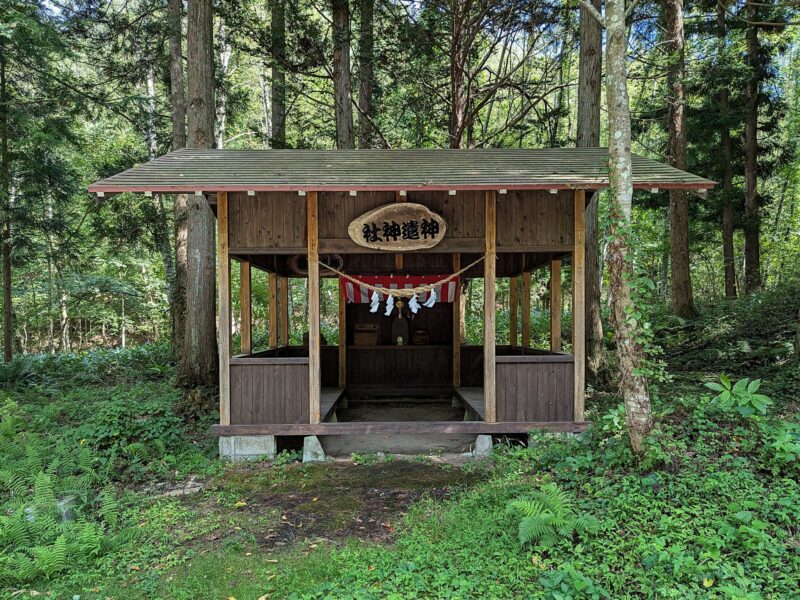
Kamiwakare Shrinetheirissaid to be the place where the three goddesses in this legend parted ways before heading to respective mountains
Shrine of the God of Fortune
It is located on the way to Hayachine Shrine in Tsukemauushi-cho, Tono City, but as it is a small gazebo-like shrine, you may miss it if you are not looking carefully
Altar of Kamikiri Shrine
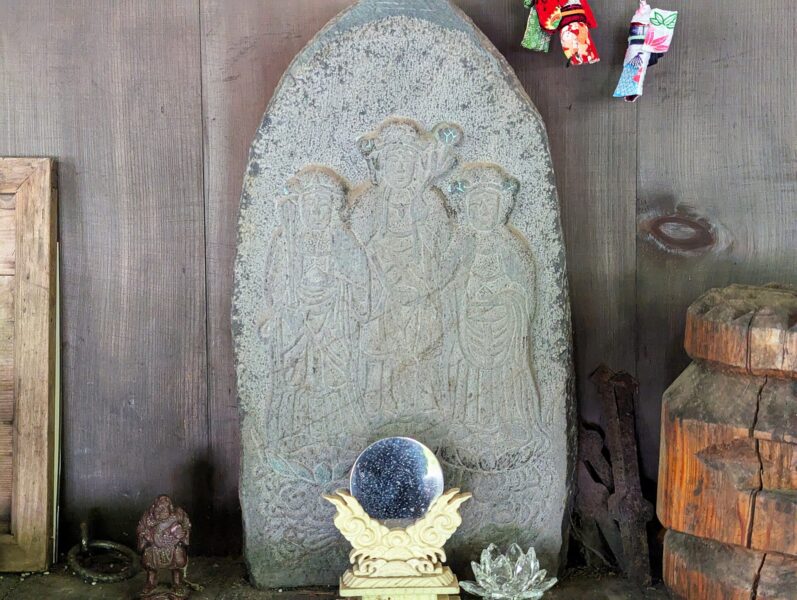
The shrine is simply built, and it looks as though wind and snow could easily seep in from the sides, but inside there is an altar and in the center is a stone slab with the images of the three goddesses carved on it
A stone slab engraved with the three goddesses at Kamitsari Shrine
Based on other sources, it is thought that the one in the center is the goddess of Mt. Hayachine, the one on the right is the goddess of Mt. Rokkakuushi, and the one on the left is the goddess of Mt. Ishigami
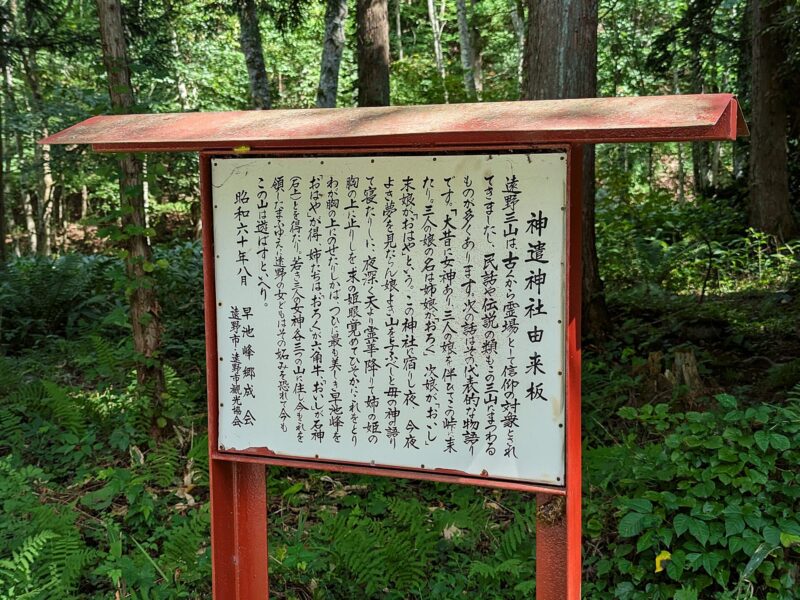
The legend on the local information board is slightly different from "The Tale of Tono"
An explanatory board about the legend behind the Kamikazuchi Shrine
at the site"Origin of the Kamitsukai Shrine," which describes the legend of the three goddesses, but it differs slightly from the description in the aforementioned "Tono Monogatari."
The contents are as follows:
Description from the plaque at the Kamitsukai Shrine
Long ago, there was a goddess who came to this pass with her three daughters
The names of the three daughters are Oroku, the eldest is Oishi, and the youngest is Ohaya
One night while staying at this shrine, the mother goddess told her that if her daughter had a good dream that night she would be given a good mountain, and as they went to sleep, a sacred flower descended from the sky and landed on the chest of the older princess. When the youngest daughter woke up, she secretly took the flower and placed it on her own chest, and in the end, Ohaya obtained the most beautiful Mt. Hayachine, and her older sisters, Oroku, obtained the hexagonal cow, and Oishi, obtained Ishigami (Ishigami)
The three young goddesses each lived on three mountains and still rule over them, so it is said that the women of Tono still avoid these mountains for fear of their jealousy
Hayachine Village Association, Tono City, Tono City Tourism Association
The legend first mentions the names of three goddesses
The eldest daughter was named "Oroku," the second daughter was named "Oishi," and the youngest daughter was named "Ohaya"...these are clearly linked to the names of the mountains that each of them later protected
" Ohayaはや" is "はやHayachine ," " Orokuろく" is "ろっRokkoushi ," and " Oishiいし" is "いしIshigami "... Perhaps these names are also related to the origins of the mountain names.
In fact, there are various other versions of this legend of the three goddesses, including the theory that they were the daughters of Abe no Muneto , a powerful local lord of Mutsu Province during the mid-Heian period, the theory that they originated from Sakanoue no Tamuramaro, the Shogun who succeeded the barbarians , and the theory that the mountain in question is actually different.
Furthermore,the theory that they were the daughters of "Abe no Muneto"are "Oroku," "Oishi," and "Ohaya," and there are various commonalities between the different theories.
Perhaps the legend changed little by little as it passed through different people, branching out into various theories..
summary
You may not often visit this specific spot, but it is on the way to Hayachine Shrine, so it might be worth stopping by for a bit on your way to worship
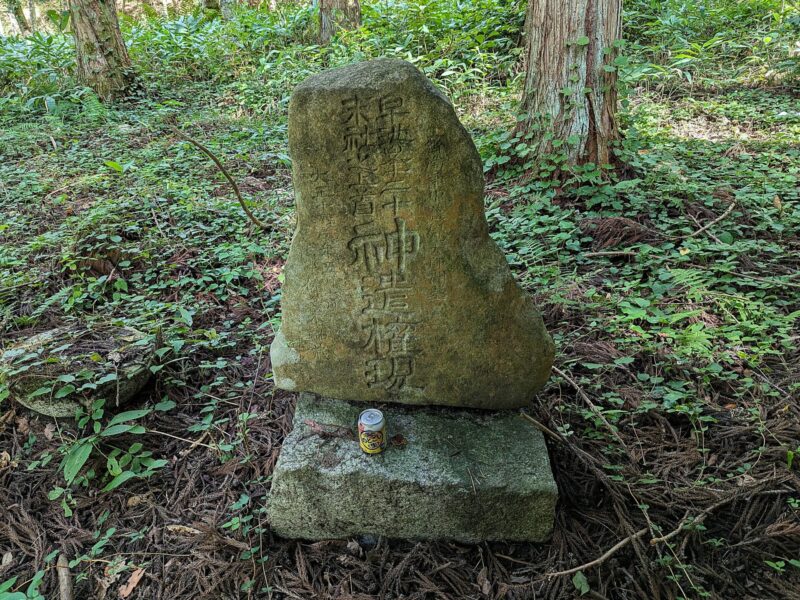
Stone monument behind Kamikazuchi Shrine
Kamitsukare Shrine is one of the many places in Tono that have been the setting for many of the legends that remain. Experiencing the legend of the Three Goddesses on-site will surely become a memorable experience for your trip!
Kamikiri Shrine <Information>
Name: Kamiwakare Shrine
Address: Shimotsukeumaushi, Tsukeumaushi-cho, Tono City, Iwate Prefecture, 028-0663
Traveling around the Tohoku region, I enjoy drinking delicious sake and exploring the local history, traditions, and customs. I write articles based on my interests. I'm currently interested in folk performing arts, local toys, and folk beliefs










![What day is it today? Tohoku Edition [0116]](https://jp.neft.asia/wp-content/uploads/2026/02/0116-150x150.png.webp "[What day is it today? | Tohoku Edition] What day is January 16th?")