


What is "Danburi Choja"? A detailed explanation of the old story that inspired the name of the sweet potato shochu [Akita Prefecture]

In May 2021, "Danburi Choja," a sweet potato shochu manufactured and sold by Akita Fermentation Industry Co., Ltd., won a bronze medal at the "Tokyo Whisky & Spirits Competition (TWSC) 2021," a distilled spirits competition
This article provides a detailed explanation of the folktale "Danburi Choja," a story so beloved that it has become the name of a type of sweet potato shochu, and is even featured as basic knowledge about Akita in the Akita Hometown Examination
reference
Synopsis of Danburi Chōja
The Danburi Chōja, a folktale from Akita, tells of how "danburi," meaning "dragonfly," brings happiness to a married couple. Let's review the plot
Summary of Danburi Choja
Once upon a time, in Tokko, Hinai (present-day Odate City), there was a girl who was grieving the death of her parents. One day, a white-haired old man appeared in the girl's dream and told her to "go upstream and marry a young man you meet there."

As predicted, the daughter married a young man she met in Azusawa (present-day Kazuno City), but no matter how hard she worked, they remained poor and their life did not improve. They were in such a difficult situation that they could not even buy sake to offer to the gods at New Year's
Then, a white-haired old man, an incarnation of the god Dainichi, appeared in the couple's dream and told them, "If you move upstream and live, you will become wealthy." So the couple opened up fields in a village called Hiramata, further inland from Tayama (now Tayama, Ashiro Town, Iwate Prefecture)
One day, while her husband was sleeping between farm work, a dragonfly flew over and repeatedly touched its tail to her husband's lips, which puzzled her
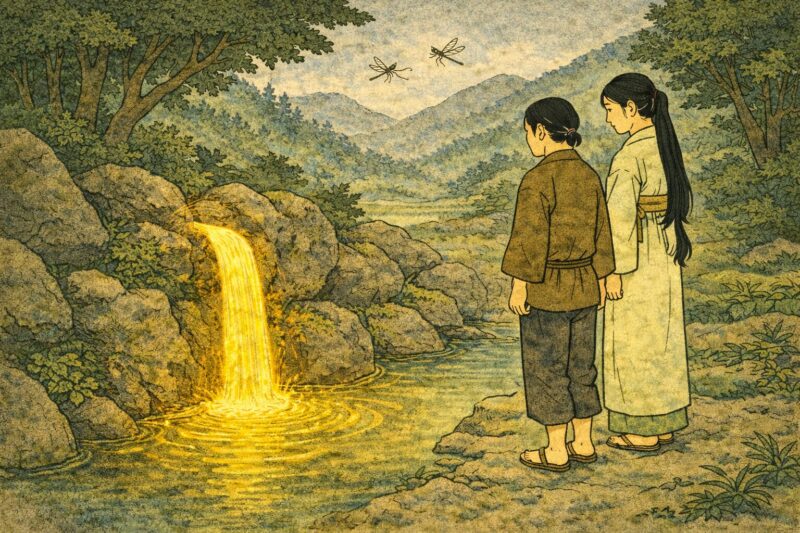
When the husband woke up, he felt as if he had drunk some very delicious sake in his dream, so he went in the direction the bowl had flown and found a spring from which sake gushed forth
The liquor had the power to cure any illness and even prolong life, so the couple quickly became the richest people in the country
Many people gathered at the large mansion, and rice was cooked continuously to entertain them, and the water from the rice rinse flowed into the river, turning the water cloudy and white. From then on, people began to call the river Komeshiro (Yoneshiro) River
However, the couple was still unable to have children even after they turned 40, so they prayed to Dainichi-no-kami and were finally blessed with a beautiful baby girl
A short time later, the couple went to the capital with their daughter to ask for the Emperor's permission to call themselves Choja. The daughter caught the eye of Emperor Keitai and was appointed to serve in the Imperial Court. She married the Emperor and took the name Kisshohime
Soon after, the wealthy couple passed away in their hometown, and the sake fountain turned into water

When Princess Kissho heard of the deaths of the wealthy couple in the capital, she was saddened and requested to build a shrine in her hometown, which was granted, and she paid a respectful tribute to the couple
This shrine is the Ohirume Muchi Shrine located in what is now Azusawa, and is said to have been built in 523 (the 17th year of Emperor Keitai's reign), so it is possible that the "Danburi Choja" actually existed around that time

When Princess Kissho passed away, she was buried next to Dainichiryouki Shrine according to her will, so a ginkgo tree was planted there and a temple called Kisshoin was built
Information
- Name: Dainichi Reiki Shrine (Dainichido)
- Address: 16 Hachimantai-do, Kazuno City, Akita Prefecture, 018-5141
- Phone number: 0186-32-2742
- Official website:https://dainichido.org/
Google Map
- Name: Kisshoin
- Address: 40 Azusawa, Hachimantai, Kazuno City, Akita Prefecture, 018-5141
- Phone number: 0186-32-2042
Google Map
Masumi Sugae and "Danburi Millionaire"
The folktale of Danburi Choja was originally told in the Edo period as Oku Joruri, a form of Japanese folklore told in the Oshu region, and a story similar to this one is included in Sugae Masumi's book "Kenno Sebanono" as "The Tale of Danburi Choja."

In "The Tale of the Danbiru Millionaire," it is written that what flew to the husband was an akitsu mushi (dragonfly), and that the people of the village called it danbi, so the couple was called Danbiru Millionaire. This is one difference from the old tales that are handed down in Akita today
Another major difference is that after the couple's death, a temple called Yorosan Kitoku-ji Temple was built by imperial order, rather than Dainichireiki Shrine
"Kefu no Seba Nono" is included in the second special collection of the Akita Collection, so if you're interested, be sure to read them both and compare them

Hi, I'm Sakihime. I'm a web writer born in Akita who loves sake, so I'll be introducing delicious sake from Akita, snacks that Akita residents secretly enjoy, and tourist spots where you can enjoy beautiful scenery
Please come to my hometown, Akita!
Please support NEFT's article creation!
NEFT gathers and publishes articles about the history, culture, and tourism information of various regions in Tohoku
If you enjoyed this article, we would be grateful if you would consider supporting our future interviews, article creation, and website management
*Clicking "Tip" will open the tip sending screen for the external service "codoc"
Other articles

20,000 year old ruins preserved as they were at the Underground Forest Museum...

New discoveries are being made one after another! 33 lakes and ponds in the forests of the Shirakami-Sanchi Mountains...

Excited to see Namahage for the first time! The 62nd Namahage Sedo Festival...

Visiting sake breweries in the six Tohoku prefectures! A warm visit to Shiwa Town, the birthplace of Nanbu Toji (sake brewers)...

Akita Prefecture is one of Japan's leading sake producing regions! 5 sakes you should buy when you visit

[Yamagata Prefecture] View the history of safflower culture from Risshakuji Temple in the mountains...

[Aizuwakamatsu City, Fukushima Prefecture] Aizu's largest festival! Aizu Festival 2023...

"Grilled Squid Street" is famous for its squid curtains! A delicious dish packed with flavor...

Yellow and pink ice flower blooming in Akita! What is "Babahera"?

[Miyagi Prefecture] 5 Recommended Beaches in Miyagi Prefecture!...

Who is Yuji Koseki? The Fukui man who inspired the NHK morning drama "Yell"...
