


What is the connection between Oda Nobunaga and Yamagata? Introducing a precious portrait and a shrine dedicated to Nobunaga [Yamagata Prefecture]

When you think of popular warlords from the Sengoku period, who comes to mind?
Many people probably think of Oda Nobunaga, the military commander who aimed to unify the country during a time of war
This time, we will explore the relationship between Yamagata Prefecture and the Oda clan, and introduce places associated with Nobunaga, such as the portrait said to most closely resemble him, and the shrine dedicated to him
What is the relationship between the Oda clan and Yamagata?

When it comes to places closely associated with Oda Nobunaga, Owari Province (present-day Aichi Prefecture) is probably the most likely to come to mind
Let's take a look at why Yamagata, a place in the Tohoku region far from Owari Province, is said to have ties to the Oda clan, and what fate the Oda clan faced after the Honnoji Incident
After Nobunaga passed away in the Honnoji Incident, his eldest son, Nobutada, was forced to commit suicide by Akechi Mitsuhide's army, and his second son, Nobukatsu (or Nobuo), became the head of the Oda clan
However, Toyotomi Hideyoshi and successive Tokugawa shoguns feared that the Oda clan would rise to power again, and repeatedly transferred them to other provinces under the policy of "high rank, low stipend."
The Oda clan was transferred from one territory to another, from Owari to Shimotsuke to Yamato to Kozuke, and in 1767, 185 years after the Honnoji Incident, they were transferred to Takahata Domain in Dewa Province, present-day Yamagata Prefecture
Later, in 1831, the castle was moved to Tendo in Yamagata Prefecture, and the Tendo Oda Domain was born. The domain ruled the area until the end of the Edo period, and its ties with Yamagata deepened
Introducing spots related to the Oda clan
Tendo Oda Village History Museum

This is a must-see place for anyone wanting to learn about the history of the Tendo Oda clan. It's the first place you should visit. The exhibits clearly explain the origins of the Tendo Oda clan
The museum building was formerly used as the Higashimurayama Municipal Office building, and is said to be the oldest cultural asset in Yamagata Prefecture as a Western-style building from the Meiji era. Its retro and stylish atmosphere is also one of its attractions
Tendo Oda no Sato History Museum <Information>
- Name: Tendo Oda no Sato History Museum (Tendo City Former Higashimurayama County Office Museum)
- Address: 2-4-8 Itsukamachi, Tendo City, Yamagata Prefecture
- Phone number: 023-653-0631
- Official URL:Tendo Oda no Sato Historical Museum
Google Maps
Sanboji Temple
Sanbo-ji Temple is the family temple of the Oda clan, and houses the memorial tablets of successive feudal lords, including Nobunaga. The grounds are beautifully maintained, making it a comfortable temple where time passes slowly and peacefully
This temple houses a portrait of Oda Nobunaga, said to have been painted by a missionary

According to one theory, this portrait is said to be the most likeness of Oda Nobunaga himself, with his gentle, intelligent eyes and well-defined nose being particularly striking.
This photograph was copied by a court photographer from the Tendo Oda domain and was held by the Imperial Household Agency and the Oda family, but only Sanboji Temple still possesses it.
Along with the ancestral tablets of the Oda family, this extremely valuable portrait is still carefully preserved today.
Sanbo-ji Temple <Information>
- Name: Sanpoji Temple
- Address: 1-2-5 Nakamachi, Tendo City, Yamagata Prefecture, 994-0045
- Phone number: 023-653-2551
- Official URL:
Google Maps
Takekun Shrine

Kenkun Shrine is located on a corner of Maizuru Mountain in the center of Tendo City. It is the first shrine in Japan to enshrine Oda Nobunaga as its deity. Shrines that enshrine Nobunaga are rare throughout Japan, making it a very unique existence.
In 1870, as a token of honor for the achievements of Nobunaga, the first lord of the domain, the title of "Kenkun-no-kami" was bestowed upon him, and Oda Nobutoshi, the governor of the Tendo domain, built this shrine.
It is said that the fact that the Tendo Oda domain sided with the new government forces during the Meiji Restoration greatly influenced the fact that permission to build the shrine was granted.
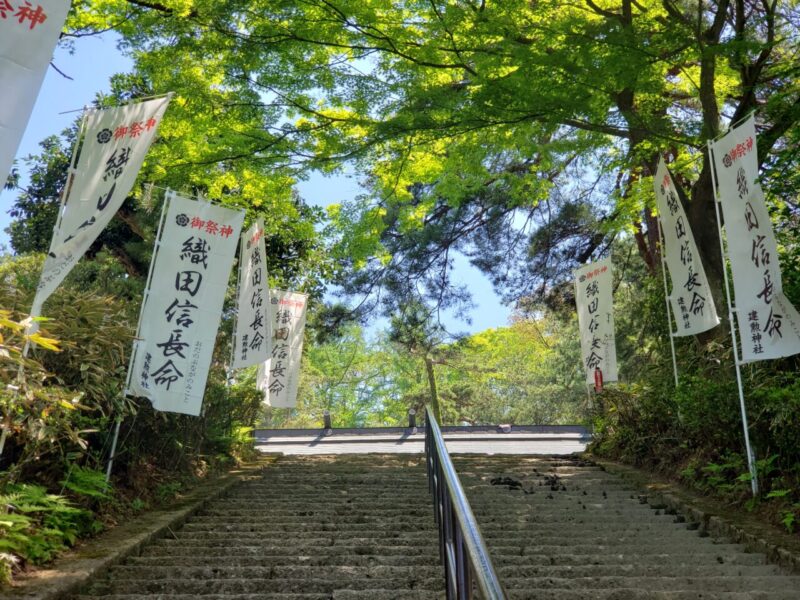
Along the approach to the shrine, there are many banners bearing the name of Oda Nobunaga
There is a dignified atmosphere within the grounds, and when you think that Oda Nobunaga is enshrined here as a god, you feel a sense of tension that makes you stand up straight
Above the offering box is the inscription "Tenka Fubu" (Unifying the nation through military force)!

The "Sazareishi" (pebbles) that appear in Japan's national anthem, "Kimigayo," were also placed within the grounds

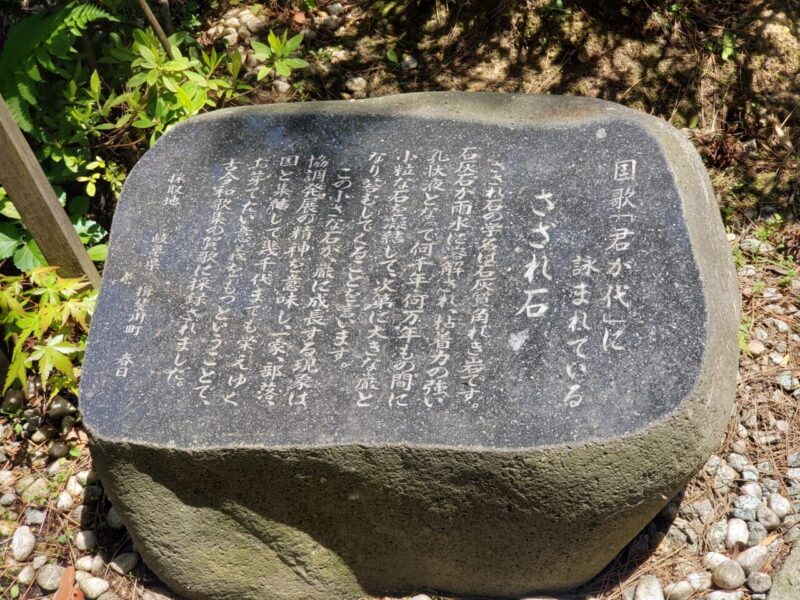
At Kenkun Shrine, the "Nobunaga Festival" is held every June, the same month as the Honnoji Incident, and wine is offered to the altar as sacred sake
It is said that Oda Nobunaga was the first person in Japan to drink wine, which was brought to Japan by the missionary Francis Xavier. The offering of wine instead of sake shows respect and love for Nobunaga
Kenkun Shrine <Information>
- Name: Kenkun Shrine
- Address: 1043-5 Tendo, Tendo City, Yamagata Prefecture, 994-0000
- Phone number: 023-653-0289
- Official URL:
Google Maps
summary
After losing their lord Nobunaga in the Honnoji Incident, the Oda family spent many years relocating from Owari Province to Yamagata, a place far away from their homeland. It is known that they continued to establish themselves in this region, praying for the souls of their ancestors.
Yamagata Prefecture is one of the few places in Tohoku where you can experience the history of Oda Nobunaga. Why not visit these places associated with him and reflect on history?

Thank you for reading this article.
I'm Naka, a writer born and raised in Tohoku.
My hobby is visiting temples and shrines, and I'm currently on my third goshuin (temple/shrine stamp) book.
I'll be sharing timely information and in-depth topics about Tohoku from a local's perspective!
Other articles

The submerged forest of Lake Akiogi can only be seen from May to June! The trees in the lake...

[Miyagi] Who is this popular local YouTuber based in Sendai?.

The origin of the name was the Shogun's "infidelity"?! He is praised as a wise ruler...

Nekka Okuaizu Distillery's rice-based vodka "Ne...

[Series 4: The Battle of Zenkunen and the Battle of Gosannen] The events surrounding the Battle of Zenkunen...

Boasting Ekiben from the 6 Tohoku Prefectures! Top 5 Recommended Ekiben in Yamagata Prefecture...

[Iwate Prefecture] Tracing Morioka's coffee shop culture: "Good old coffee shops"...

Full of retro charm! Aizu's lesser-known sightseeing route: Nanokamachi...

[Aomori Prefecture during the Boshin War] The Hirosaki, Kuroishi, Hachinohe, and Shichinohe Domains...

Come see the large and small Kanto floats at the Neburi Nagashi Hall!.

Mount Adatara, an active volcano in Fukushima, is one of Japan's 100 most famous mountains
