

![Daito-ryu Aikijujutsu [Part 1]](https://jp.neft.asia/wp-content/uploads/2026/01/aiki_tkd01-1200x800.jpg.webp)
Did Aikido originate in Aizu? Daito-ryu Aikijujutsu and Takeda Sokaku [Part 1] | The difference between "Aikido" and "Aikijujutsu"

Introduction
It is well known that Japanese martial arts, including judo, which has been adopted as an Olympic sport, are popular worldwide and are studied by many enthusiasts
Martial arts that were formed after the Meiji period and that emphasized aspects of modern physical education are called modern martial arts, and currently nine organizations are members of the Japan Martial Arts Council (there are many other martial arts as well)
These include kendo, judo, karate, kyudo, shorinji kempo, sumo, naginata, juken-do, and aikido. All of these have a historical background based on martial arts, but are characterized by the fact that they are based on the idea of spiritual training as a "path to human development."
Among them, Aikido has maintained an even more unique style, one of which is that it does not hold competitions (this varies depending on the school or organization that was established later). Rather than competing, Aikido trains through kata practice, and is impressive for its collection of techniques with a strong self-defense element that transcends physique, age, and gender
The founder was Morihei Ueshiba , a martial artist from Wakayama Prefecture .
It is almost mystical to see the person who has been hit by a technique take a defensive stance as if flying through the air, but Aikido actually has its origins in a martial art
Its name is "Daito-ryu Aikijujutsu." It is a technique passed down by Takeda Sokaku, an unparalleled master born in Aizu
In this article, we will look into the history and anecdotes surrounding Daito-ryu, the origin of the famous martial art of Aikido, while also looking at its relationship with Takeda Sokaku of Aizu and Ueshiba Morihei of Kii
What is Aikido?
First, let's take a look at what kind of martial art Aikido is
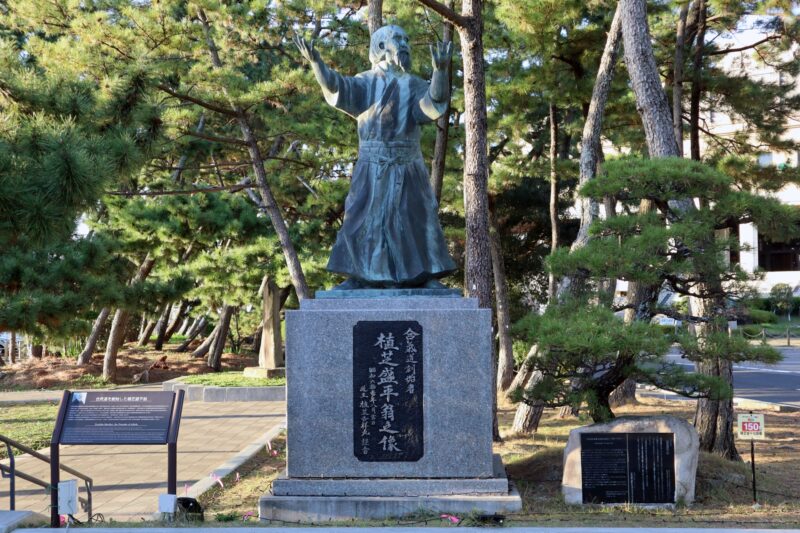
It gives the impression of an elderly person or woman being able to easily throw a physically superior person, but of course it is not a magic technique or trick, but rather a technique that is made possible through rational physical manipulation
Let's take a look at the main parts of it below
Characteristics as a martial art
Aikido is a martial art that focuses on physical techniques, and is characterized by a style that involves catching the opponent's joints and throwing them, or pinning them down and immobilizing them
The techniques are broadly similar to those of judo, but rather than fighting from a grappling position like in modern judo, the forms are developed to respond to crises such as being grabbed or punched by the opponent

The unique form of Japanese martial arts is that it includes not only standing techniques but also techniques performed while seated, and punches and kicks are rarely seen in the forms. However, some believe that such strikes are actually included in the flow of the technique to disrupt the opponent's posture or create an opening
For this reason, the distance from which the technique is initiated is somewhat far, and it is common to see throws that twist the opponent's joints. As a result, if the person on the receiving end of the technique tries to withstand it, they run the risk of suffering severe damage to their joints, so they are forced to take a defensive position by jumping. Aikido's demonstrations, which are almost like flying through the air, are based on the characteristics of these techniques
Since karate does not involve launching attacks, but rather focuses on techniques for responding to attacks from the opponent, it also has a strong element of self-defense, and techniques such as skillfully using the strength of an attacking opponent to parry or throw them are also noteworthy
In addition to one-on-one demonstrations, there are also multi-person demonstrations where the opponent is a large number of people
Weapons to be used
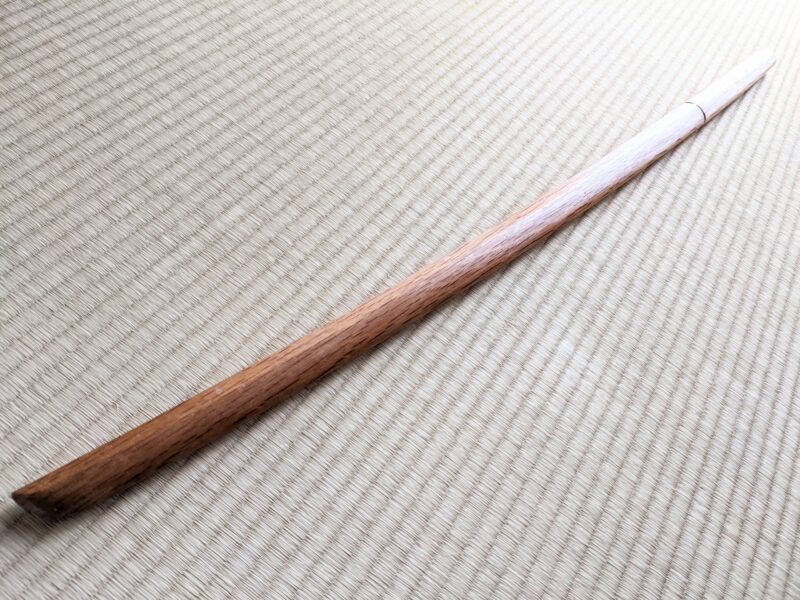
Aikido is centered around physical techniques, but it also teaches techniques using weapons such as swords and staffs
The sword is of course a Japanese sword, and wooden swords are used in training. The staff is what is known as bojutsu, and in Aikido, a five-foot (approximately 150 cm) oak staff is used
To be precise, there are sword vs. sword, staff vs. staff, sword vs. staff, unarmed vs. sword, and unarmed vs. staff patterns, and it is noteworthy that it also includes weapon techniques and techniques for fighting weapons while unarmed
This is because, although Aikido is a martial art based on Jujutsu, its theory is sometimes described as an application of that of swordsmanship. In other words, it has an aspect that can be described as swordsmanship without a sword, or a martial art for when a sword is not available, and so it is considered quite natural to position it as an extension of swordsmanship as an unarmed exercise, or vice versa

Additionally, one of the techniques is "tanto-dori," in which a dagger is used to subdue an attacking opponent, so it is likely that students will naturally become proficient in handling such weapons
Unlike swords and staffs, it is not referred to as an independent category of short sword technique, but it is notable for conveying a group of techniques similar to so-called "kaikenjutsu," such as thrusting with the blade held upward and swinging down with the blade held in the reverse grip
What is "Aiki" in Aikido?
Let's take a look at what the word "aiki," from which Aikido and Aikijujutsu are named, means
In conclusion, it is a concept that has a very broad and complex meaning, and is difficult to define uniformly because interpretations vary from person to person
However, in general terms, it can be seen as a general term for a group of fundamental techniques, such as those seen in Aikido techniques, which instantly neutralize the opponent's strength, or attack the joints and meridians as if they are stiff, leading to a breakdown
These Aikido techniques allow for extremely exquisite bodily movements that at first glance seem almost godlike, but the term is also used in spiritual and philosophical contexts
It is said that Aikido places great emphasis on this meaning, and the ultimate goal is to achieve harmony with the opponent rather than conflict, which is sometimes explained as Aikido
What is Daito-ryu Aikijujutsu?
On the other hand, what kind of martial art is Daitoa-ryu Aikijujutsu, which is said to be the origin of Aikido?
As the name of the style includes "jujutsu," one can imagine that it is a type of ancient martial art that became the basis for judo, but it is also characterized by the use of a group of techniques that have established a very unique style

According to the school's tradition, it was founded by Shinra Saburo Yoshimitsu (Minamoto no Yoshimitsu) , a warrior from the late Heian period , and was brought to Aizu via the Kai Takeda clan, where it was secretly passed down as a court martial art called "Oshikiuchi."
Traditionally, Takeda Sokaku has been said to be the founder of this revival
This explanation will be a bit long, but let's take a look at the overview below, focusing on the comparison with Aikido
Characteristics as a martial art
Daito-ryu Aikijujutsu is one of the roots of Aikido, and as such, it is a martial art that draws attention for its throwing and pinning techniques that attack the inverted joints and meridians
It is characterized by the use of Aikido principles, which form the basis of the technique, to instantly weaken and paralyze the opponent, rendering them powerless and subduing them
However, since it is a martial art and not a martial art, it is not a competition, and it is not positioned as a physical education, so many of the techniques used are perceived as being dangerous
For example, Koryu Jujitsu features striking strikes such as punches and kicks, which Daito-ryu also uses. This is a striking difference from Aikido, which does not feature many striking strikes, and gives the impression of a more intense and rigorous ancient fighting style
In terms of throwing techniques, Aikido involves taking a large, flying fall, which gives the impression of being graceful in a sense, whereas Daito-ryu gives the impression of using sharp, powerful throws that seem to slam the opponent straight down
Even in pinning techniques, Aikido involves maintaining a state of mind while the opponent is pinned, whereas Daito-ryu almost always involves striking a vital point on the neck with a chopping hand, and the entire sequence is up to the final blow. This is said to be intended for situations where the opponent is armed with a weapon rather than bare hands, and can be said to be a technique that evokes the very essence of an old-style martial art, inheriting memories of the time when samurai engaged in grappling on the battlefield
Weapons to be used
Like Aikido, Daito-ryu Aikijujutsu uses swords, staffs, and short swords, as well as six-foot sticks and spears, giving it the aspect of being a comprehensive combat technique often seen in ancient martial arts
As mentioned above, although Aikido is a physical art, it contains a great deal of swordsmanship theory, and the same is true of Daito-ryu, and Takeda Sokaku, who popularized it, was also a master of Ono-ha Itto-ryu
For this reason, there are dojos within the Daito-ryu lineage that also teach Itto-ryu swordsmanship

There are also some unusual techniques such as dual-wielding large swords and using an iron fan
Two swords usually means holding a large sword in one hand and a small sword in the other, and the two-sword style used in modern kendo also follows this style
The Daito-ryu style of holding a large sword in each hand is extremely unusual, but this is because in situations where one is up against many and the enemy is attacking with a sword, there seems to be a flow of techniques where one takes away the opponent's weapons, neutralizing them one by one, resulting in two swords.As is the case with Aikido, Daito-ryu, the origin of the style, also draws attention with its flexible development of techniques that respond quickly to the situation of battle, such as taking away the opponent's weapon and overpowering them
The iron fan is a real tool used for self-defense in places where no sharp objects can be brought in, such as a tea room, and one is left unarmed
These include iron fan frames, and iron products that are folded into a fan shape and cannot actually be opened. Martial arts techniques use very short weapons such as the "Jutte" and "Hishigi (short wooden sticks)," and iron fans are generally used in similar techniques
Although it does not appear to be a weapon and can be carried around at all times, it can also be used to deliver powerful blows and lock joints, making it a self-defense tool that is highly compatible with Daito-ryu techniques
What is "Aiki" in Aikijujutsu?
Daito-ryu was the first to use the word "Aiki" in the name of a school, and naturally the concept is also considered to be the original
However, as mentioned earlier, Aikido has a very broad meaning, and interpretations vary slightly from person to person, so it cannot be denied that it is difficult and complex to give it a comprehensive definition
In comparison to Aikido, Daito-ryu focuses on the philosophical aspects of the state one must reach, whereas Daito-ryu is often viewed in a more technical context
It is said that Aiki was originally a term often used in swordsmanship, and it is also written as "Aiki."
It also encompasses the concept of "ki" that is often used in martial arts, but it is also a broad and difficult concept that encompasses the intention to attack, psychological effects during combat, and the effects that physical and mental reflexes and reactions have on movements
It is difficult for an outsider to put into words, but if you focus on the technical aspects, you can probably imagine a scene where the opponent grabs your arm, but then your arm stretches out completely and stiffens, and you are immediately thrown away
Or perhaps you have seen a demonstration that seems almost magical, such as when someone grabs your clothes and throws you by simply twisting your body slightly
Although this phenomenon may seem hard to believe at first glance, it is not a trick, but a genuine technology that allows for rational physical control
This is a very rough example, but what if someone tries to push down on your arm with all their weight, and you exert force to hold on, then immediately relax your arm completely?
Your opponent may lose control of their center of gravity and fall over
One aspect of the technique known as Aiki involves intentionally creating such a situation and performing the same thing with sharp, minimal movements
The sum total of techniques that instantly control the opponent's reflexes and center of gravity, neutralizing them in accordance with the laws of the human body, such as the joints and skeleton, can be said to be part of the explanation of Daito-ryu Aikido
Again, it is important to note that these analogies and definitions are just the tip of the iceberg, and the part that includes psychological and religious effects can only be described as truly profound

- Author of the original text for Seibido Publishing's "Illustrated Dictionary of the Heian Period: A Visual Guide
to Enjoying Life.
" - Honorable Mention for "The Land of Star Readings" at the 3rd Misato Western Treasury Literary Awards.
competition. - "Swordsman's Communications" at the 9th Historical and Period Novel Grand Prizes, "Exhilarating! Entertainment Swordsman Award" (book publication project in progress).
- 5th Dan in Iaido, 4th Dan in Jodo.
Please support NEFT's article creation!
NEFT gathers and publishes articles about the history, culture, and tourism information of various regions in Tohoku
If you enjoyed this article, we would be grateful if you would consider supporting our future interviews, article creation, and website management
*Clicking "Tip" will open the tip sending screen for the external service "codoc"
Other articles

What is Kesaranpasaran? Learn more about the mysterious object that brings good fortune...
A creature similar to, yet different from, the Kappa? The terrifying water spirit "Me..." from Hachinohe folklore...

The deceased's descendant, Lord Mogami Yoshimitsu, who established the largest territory of the Mogami clan, with 570,000 koku of land in Dewa.

[Sendai City, Miyagi Prefecture] Grilled goby is the highlight! Traditional Sendai cuisine...

[Fukushima Prefecture] Recommended even for first timers! Camping spots perfect for families...
The missing link in the birth of the Japanese sword? The "fern" wielded by the Emishi...

Sendai's famous temples! What are the "Kitayama Gozan" that the Date clan revered? [...

Four historical sites related to Katakura Kagetsuna, a famous vassal of Date Masamune, and the Katakura family.

A delicious snack to enjoy with local sake: cream cheese...

The only surviving building that still retains traces of the Boshin War, the "Kyu-Takizawa Honten".

[Part 1] What is the Oshu "Maikusa Blacksmith" group, one of the oldest swordsmith groups?.
