


Hinoemata Kabuki | Traditional village kabuki passed down in the secluded area of Oku-Aizu [Hinoemata Village, Fukushima Prefecture]

Hinoemata Village is located in the southwesternmost part of Fukushima Prefecture .
Located in the mountainous region between the highest peaks of the Tohoku region —Mt. Hiuchigatake, Mt. Aizu -Komagatake, and Mt. Taishakusan —this area, known as "Fukushima's hidden gem," boasts some of the heaviest snowfall in Japan and is designated as a special heavy snowfall zone . It also serves as a base for the northern trailhead to Oze National Park
In Hinoemata Village, a village kabuki tradition boasting over 280 years of history has been passed down through generations
"Why is there Kabuki in a remote mountain area?" you might ask, doubting your ears for a moment, but this time we've delved into the full story of "Hinoemata Kabuki."
What is Hinoemata Kabuki?
Although Hinoemata Village is now considered a "hidden gem," during the Edo period it flourished as a distribution hub on the old Numata Highway

The old Numata Road was a route that crossed the Numayama Pass from the Aizu side to Numata in Kozuke Province (present-day Gunma Prefecture), and it overlaps with the current walking trail to Ozenuma Lake. Hinoemata, located at the foot of Oze, played a role as a collection point for goods from the Aizu side
In Hinoemata village at the timepilgrimages to IseShrine were popular, and it is said that Hinoemata Kabuki originated when a villager, on his way to Ise Shrine, stopped in Kyoto and Edo, brought back stories of Kabuki he had seen and heard, and incorporated them into the village'sentertainment.
Currently
- Kabuki performances offered at the Atago Shrine Festival every year on May 12th.
- Kabuki performances dedicated to the guardian deity at the annual festival on August 18th.
- Every yearon the first Saturday of September: Kabuki Evening
It is performed three times a year at the "Hinoemata Stage" located within the grounds of the village's guardian shrine
Villager Kabuki was popular in Oku-Aizu
During the Bunka era (around 1790), kabuki was frequently performed in the castle town of Aizu, and as a result, numerous rural stages and kabuki troupes existed not only in Hinoemata but throughout the Oku-Aizu region
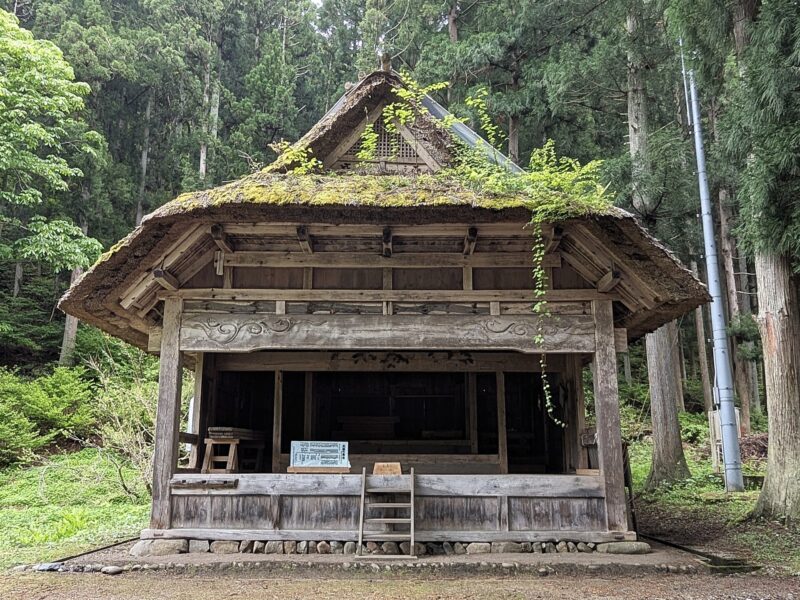
As a remnant of this tradition, rural stages such as the "Omomo Stage" and the "Yunohana Stage" still exist in Minamiaizu Town, and children's kabuki performances are also held at the "Aizu Tajima Gion Festival," which is counted as one of Japan's three major Gion Festivals

Although there were times when the feudal domains imposed restrictions on entertainment such as theater, this region"Nanzan Gokurairi,"making it less susceptible to domain restrictions and allowing for a relatively high degree of freedom, which is said to have contributed to the flourishing of local theater.
It is said that Kabuki actors from Edo often toured the Aizu-Wakamatsu area, and some of them even settled down in the area. It seems that people sometimes learned Kabuki from these actors
Chiba no Ie Hanakoma-za, a group that preserves the tradition of Hinoemata Kabuki
The origins of "Chiba no Ie Hanakoma-za," a group that preserves the tradition of Hinoemata Kabuki, date back to the Taisho era.
It is said that the first chairman, the late Aisaburo Hoshi, named the group "Chiba no Ie Hanakoma-za" by taking the characters "Chiba" and "Koma" from the Chiba Taira clan, who are said to be ancestors of Hinoemata Village , and from Mount Aizu- Komagatake, one of the mountains that symbolizes Hinoemata
The "Hinoemata Kabuki" performed by the "Chiba no Ie Hanakoma-za" began in this way and was designated as an important intangible cultural property of Hinoemata Village in 1969 , and as an important intangible folk cultural property of Fukushima Prefecture in 1999
Currently, the troupe is active under the leadership of its 11th chairman, Akihito Hoshi, with approximately 30 members
The 11 plays to be performed
The following 11 plays will be performed by the "Chiba no Ie Hanakoma-za" in their Hinoemata Kabuki repertoire
- Picture Book of Taikoki: The Honnoji Incident(Second Act)
- Picture Book of Taikoki: The Amagasaki Scene(Act 10)
- Ichinotani Futaba Gunki, Sumaura section(second section)
- Ichinotani Futaba Gunki - Kumagai Jinya Section(Third Act)
- The Tale of Hachiro at the Divine Spirit Yaguchi Crossing(Second Act)
- Yoshitsune Senbonzakura, Scene in front of the torii gate(Act 2)
- Tamamo-no-Mae Asahi's Sleeves, The Scene at Dōshunkan(Third Act)
- The Tale of the Three Generations of Kamakura: The Farewell of Miura(Seventh Act)
- The scene at Bunjikan in Adachigahara, Oshu(second act)
- The third act of the Adachigahara Festival in Oshu
- Monument to the Righteous People of Nanzan: The Scene of Kishiro's Farewell(Fourth Act)
Many of these plays are famous as Joruri or puppet plays, but the last one, "The Monument to the Righteous People of Nanzan: The Farewell of Kishiro and His Child," is a play written by the late Baba Kado, who was from Hinoemata Village. It dramatizes the "Nanzan Gokurairi Incident," which is said to have occurred in this area in 1720 (Kyoho 5) , and was completed and performed in 1933 (Showa 8).
Kabuki performance dedicated to the Atago Shrine Festival on May 12, 2026
On May 12, 2026, Hinoemata Village unfortunately began to rain around 3 PM. It turned into a torrential downpour, occasionally accompanied by thunder..
The forecast said it would stop raining around 6 PM, but mountain weather is unpredictable. It doesn't always go according to the forecast, but we decided to head there anyway

The entrance to the local shrine around 6 PM. People were slowly but steadily starting to gather

The approach to the shrine is lined with many banners. It's impossible not to feel your excitement rising
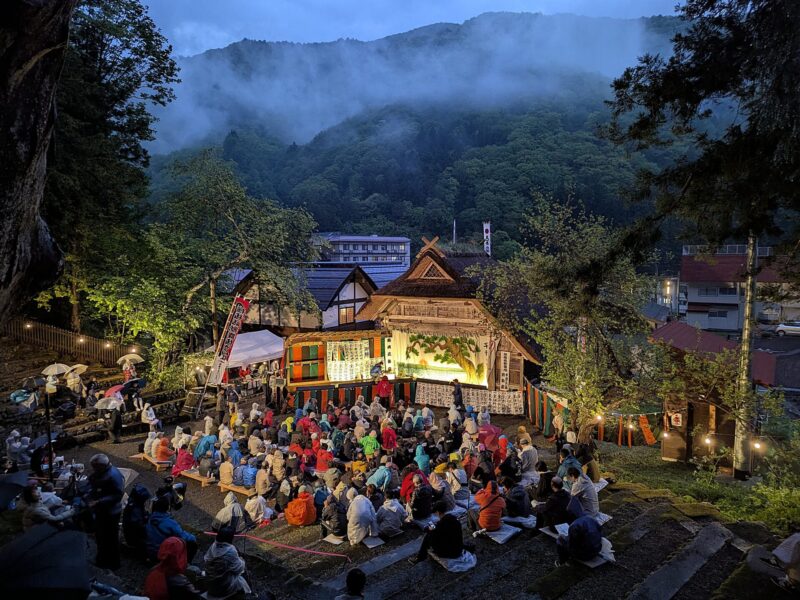
Hinoemata Kabuki performances are generally held even in rainy weather, so the audience was well-prepared. The venue was filled with people wearing raincoats. What was even more remarkable, thanks to the rain, was the sight of clouds hanging over the mountains in the background, creating a fantastical atmosphere
Kotobuki-shiki Sanbanso
Sanbasois considered a sacred ceremonial piece and is a ritual dance performed to pray for a bountiful harvest.

In Hinoemata Kabuki, the Kotobuki-shiki Sanbaso "Momi no Dan" is always performed before each show to purify the stage and pray for the success of the performance
Picture Book of Taikoki: The Amagasaki Scene (Act 10)
The performance for that day wasthe Ehon Taikoki, Amagasaki no Dan(Act 10).
This is a type of puppet play called a "historical piece," and it is composed of thirteen acts depicting the thirteen days from Akechi Mitsuhide's rebellion to his downfall, based on the "Ehon Taikoki" (Illustrated Chronicle of Toyotomi Hideyoshi)
The tenth act depicts events from the Honnō-ji Incident to the Battle of Yamazaki

The rain completely stopped as soon as the performance began, and I felt some kind of mysterious power at work..

Also, the names of the characters have been slightly altered; for example , Akechi Mitsuhide is now Takechi Mitsuhide , and Hashiba Hideyoshi is now Mashiba Hisayoshi

At the beginning, Jūjirō, the son of Takechi Mitsuhide, exchanges vows of marriage with his fiancée, Hatsukiku, and decides to go to battle


Jujiro sets out for his first battle

Pursued by Mitsuhide, Hisayoshi, disguised as a traveling monk, visits the home of Mitsuhide's mother, Satsuki, seeking lodging for the night

Mitsuhide returned to Amagasaki

Mitsuhide's mother, Satsuki, and his wife, Misao, condemn him for committing the atrocity of killing their lord

Jujiro returns after his first battle ends in defeat, but soon after, he dies
After this, Mitsuhide and Hisayoshi face each other, promise to settle their score at Mount Tennozan, and then part ways...and with that, the tenth act concludes
summary
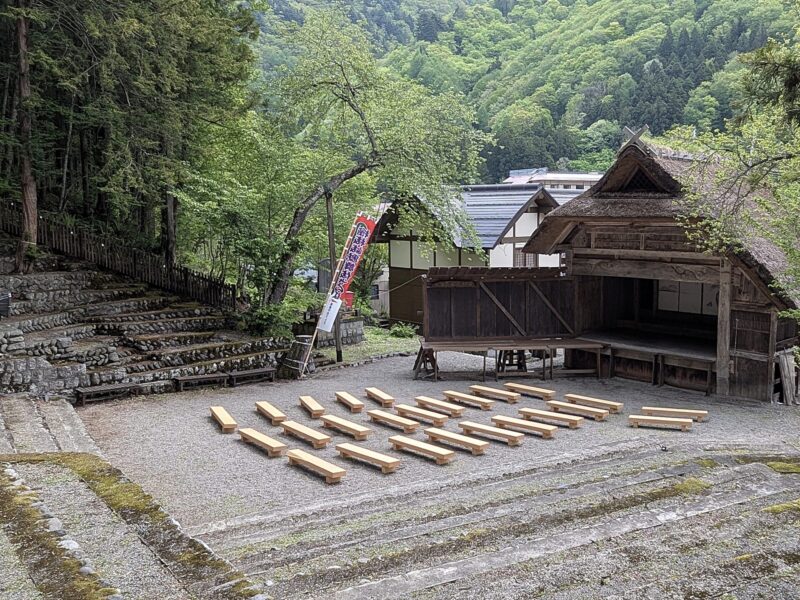
The term "village kabuki" might give the impression that it's inferior to full-fledged kabuki, but the performance far surpassed the realm of "country theater," and was truly wonderful, showcasing the techniques and dedication that have been passed down through a long tradition
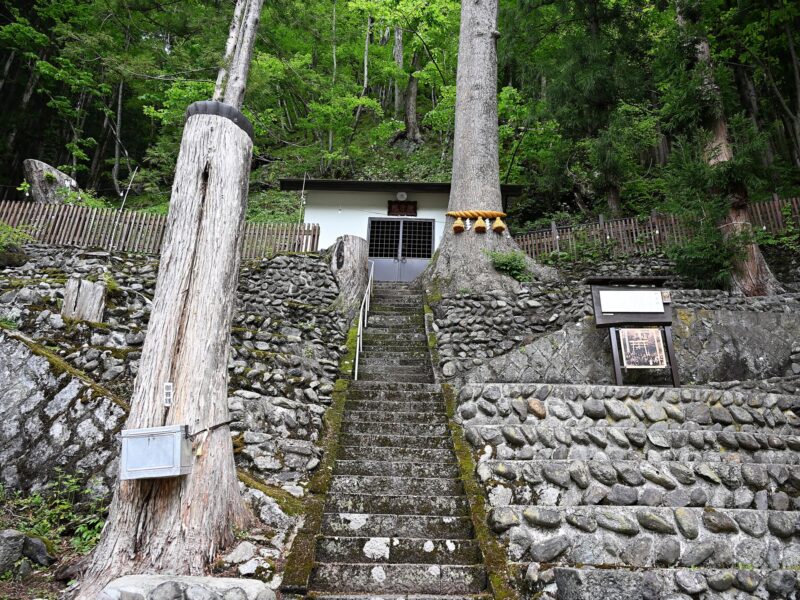
Furthermore, due to its nature as a "votive kabuki performance," the main hall of the guardian shrine is located directly in front of the stage, at the very top
Atago Shrine is located a little further away, but when you visit, remember that you are "seeing it together with the gods," and be sure to offer your prayers
Hinoemata Kabuki <Information>
- Facility name: Hinoemata Stage
- Address: 670 Iidaira, Hinoemata Village, Minamiaizu District, Fukushima Prefecture 967-0521
- Phone number: 0241-75-2432 (Oze Hinoemata Onsen Tourism Association)
- Dates: May 12th, August 18th, and the first Saturday of September
- Opening time: Show starts at 19:00 (Doors open at 18:00)
- Admission fee: Free *1000 yen on the first Saturday of September (free for those staying overnight in the village)
Google Map
reference
- Published by Chiba no Ie Hanakoma-za: Hinoemata Kabuki Pamphlet
- Oze Hinoemata Onsen Tourism Association:Oze Hinoemata Mountain Travel
- Related articles



Traveling around the Tohoku region, I enjoy drinking delicious sake and exploring the local history, traditions, and customs. I write articles based on my interests. I'm currently interested in folk performing arts, local toys, and folk beliefs
Please support NEFT's article creation!
NEFT gathers and publishes articles about the history, culture, and tourism information of various regions in Tohoku
If you enjoyed this article, we would be grateful if you would consider supporting our future interviews, article creation, and website management
*Clicking "Tip" will open the tip sending screen for the external service "codoc"
Other articles

What is Kesaranpasaran? Learn more about the mysterious object that brings good fortune...

[Series 6: The Battle of Zenkunen and the Battle of Gosannen] From the internal conflict of the Kiyohara clan...

[Tohoku] Strange festivals in Tohoku!? 6 festivals that will surprise people from other prefectures...

Enjoy the flavors of milk and sesame... Soba noodles eaten at a roadside station in southern Iwate Prefecture...

The express "Inawashiro" had three destinations, and even the staff were confused...

[Kesennuma City, Miyagi Prefecture] The entire mountain is covered in a bright red carpet. Japan's No. 1 tourist spot...

Lake Hachirogata, once the second largest lake in Japan [Autumn...

Includes railway-related works! By Yuji Koseki, a composer from Fukushima City...
The pride of the castles of the six Tohoku prefectures: "Constructed in peacetime, but with a sturdy structure!" Station-front...
A mysterious park lined with impressive stone Buddha statues | Morioka City's "Ra...

[Sendai City, Miyagi Prefecture] Sendai City History and Folklore Museum at Tsutsujigaoka Park...
