


Japan's northernmost private railway, the Tsugaru Railway: Discover the charms of the line, which go beyond just a railway [Aomori Prefecture]

Winters in the Tohoku region, especially along the Sea of Japan, are harsh
However, even in the midst of such harsh winters on the Tsugaru Peninsula in Aomori Prefecture, the Tsugaru Railway, Japan's northernmost private railway*, continues to operate vigorously today
This time, we will introduce the charm of the Tsugaru Railway and the fun that can only be had in winter
*Private railway: Here, this refers to a railway that is not JR, publicly operated, or a third-sector railway
Tsugaru Railway running through northern Tsugaru

operated by Tsugaru Railway Co., Ltd., is a 20.7km line connecting Tsugaru-Goshogawara Station in Goshogawara City, Aomori Prefecture, to Tsugaru-Nakazato Station in Nakadomari Town.
The starting point, Tsugaru-Goshogawara Station, is adjacent to JR Goshogawara Station, where you can transfer to the Gono Line
In addition to local trains, the"Resort Shirakami" sightseeing train, which runs on the Gonō Linealso stops at JR Goshogawara Station. On days when the Resort Shirakami is operating (mainly Saturdays and holidays), you can access Goshogawara Station from stations such as Akita and Aomori without changing trains.
The Tsugaru Railway opened in 1930
For over 90 years, it has played a vital role in the transportation network in northern Tsugaru
Sightseeing spots along the line
The Tsugaru Railway uses the fact that Osamu Dazai's birthplace is located along its line as a selling point, and the diesel railcars used on its trains are nicknamed "Hashire Melos-go" (Run, Melos! ) in honor of Osamu Dazai
Additionally, the "Tsugaru Railway Library" has been established at Tsugaru Goshogawara, Kanagi, and Tsugaru Nakazato stations (stations with station staff), as well as inside the trains
You can enjoy reading at stations and on trains, and books are freely available for borrowing and lending
Near Kanagi Station

Near Kanagi Station is the birthplace of the writer Osamu Dazai, which is open to the public as the Dazai Osamu Memorial Museum "Shayokan."
Dazai Osamu Memorial Museum "Shayokan" <Information>
- Facility name: Dazai Osamu Memorial Museum "Shayokan"
- Address: 412-1 Asahiyama, Kanagicho, Goshogawara City, Aomori Prefecture
- Inquiry number: 0173-53-2020
- Business hours: 9:00-17:00
- Closed on December 29th
- URL: Goshogawara City, Dazai Osamu Memorial Museum "Shayokan"
GOOGLE MAP
Tsugaru Shamisen Hall


The Tsugaru Shamisen Hall is also located near Kanagi Station
You can enjoy performances of the Tsugaru shamisen, a specialty of the Tsugaru region. However, please note that the museum is closed during the winter (December 1st to March 31st of the following year)
Tsugaru Shamisen Hall <Information>
- Facility name: Tsugaru Shamisen Hall
- Address: 189-3 Asahiyama, Kanagi-cho, Goshogawara City, Aomori Prefecture
- Inquiry number: 0173-54-1616
- Business hours: 9:00-16:00
- Closed: December 1st to March 31st of the following year
- URL Tsugaru Shamisen Hall
GOOGLE MAP
Tsugaru Iizume Station

Tsugaru Iizume Station opens the Tsugaru Iizume Station Museum & Train Travel Library on the third Sunday of every month
The museum displays valuable items related to the Tsugaru Railway
alsosee the personal collection and writing desk of the renowned railway writer, Naoki Tanemura (deceased).The Railway Travel Librarythe "Iizume Revitalization Association,"but it is quickly becoming a new attraction of the Tsugaru Railway.
Admission to the museum and the Train Travel Library is free, but donations are accepted in the fare box at the entrance (the same one used on trains operated by a single driver)
Tsugaru Railway Iizume Station Museum & Steam Train Travel Library <Information>
- Facility name: Tsugaru Railway Iizume Station Museum & Steam Train Travel Library
- Address: 22-3 Iizume Kiyono, Goshogawara City, Aomori Prefecture
- Inquiry number: 0173-34-2148 (Tsugaru Railway General Affairs Division)
- Opening hours: 10:00-14:00 on the third Sunday of every month
- URL Tsutsumi Railway Library & Train Travel Library
GOOGLE MAP
Near Ashino Park Station
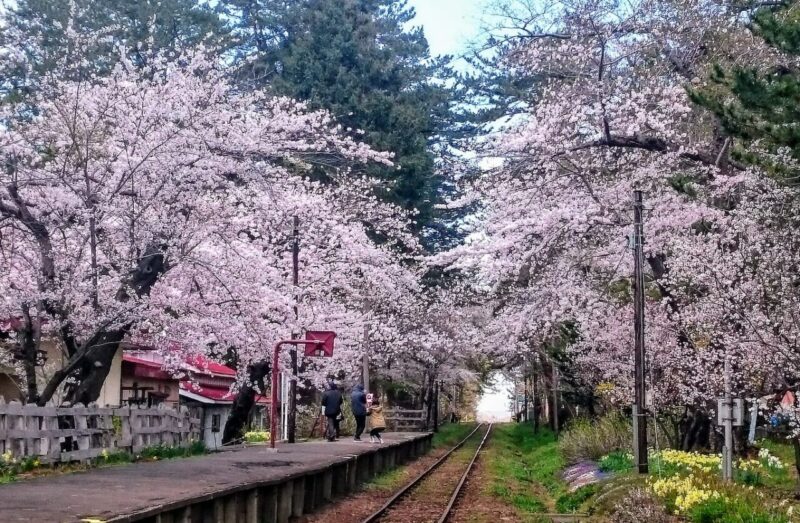
The Tsugaru Railway tracks run under the rows of cherry trees that line the area around the station, and when the cherry blossoms are in bloom, the train passes under the blossoms, which bloom like a tunnel
It's a sight well worth seeing
Ashino Park <Information>
- Facility name: Ashino Park
- Address: 84-170 Ashino, Kanagicho, Goshogawara City, Aomori Prefecture
- Inquiry number: 0173-35-2111
- URL Goshogawara City Official Tourism Website
GOOGLE MAP
Retro station and tickets

There are no automatic ticket gates at stations. Tickets are "hard tickets" made of hard paper, and station staff cut them open at the ticket gates
The Tsugaru Railway has scenery that has been completely lost from urban railways
When it comes to methods for safely operating trains, the long-standing methods of tablet blocking and staff blocking are still in use even in the Reiwa era (note: this does not mean that they are unsafe)
At Kanagi Station along the way, you can see tablet staff being exchanged, something that is now rare nationwide

Furthermore, Goshogawara Station and Kanagi Station are the only places in Japan where the old-fashioned"semaphore signals"are still in active use. At Tsugaru-Goshogawara Station, there are also vintage train cars that were used in the past, allowing visitors to reflect on a part of railway history.
This is also a recommended route for railway fans
A winter tradition: the stove train

What further accentuates the retro feel of the Tsugaru Railway is the "stove train," a winter tradition
It usually runs from the beginning of December to the end of March the following year, and as its name suggests, stoves are lit inside the cars. It has a history of running since the Tsugaru Railway opened in the winter of 1930, except for the wartime and immediate postwar periods
The passenger cars currently used on the stove train are the fourth generation
This old passenger car was manufactured around 1950 and is equipped with a potbelly stove. Looking out the window at the scenery of Tsugaru in the harsh winter, you can enjoy a nostalgic atmosphere

You can also grill dried squid on a wire rack above the stove, and there is even alcohol on board
Enjoying a drink with some dried squid as a snack is a pleasure that can only be enjoyed on a train journey
To ride the stove train, you need to purchase a 500 yen stove train ticket in addition to your regular ticket, but it's definitely worth trying (there are also regular cars attached to the train that do not require a stove train ticket)
Stove Train <Information>
- Train name: Stove Train
- Operation period: December 1st to March 31st of the following year
- Inquiries: 0173-34-2148
- Official URL:Tsugaru Railway Co., Ltd. Stove Train
Special trains don't just run in the winter
From July to August, the train operates as the "Wind Chime Train," with Tsugaru Kanayama-yaki wind chimes hanging from the inside of the train, and from September to October, the train operates as the "Suzumushi Train," with baskets filled with bell crickets placed on shelves inside the train
These trains operate as regular trains equipped with wind chimes and insect cages, so no special tickets need to be purchased
summary
This time we introduced the Tsugaru Railway, which runs through the hometown of literary giant Dazai Osamu
This winter, why not head to Tsugaru and enjoy a drink while admiring the winter scenery on a stove train, an experience that can only be had on the Tsugaru Railway?

I'm a member of the Neft editorial team. I love alcohol, music, and travel, and on weekdays I indulge in drinks after work, and on weekends I travel to nearby places whenever I have free time.
My goal is to one day travel abroad to explore connections with Tohoku for a Neft feature! I work hard every day towards that goal.
Other articles

[Iwate Prefecture] A World Heritage Site famous for the temples of three generations of the Oshu Fujiwara clan...

The "Nambu Magariya" was unique to the Nanbu clan, which was well aware of the importance of horses...

The track of the express "Oga" that connected Ueno and Akita and had strong demand...

New spots have opened in Miyagi Prefecture! Three new spots have opened in the prefec...

[Aomori and Iwate Edition] Valuable ancient martial arts from the six Tohoku prefectures! Still passed down today...

Neither an express train nor an electric railway!? Bandai Express Electric Railway [Fukushima Prefecture]

Two years after the heavy rains of August 2022... What will happen to the Tsugaru Line? [Aomori Prefecture]

[Aomori Prefecture] A station immersed in the world of artist GOMA [ART S...

Have you heard of Apios? Introducing the superfood grown in Aomori...

Rairaikyo Gorge is a wonderful spot for people of all ages and genders!.

Aomori's blizzards are amazing! Experience the horror of snow in Tsugaru on an experienc...
