This site is an online media that delivers all sorts of trivia about the six Tohoku prefectures, from sightseeing and gourmet spots to local customs, history, and more
[Paleolithic Sites in Aomori Prefecture: Part 2] At Shiriyazaki, a treasure trove of animal fossils, the alkalinity of the limestone protected the fossils!
[Paleolithic Sites in Aomori Prefecture: Part 2] At Shiriyazaki, a treasure trove of animal fossils, the alkalinity of the limestone protected the fossils!
Aomori Prefecture has only a little over 30 Paleolithic sites, which is extremely few compared to other municipalities. The reasons for this are explained in detail in [Paleolithic Sites in Aomori Prefecture: Part 2]
Among these locations, there is one that is currently attracting worldwide attention as a treasure trove of Paleolithic sites and animal fossils. That placeShiriyazaki.
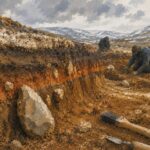
The limestone layers of Shiriyazaki protected the bones of the animals
While Shiriyazaki is known as a scenic cape for its tourist attractions such as the Shiriyazaki Lighthouse and the Kandachime horses , geologically it is one of Japan's leading limestone producing areas , boasting a large limestone layer . You can see just how significant this is by looking at aerial photographs from the Ministry of Land, Infrastructure, Transport and Tourism.
This limestone layer is part of a geological formation that is approximately 150 million years old, and is characterized by numerous deep cracks in the portion exposed on the surface
The plains south of Honshu, including the northernmost areas such as the Shimokita and Tsugaru Peninsulas, did not freeze over due to the influence of ocean currents (Oyashio/Tsushima Current) that brought warm air from the south to the coast. Furthermore, despite the Sea of Japan being mostly frozen over, there was little snowfall
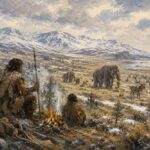
Therefore, the Shimokita Peninsula was home to a variety of animals, including large mammals such as Naumann's elephants, brown bears, bison, Yabe's giant deer, and lions, as well as wolves, foxes, raccoons, and marine mammals such as fur seals
It is believed that some animals migrated from Hokkaido
The alkalinity of limestone protects bones from dissolving in acidic soil, promoting fossilization
At Cape Shiriya, layers of limestone were exposed near the surface due to crustal movements, and many animals fell into the grooves formed in the limestone and lost their lives. Over long periods of time, these animals became fossils, which are now being discovered
Limestone is alkaline, and the water it dissolves in neutralizes the acidic volcanic ejecta that has accumulated on top of it
Bones dissolve in acidic environments, but they were protected from dissolution by a neutral liquid. Furthermore, lime powder penetrated the tiny pores in the bones, fossilizing them
Animal fossils have long been found on the limestone cliffs exposed on the coast of Shiriyazaki, and it seems that in the past, local children would casually take them home without realizing they were fossils
It began to attract academic attention in 1958 when the Nittetsu Mining Company's Shiriya Mine started operations, and many bone and tooth fossils have been found in the limestone being mined in the open pit
The mining sites are located near the coast on the northern side (Shiriya district) and the southern side (Shitsukari district) of the Shimokita Peninsula. With the cooperation of the mining company, it is now possible to enter the tunnels and conduct further investigations
Large animals that went extinct because they couldn't keep up with climate change
An imagined model of a Naumann's elephant on display at the Nojiri Lake Naumann Elephant Museum in Shinano-machi, Nagano Prefecture
The fossils of large animals discovered at Cape Shiriya, such as Naumann's elephants, lions, giant deer, and brown bears, are all animals that are now extinct or no longer survive south of Honshu
Conversely, most land animals of medium size or smaller, including humans, and marine animals still exist. The reason for this is said to be the difference between being able to adapt to the rapidly warming global environment since the Ice Age and not being able to
The Shiri-Ro-Abe Cave is expected to provide insights into the relationship between humans and animals during the Paleolithic period
The Shikkari Abe Cave (Abe Site)is located on a river terrace about 33 meters above sea level, close to the Shiriyazaki Lighthouse at the northeastern tip of the Shimokita Peninsula. Numerous animal fossils of various sizes have been unearthed there, along with a variety of stone tools.
Since excavations began in 2002, the site has been an important archaeological site for understanding the relationship between humans and animals, and research continues to this day (as of 2025)
Knife-shaped stone tools, believed to be from the Paleolithic period, were unearthed from the cave, indicating that people lived there
Furthermore, animal fossils of various sizes were discovered in the same location where the stone tools were unearthed. Detailed examination revealed that the animal fossils were approximately 20,000 years old, suggesting that humans hunted animals and processed them in some way at this site
Paleolithic humans ate small animals such as rabbits
It is believed that during the Paleolithic period, about 20,000 years ago, humans did not live in one place but rather lived a hunting lifestyle, moving around in small groups and chasing animals
It was discovered that the caves were used as bases for short periods, and that they also used small animals such as rabbits as food
The world hopes that Paleolithic human fossils will be unearthed
The animal fossils unearthed from the "Shirirou Abe Cave" include large animals such as brown bears, giant deer, and serows, with rabbits being the most numerous. Others include rodents, squirrels, raccoons, and other small animals
However, fossils of Naumann's elephants, Yabe's giant deer, and cave lions have also been found in the surrounding geological layers. Naumann's elephants and cave lions have become completely extinct due to global warming, but those that lived in Japan were likely in their final stages before their extinction
It is believed that this species survived in Japan for thousands of years, even though it is extinct in other regions. However, while Paleolithic people likely hunted elephants, bears, and lions, they were constantly being targeted by such ferocious animals
Fossilized teeth believed to belong to a Jomon period human were unearthed from inside the cave. However, no Paleolithic fossils have been found. While it has been confirmed that the Shirikura Abe Cave was used during the Jomon period, expectations are now high for the discovery of Paleolithic human fossils
remarks
The "Shirirou Abe Cave" is closed to the public as it is an archaeological site currently under excavation
My love of travel led me to work for a travel magazine some time ago, and now I work as a travel writer for an online publication. I have visited all 47 prefectures in Japan, focusing on the Tohoku region, and I enjoy soaking in hot springs and experiencing traditional Japanese culture, including old townscapes, lifestyles, and performing arts and crafts