This site is an online media that delivers all sorts of trivia about the six Tohoku prefectures, from sightseeing and gourmet spots to local customs, history, and more
The new HB-E220 series hybrid diesel railcar has begun operation on the JR Kamaishi Line in Iwate Prefecture . This article will introduce what kind of train it is and how the Kamaishi Line will change with the JR timetable revision in March 2026.
What is the JR Kamaishi Line?
Kawasemi556 – Map: Copyright used by the uploader: Ministry of Land, Infrastructure, Transport and Tourism, National Land Numerical Information (Administrative Boundaries (N03), Railways (N02), Lakes and Marshes (W09)), CC BY-SA 4.0 , https://commons.wikimedia.org/w/index.php?curid=127788816
The Kamaishi Lineis a JR East railway line connecting Hanamaki Station in Hanamaki City, Iwate Prefecture, and Kamaishi Station in Kamaishi City, covering a distance of 90.2 km. It plays a vital role in connecting the inland central part of Iwate Prefecture with the Pacific coast. While it once carried freight trains related to Kamaishi's steelworks and mines, it is now a locally-oriented line that only carries passengers.
Because the children's author Kenji Miyazawa was born in what is now Hanamaki City, the Kamaishi Line is nicknamed the "Galaxy Dream Line," after one of his works, "Night on the Galactic Railroad." Since Esperanto, an artificial language invented in the 19th century, frequently appears in Miyazawa's works, all 24 stations on the Kamaishi Line have been given nicknames in Esperanto
At the starting point, Hanamaki Station, you can transfer to the Tohoku Main Line, which connects Tokyo Station in Tokyo and Morioka Station in Iwate Prefecture. At Shin-Hanamaki Station, you can transfer to the Tohoku Shinkansen, which connects Tokyo Station and Shin-Aomori Station in Aomori Prefecture. At the final stop, Kamaishi Station, you can transfer to the Sanriku Railway Rias Line, which runs from Sakari Station in Ofunato City, Iwate Prefecture, through Kamaishi Station and Miyako Station in Miyako City, to Kuji Station in Kuji City.
Aside from the three stations mentioned above and Tono Station along the way, the other stations are unmanned and have no station staff present throughout the day, exhibiting the typical characteristics of a local line
Tono Station building
Trains on the Kamaishi Line
The Kamaishi Line operates two main types of trains: local trains and rapid trains (information as of the timetable revision on March 14, 2026).
local train
There are six local trains per day bound for Kamaishi and seven local trains departing from Kamaishi, all of which stop at every station between Hanamaki Station and Kamaishi Station. Of these trains, two southbound trains at night, one northbound train in the morning, and one northbound train at night enter the Tohoku Main Line at Hanamaki Station and operate between Morioka Station and Kamaishi Station. Additionally, there is one train from Tono to Kamaishi in the morning, one from Tono to Morioka, and one train from Hanamaki to Tono late at night.
fast train
On the Kamaishi Line, there are express trains with fewer stops. The " Hamayuri " is an express train that runs daily . Three trains run in each direction per day, and the route is between Morioka Station and Kamaishi Station. Major stops along the way include Yahaba, Hanamaki, Shin-Hanamaki, Miyamori, and Tono.
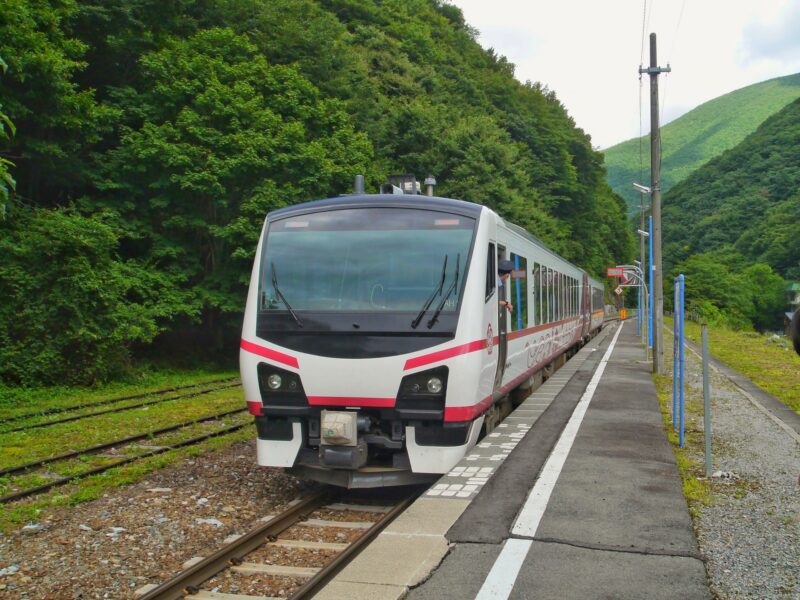
Additionally, the "Hinabi Kamaishi," which uses the "Hinabi" (陽旅) train, a "fun-to-ride train" (sightseeing train), sometimes operates one round trip per day during peak seasons. Like the "Hamayuri," this train also runs between Morioka Station and Kamaishi Station
Hinabi Kamaishi
Although it runs less frequently than the "Hinabi Kamaishi," the "Pokemon Train Kamaishi," which uses the "POKÉMON with YOU Train," also occasionally operates between Hanamaki Station and Kamaishi Station
In addition, the "TRAIN SUITE Shiki-shima," a cruise train, will operate between Hanamaki Station and Tono Station
Past trains
While the current Kamaishi Line has a relatively simple lineup of trains, in the past, a more diverse range of trains operated on the line. One example is the "SL Ginga," a steam locomotive train that ran until June 2023. As the name suggests, it was a train themed after "Night on the Galactic Railroad."
Then there's the express train "Rikuchu," which ran until 2002. This train was the predecessor to the rapid train "Hamayuri," and although its final route was mainly between Morioka Station and Kamaishi Station, the same as the current "Hamayuri," it was known for having an even stranger route in the past. For example, there was a train that ran from Kamaishi Station onto the Yamada Line (now the Rias Line) and went all the way to Miyako Station, meaning it ran on a route of Morioka Station - Hanamaki Station - Kamaishi Station - Miyako Station.
Around the year 1970,
Sendai Station ~ (Tohoku Main Line) ~ Hanamaki Station ~ (Kamaishi Line) ~ Kamaishi Station ~ (Yamada Line, now Rias Line) ~ Miyako Station ~ (Yamada Line) ~ Morioka Station ~ (Tohoku Main Line, now Iwate Galaxy Railway Line) ~ Koma Station ~ (Hanawa Line) ~ Odate Station ~ (Ou Main Line) ~ Akita Station
There was a time when the train took an extremely roundabout route between Sendai Station, Morioka Station, and Akita Station, and it's still a topic of conversation among railway enthusiasts today
In addition, there were two "circular trains" called "Sotoyama" and "Goyo." These trains were unique in that they made a loop around Iwate Prefecture via the Yamada Line, Kamaishi Line, and Tohoku Main Line (between Hanamaki and Morioka), with both their starting and ending stations being Morioka Station. The route of "Sotoyama" was clockwise, while that of "Goyo" was counterclockwise.
What is the new HB-E220 series hybrid diesel railcar?
HB-E220 series hybrid diesel railcars being transported in preparation for the start of operations on the Kamaishi Line
For many years, the KiHa 100 series and KiHa 110 series diesel railcars have been used for local trains and the "Hamayuri" rapid train on the Kamaishi Line. A diesel railcar is a type of vehicle that runs on diesel fuel powered by a diesel engine, and is different from an electric train (although most diesel railcars that have appeared in recent years use electricity generated by a diesel generator to power the motor, the KiHa 100 and 110 series run on an engine).
From January 19, 2026, some trains on the Kamaishi Line switched to operation with the new HB-E220 series trains. With the timetable revision on March 14, all local trains and the "Hamayuri" limited express trains were changed to be operated by the HB-E220 series, and the KiHa 100 series and KiHa 110 series trains were withdrawn from daily service
The biggest difference between the HB-E220 series and conventional diesel railcarsa hybrid vehicle. It runs by using electricity from both an onboard diesel generator and a battery to power its motors. By using a battery in conjunction with the diesel generator, it is characterized by reduced diesel fuel consumption and noise generation compared to conventional diesel railcars.
The train is equipped with modern amenities such as security cameras, a free space for wheelchairs and strollers, and a Western-style toilet that is accessible to electric wheelchairs
On the other hand, the KiHa 100 and 110 series had semi-cross seats, where some seats faced each other in the front-to-back direction. Some cars even had seats comparable to those on express trains. However, the HB-E220 series has long seats where all seats face the side wall, a common feature on commuter trains in the Tokyo metropolitan area. Some people may feel this is a downgrade in service. In addition, the number of doors for boarding and alighting has been increased, resulting in a reduction of about 40% in the total number of seats.
What are the retired KiHa 100 series and KiHa 110 series diesel railcars?
The KiHa 100 and 110 series trains, which ceased operation on the Kamaishi Line with the March 2026 timetable revision, both began operating as commercial trains in 1990. There are no major differences in appearance between the two; the biggest difference is the overall length of the train, with the KiHa 100 series being 16.5m and the KiHa 110 series being 20.0m. Since their introduction, they have been deployed on numerous non-electrified lines of JR East (lines that do not have the facilities for electric trains to run on), and have been operating on the Kamaishi Line since 1991. However, more than 35 years have passed since their introduction, so it is time to replace them with new trains.
With the HB-E220 series beginning operation on the Hachiko Line in the Tokyo metropolitan area in December 2025, and service on the Kamaishi Line starting in January 2026, it is expected that the retirement and scrapping of the older KiHa 100 and 110 series trains will begin in earnest from now on
What has changed on the Kamaishi Line with the revised timetable?
With the timetable revision on March 14, 2026, all regular trains on the Kamaishi Line (trains that run daily) were changed to be operated by HB-E220 series trains, but there are also several other changes
The "Hamayuri" rapid train from the era when it was operated using the KiHa 110 series
First, before the timetable revision, the "Hamayuri" trains consisted of three cars, with the third car being reserved seating. However, all trains are now two cars long, and reserved seating has been eliminated. It is believed that the HB-E220 series, which only has long seats, was introduced, making it no longer worthwhile to charge a reserved seat fee, thus eliminating the reserved seating. Also, before the timetable revision, the "Hamayuri" trains were numbered, such as No. 1 and No. 6. However, with the elimination of reserved seating, there is no longer a need to distinguish between train numbers, so the numbers have disappeared, and the trains are now simply called "Hamayuri."
Other trains besides the "Hamayuri" have also had their number of cars reduced, and all trains are now operating with one or two cars. There are no longer any trains operating with three cars. Since the HB-E220 series already has fewer seats, this will likely mean fewer opportunities to find a seat compared to before
Additionally, the operating sections of some trains have been shortened by discontinuing service between Tono Station and Kamaishi Station. The one morning train from Tono to Morioka and the one late-night train from Hanamaki to Tono, mentioned earlier, are trains that resulted from this shortened operating section
The number of passengers on the Kamaishi Line has been generally declining year after year, and the operating deficit for fiscal year 2024 is projected to be approximately 2.7 billion yen. It is therefore understandable that the number of trains will be reduced and the operating section shortened
Although I've written some rather pessimistic things, the Kamaishi Line has changed dramatically since the timetable revision. You'll surely be able to experience a new "Galaxy Express" journey on the new trains






![What day is it today? Tohoku Edition [1005]](https://jp.neft.asia/wp-content/uploads/2026/02/1005-150x150.png.webp "[What day is it today? | Tohoku Edition] What day is October 5th?")

![What day is it today? Tohoku Edition [0525]](https://jp.neft.asia/wp-content/uploads/2026/02/0525-150x150.png.webp "[What day is it today? | Tohoku Edition] What day is May 25th?")
![What day is it today? Tohoku Edition [0216]](https://jp.neft.asia/wp-content/uploads/2026/01/0216-150x150.png.webp "[What day is it today? | Tohoku Edition] What day is February 16th?")


