This site is an online media that delivers all sorts of trivia about the six Tohoku prefectures, from sightseeing and gourmet spots to local customs, history, and more
The end of the Conquest of the Emishi from 789 to 811
After the Ikomaro Rebellion, the Imperial Court further increased military pressure on the Emishi, and frequently resorted to large-scale military force
The current Taga Castle ruins and surrounding area (Tagajo City, Miyagi Prefecture)
the "Conquest of the Barbarians in the 8th year of Enryaku (789),"and records show that the previous year, the imperial court had ordered the assembly of over 52,800 soldiers at Taga Castle, the preparation of provisions and other supplies, and other massive military preparations.
Aterui's name first appears in historical records at the Battle of Sufukue during the Seii-sei (Subjugation of the Barbarians) in the eighth year of the Enryaku era, and although it is not certain whether he directly commanded the battle, it is highly likely that he was involved
In this battle, the General of the Eastern Expedition, Kinokosami, led a total of about 4,000 soldiers, but they were repelled by the Emishi army, which consisted of only about 1,500 men, using tactics of diversion, ambush, and pincer attack
Despite the complete and utter defeat, the vice-commanders who had planned the Imperial army's strategy did not take command themselves, and although many Emishi villages were burned down, Kosami unilaterally decided to halt military operations and disband the army. This angered Emperor Kanmu, who was severely reprimanded
As such, the morale of the Imperial Army was not necessarily high, and we can see that they wanted to avoid fighting the powerful Emishi army
Subsequently, in the campaign against the barbarians in 794,Sakanoue no Tamuramaro,, was appointed as the deputy general of the imperial army, and it is believed that he played a central role in the actions that followed.
Two years later, in the 15th year of the Enryaku era, Tamuramaro was appointed Governor of Mutsu and Inspector General of Mutsu and Dewa, concurrently serving as Chinju Shogun. In the 20th year of the Enryaku era (801), he was awarded the ceremonial sword by Emperor Kanmu as Seii Taishogun, and thus rose to a position that could be described as the supreme commander in charge of managing the Tohoku region in both name and reality
Isawa Castle Ruins (Oshu City, Iwate Prefecture)
, the following year"Izawa Castle", where Aterui and More surrendered.
The construction of castle walls continued after that, but the people were exhausted from the long fighting and other hardships, so in the 24th year of the Enryaku era (805), Emperor Kanmu had Fujiwara no Otsugu and Sugano no Mamichi hold a debate on political policy called the "Tokusei Soron."
Otsugu recommended the construction of a capital and the cessation of military action against the Emishi, and Emperor Kanmu adopted this proposal, amending his own opinion, and the Imperial Court underwent a major policy shift
Military operations continued for a while, but in 812, it was decided to gradually reduce military forces in the Mutsu area, marking the tentative end of the 38-year war in the Tohoku region
Emishi Chief Aterui and General Sakanoue no Tamuramaro
Who exactly were Aterui, who is believed to have led the Emishi army for over 13 years, and Sakanoue no Tamuramaro , to whom More surrendered ?
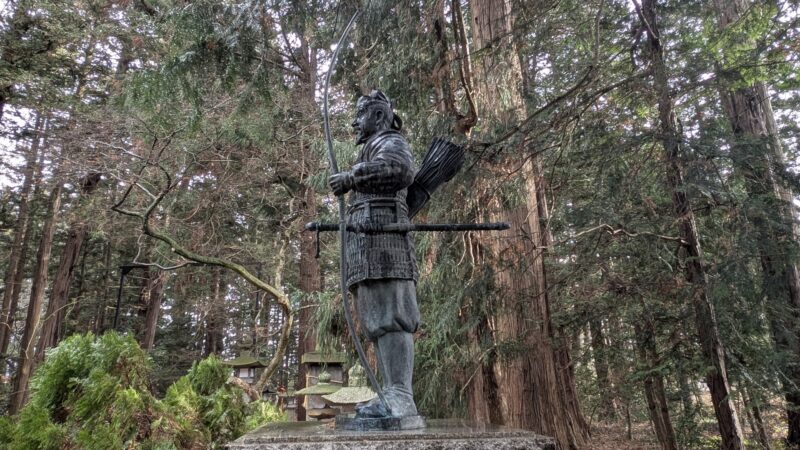
Statue of Tamuramaro at Sumiyoshi Shrine in Azumino, Nagano Prefecture
Although Tamuramaro seems to be a legend that has taken on a life of its own in later generations, the Sakanoue clan from which he descended is believed to be the same clan as the Yamato no Ayauji, a clan of immigrants who claimed to be descendants of Emperor Ling of the Later Han Dynasty
The family was renowned for their mastery of martial arts, including archery and horsemanship, and"haseyumi,". His father, Karita Maro, served as the commander-in-chief of Mutsu Province for a short period of about six months, and it has been suggested that Tamuramaro may have also lived in Tagajo during his boyhood.
If this is the case, it is likely that the personnel decisions for managing the Tohoku region in later years took into account not only Tamuramaro's bravery, but also his knowledge of Emishi culture and language
Were the Emishi army masters of guerrilla warfare?
As we have seen, the Emishi army plagued the Imperial army, and a long-term battle ensued, with large numbers of troops deployed
So why was the Emishi army so strong?
One obvious reason is that they had a geographical advantage. Local forces who were familiar with the terrain found it easier to devise strategies, and even with a small number of troops, it was easier to employ tactics such as diversions and pincer attacks
This was a guerrilla-like fighting style, and there are countless examples throughout history of people struggling with this tactic
The martial arts and weapons that made the Emishi so formidable
Another point to consider is that the Emishi were skilled in "mounted archery ."
Yabusame, a representative Shinto ritual of horseback archery that remains to this day
Just like the "chisha" (fast shooting) that Tamuramaro's clan was familiar with, it is easy to imagine that shooting from horseback, which requires high speed maneuvering, was a threat
To achieve these skills, it is first necessary to have the necessary number of horses and the necessary system for raising them, and to be able to train as a group to acquire the skills
The Emishi army, based in the Tohoku region, known for producing fine horses, likely had a base of such equipment through their daily hunting activities. Evidence of the Imperial army increasing its cavalry forces in addition to its infantry is also one piece of evidence that points to this history of combat
Furthermore, the Emishi's use of a unique type of sword called the "warabite-to" (bracken-shaped sword) likely contributed to its effectiveness in close-quarters combat
It is known that swords developed in the Tohoku region, which was blessed with iron raw materials, and that as horse-mounted combat intensified, they gradually evolved into curved swords
A Warabite sword has been preserved in its entirety in the Shosoin Repository in Nara, and the existence of this unique sword was likely known to the Imperial Court at the time
As an aside, it is believed that the Warabite sword had a great influence on the swords used by the Imperial Army, and that it eventually led to the birth of the Japanese sword
Executions in Kawachi Province and the Mystery of the "Belief Tomb"
Finally, we will introduce the records surrounding Aterui and More's final moments and an episode related to the legend that has been revived in modern times
The Nihon Shoki, in its entry for August 21st year of the Enryaku era, succinctly describes their demise, saying that the two men were executed at Mt.□ in Kawachi Province
This is preceded by a plea for mercy from Tamuramaro, which suggests that he strongly expressed his opinion that he was a necessary person to govern the Emishi lands
However, the Imperial Court feared that he would rebel again like in the previous Ikomaro Rebellion, and decided to execute him by beheading
It is no exaggeration to say that this was a traumatic experience for the Imperial Court, and it can be said that there was a reasonable basis for the harsh treatment
Kawachi Province, where Aterui and More were executed, refers to the area around eastern Osaka Prefecture today, but the exact location is unknown. The fact that it is referred to as "Yamayama" indicates that it is written in various ways depending on the book, making it unclear which is the correct place name
However, in Makino Park in Hirakata City, Osaka Prefecture, there is a burial mound called "Kubizuka" (Head Mound), and it is believed to be Aterui's tomb. Currently, a monument inscribed with "Den Aterui More no Tsuka" (Mound of Aterui's Tomb) has been erected there
Interestingly, the legend that this is Aterui's grave is not ancient, but is said to have begun around 1979 when a local resident made an inquiry to the Hirakata City History Compilation Office
Apparently, the person had a dream in which he saw an old man with white hair and a white beard leaning out of the ground and pleading for something, so he asked if there had been any incident in the area
Although the editorial office did not take the story seriously, they did provide information that there was a record of the Emishi chief Aterui being beheaded in Kawachi
The media heard about the incident and reported it extensively, and it is said that a rumor was formed that this was the place where Aterui met his end
Regardless of its historical accuracy, this can be seen as a movement that was sparked by many people across the ages sympathizing with an ancient tragedy
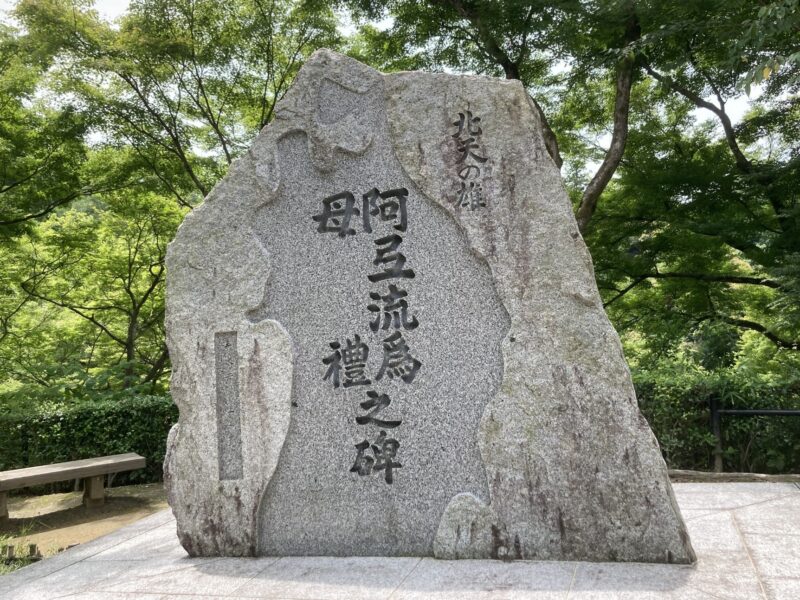
Monument to Aterui and Mother at Kiyomizu-dera Temple in Kyoto
Similarly, at Kiyomizu-dera Temple in Kyoto, which is said to have been founded by Tamuramaro, a stone monument bearing the inscription "The monument to Aterui, the hero of the northern sky, and Mother" was erected to commemorate the 1200th anniversary of the capital's relocation to Heian
In any case, this is an example of how feelings of sorrow for ancient heroes have been revived in modern times
- Author of the original text for Seibido Publishing's "Illustrated Dictionary of the Heian Period: A Visual Guide to Enjoying Life. " - Honorable Mention for "The Land of Star Readings" at the 3rd Misato Western Treasury Literary Awards. - Honorable Mention for "Io-san's Bride's Meals" at Everystar's "Delicious Time" competition. - "Swordsman's Communications" at the 9th Historical and Period Novel Grand Prizes, "Exhilarating! Entertainment Swordsman Award" (book publication project in progress). - 5th Dan in Iaido, 4th Dan in Jodo.


![The Ancient Emishi Hero Aterui and the 38-Year Tohoku War [Part 2] | Did Aterui End His Life in Present-Day Osaka Prefecture?](https://jp.neft.asia/wp-content/uploads/2026/02/eeb260cc73c18309bc819a9df185f46e-1200x800.jpg.webp)






![The Ancient Emishi Hero Aterui and the 38-Year Tohoku War [Part 2] | Major Battles in Ancient Tohoku and Their History](https://jp.neft.asia/wp-content/uploads/2026/02/8f4979ebfa4c5bcbf24ba36c0826a52a-150x150.jpg.webp "The Ancient Emishi Hero Aterui and the 38-Year Tohoku War [Part 2] | Major Battles in Ancient Tohoku and Their History")
![Daito-ryu Aikijujutsu [Part 2]](https://jp.neft.asia/wp-content/uploads/2026/01/aiki_tkd03-150x150.jpg.webp "Did Aikido originate in Aizu? Daito-ryu Aikijujutsu and Takeda Sokaku [Part 2] | Was Sokaku the founder of Aikijujutsu? His lineage and ties to Kii")
![Daito-ryu Aikijujutsu [Part 2]](https://jp.neft.asia/wp-content/uploads/2026/01/aiki_tkd02-150x150.jpg.webp "Did Aikido originate in Aizu? Daito-ryu Aikijujutsu and Takeda Sokaku [Part 2] | The secret Aizu martial art "Oshikinai" and the mystery of Sokaku's youth")
![Daito-ryu Aikijujutsu [Part 1]](https://jp.neft.asia/wp-content/uploads/2026/01/aiki_tkd01-150x150.jpg.webp "Did Aikido originate in Aizu? Daito-ryu Aikijujutsu and Takeda Sokaku [Part 1] | The difference between "Aikido" and "Aikijujutsu"")


