This site is an online media that delivers all sorts of trivia about the six Tohoku prefectures, from sightseeing and gourmet spots to local customs, history, and more
Mount Haguro is revered as a sacred mountain, with three shrines located there: Dewa Shrine (Ideha Jinja/Dewa Sanzan Shrine) on Mount Haguro , GassanShrine on Mount Gassan, and Yudono-san Shrine on Mount Yudono
All three mountains were founded in the late Kofun period by a cousin of Prince Shotoku
It is said that Prince Hachiko was the one who opened up the Dewa Sanzan (Three Mountains of Dewa)
Prince Hachiko was the son of the 32nd Emperor Sushun (553?–592?), and when his father was assassinated by Soga no Umako (dates unknown–626), he himself was in danger
At that time, with the help of his cousin, Prince Shōtoku, he escaped the capital and traveled north along the Sea of Japan, finally arriving in Yaotomeura (Yura, Tsuruoka City, Yamagata Prefecture) in Shōnai in the spring of 593
Prince Hachiko, who took a liking to Yaotomeura, was helped by the local people and, ultimately guided by the three-legged Yatagarasu (a mythical crow), entered Mount Haguro to train and founded Hagurosan Jakkoji Temple (present-day Dewa Shrine/Dewa Sanzan Shrine)
Afterward, he climbed Mount Gassan , which still had snow on it, and built Boreizan Gassanji Temple (the present-day Gassan Shrine Main Shrine) on its summit. On his way down from Mount Gassan, he came across a mountain with hot springs, and opened Mount Yudono (the present-day Yudono Shrine Main Shrine) , thus establishing the "Dewa Sanzan" (Three Mountains of Dewa)
Illustrated Guide to Famous Places in the Sixty-Four Provinces: Dewa Province, "Mogami River, View of Mount Gassan in the Distance" by Hiroshige, Collection: Art Institute of Chicago
The Three Mountains Pilgrimage: A journey of rebirth, encompassing this life and the afterlife
From the time of Prince Hachiko to the Edo period, the Dewa Sanzan mountains served as a training ground for Shugendo (mountain asceticism), and many Shugendo practitioners (mountain ascetics) entered the mountains to undergo rigorous training.
What is Shugendo ?
It is believed to have been founded by En no Ozunu during the Asuka period, and is a uniquely Japanese form of worship that blends elements of Shinto-derived mountain worship with elements of Buddhism (Esoteric Buddhism) and Taoism (Nine-Character Incantation)
asceticpractices at the Dewa Sanzan, known as Haguro Shugendo,
Mount Haguro is a mountain where people pray for happiness in this world. [This world] Principal deity: Kannon Bodhisattva
Mount Gassan is a mountain where people pray for peace and salvation after death. [Past] Principal deity: Amida Buddha
Yudono-san is a mountain where people pray for rebirth [Future] Principal deity:Dainichi Nyorai(Vairocana Buddha)
The pilgrimage to the three mountains is considered a way to achieve this goal, and this"journey of rebirth"became popular among the townspeople of Edo, leading to a great boom in pilgrimages to the Dewa Sanzan mountains.
The Dewa Sanzan mountains, which became only shrines after the separation of Shinto and Buddhism during the Meiji era
With the arrival of the Meiji era, the Meiji government implemented a policy to establish Shinto as the state religion and prohibited the coexistence of shrines (Shinto) and temples (Buddhism)
"separation of Shinto and Buddhism,"and it involved removing Buddhist elements from Shinto shrines.
The Dewa Sanzan mountains were also affected, and only the Dewa Shrine remains at Hagurosan, the Gassan Shrine at Gassan, and the Yudonosan Shrine at Yudonosan
Until the Edo period, many Buddhist statues, including the principal image, were enshrined there, but after the Meiji era, only the shrine remained, so the Buddhist statues, which were symbols of the temple, were discarded, and the deities enshrined in each shrine were replaced
Dewa Shrine = Ideha-no-kami and Ukanomitama-no-mikoto
Opening hours: 10:00 - 16:30 (Last entry at 16:00)
Closed: Thursdays (except July and August) andwinter holidays from late November to late April.
Google Map
Currently, the three shrines are collectively referred to as "Dewa Sanzan Shrine."
Of the scattered Buddhist statues, 243 were collected by the late Taitaro Sato using his personal funds. Some of them are on display at the Dewa Sanzan Historical Museum located within the grounds of Dewa Shrine
Hagurosan, the headquarters of the three sacred mountains where people pray for happiness in this world
Mount Hagurois the gateway to the Dewa Sanzan (Three Mountains of Dewa), a journey of rebirth, anda mountain where people pray for happiness in this life.
Among the three mountains, it is an extremely low, hill-like mountain, and the"Dewa Shrine"isthe Sanjin Gosaiden(Shrine of the Three Gods), and it enshrines the three gods of Mount Gassan, Mount Haguro, and Mount Yudono.
The temple grounds contain many cultural and natural monuments , including the Hagurosan Five-Storied Pagoda (a national treasure) , the Hagurosan Three Gods Combined Shrine and Bell Tower (a nationally designated important cultural property), the Hagurosan Shozen-in Golden Hall (a nationally designated important cultural property), the Hagurosan Old Man Cedar (a nationally designated natural monument), and the Hagurosan Cedar Avenue (a nationally designated natural monument).
From the Zuishinmon Gate, the entrance to the Dewa Sanzan mountains, to Dewa Shrine (Sanshin Gosaiden), it takes about an hour to climb the 2,446 stone steps through a cedar-lined path, stopping at places like the Hagurosan Five-Storied Pagoda along the way
The original "Journey of Rebirth" involves climbing Mount Gassan and visiting Mount Yudono, but this requires full mountaineering equipment and takes 2 nights and 3 days
For sightseeing purposes, the most common method is to hike to the summit of Mount Haguro and then take a local bus from the summit to the 8th station of Mount Gassan. Since there is a local bus service to the summit of Mount Haguro, you can also take the bus for one leg of the journey up or down
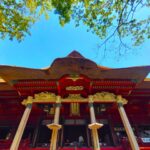
The Sanshin Gosaidenis the main shrine of Dewa Shrine, located on the summit of Mount Haguro, and enshrines the deities of the three mountains of Haguro, Gassan, and Yudono.
In the inner sanctuary, the "Gassan Shrine" is enshrined in the center, the "Yudono Shrine" on the left, and the "Dewa Shrine" on the right
The current building was completed in 1818 and is a nationally designated important cultural property
The Meiji government's separation of Shinto and Buddhism clearly defined the distinction between shrines and temples. However, within the grounds of Dewa Shrine, there remain buildings that are not typically found in shrines
The five-story pagoda of Mount Haguro is designated as a national treasure
The five-story pagoda(Hagurosan Five-Story Pagoda) was built around 1372 in the early Muromachi period (there is also a legend that it was built by Taira no Masakado in the late Heian period), and the current pagoda is said to have been rebuilt about 600 years ago by Muto Masauji (also known as Daihoji Masauji, birth and death dates unknown), who was the lord of Shonai and the chief priest of Hagurosan.
The "Five-Storied Pagoda" is designated as a National Treasure under the registered name "Hagurosan Five-Storied Pagoda"
The bell tower, which houses the third oldest bell in Japan
The bell towerwas rebuilt in 1618 by Mogami Ienobu (1605-1631), the third lord of the Yamagata domain, and is the second oldest building on the mountain, after the five-story pagoda.
The bell was cast in 1275, and with a diameter of 1.68m and a total height of 2.86m, it is the third oldest and largest bell after those at Todai-ji Temple (Nara Prefecture) and Kongobu-ji Temple (Wakayama Prefecture)
Thisbell toweris also designated as a nationally important cultural property.
Mount Gassan, where people pray for peace after death, is a treasure trove of alpine plants
Mount Gassanisa mountain where people pray for peace and a peaceful death, and it is also one of Japan's 100 Famous Mountains, boasting a wealth of rare alpine plants, and has been selected as one of Japan's 100 Famous Mountains for Flowers.
Furthermore,YajagaharaandNenbutsugahara, is a national natural monument, and the volcano has been dormant since its last eruption approximately 300,000 years ago.
Mount Gassan is accessible by a bus service from the summit of Mount Haguro to the 8th station where Mijagahara is located (seasonal service from around July to September), and it is also accessible by private car, so it is bustling with many hikers and climbers (road closed in winter)
The area above the 8th station of Mount Gassan is private property belonging to the Dewa Sanzan Shrine, and a purification ritual is required to visit the Gassan Shrine main sanctuary at the summit
for "Gassan Shrine Main Sanctuary"from around July to mid-September.
Yudono-san, where monks still practice asceticism and pray for rebirth
[A mountain where one prays for rebirth] Yudono-san is a mountain with an elevation of 1,500m that is part of the Gassan mountain range. From Gassan, it takes about 8km along the ridge to reach Yudono-san Shrine, which is at an elevation of approximately 1,100m
At the main shrine of Yudono-san Shrine, you must undergo a purification ritual and go barefoot before you can worship.
Descending about 90 meters down the iron ladder behind the main shrine of Yudono-san Shrine, you will find a waterfall (Yudono-san Otaki), which is still visited by many ascetic monks who perform waterfall meditation
*While Yudono-san was previously listed as 1,504m, it is now consistently listed as 1,500m, which is the elevation of the summit
The traverse from Mount Gassan to Mount Yudono takes about 3 hours and is mostly downhill
However,since you will be hiking in high mountains over 1,500m, you will need proper mountaineering equipment.
You can take a local bus to the 8th station of Mt. Gassan, and then walk from there via Gassan Shrine, which takes about 6 hours. There is no regular bus service between Mt. Yudono and Tsuruoka Station, but a shuttle bus, the "Tsuruoka Sightseeing Shuttle Bus," operates during the summer season only
Additionally, the "Tsuruoka Sightseeing Taxi," a reservation-only sightseeing taxi service connecting Tsuruoka Station, Hagurosan, and Yudonosan, is convenient (please inquire about operating periods and fares)
The main shrine of Yudono-san Shrineis open to the public from around June to early November.
supplement
"Dewa Sanzan: A Journey of Rebirth Where Nature and Faith Thrive" has been designated a Japan Heritage site
My love of travel led me to work for a travel magazine some time ago, and now I work as a travel writer for an online publication. I have visited all 47 prefectures in Japan, focusing on the Tohoku region, and I enjoy soaking in hot springs and experiencing traditional Japanese culture, including old townscapes, lifestyles, and performing arts and crafts