

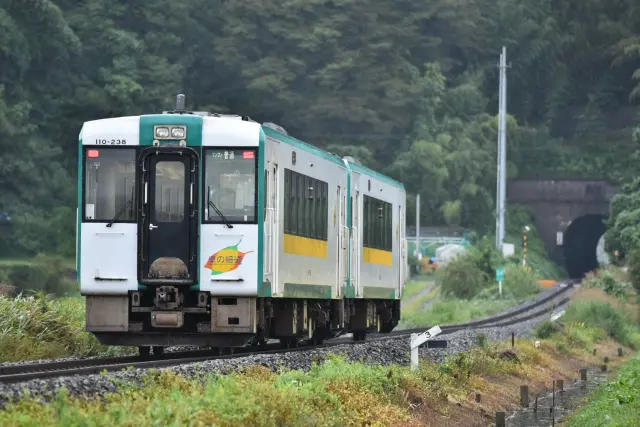
3 Recommended Local Trains in Miyagi Prefecture! From the City of Forests to the Land of Beautiful Mountains and Rivers

There are many local JR lines in the north of the prefecture, and the rush hour for lines departing and arriving at Sendai Station is comparable to that in the Tokyo metropolitan area. However, if you travel just a short distance from the city center, you will be greeted by tranquil countryside, mountain, and seascapes
What is the definition of a local line?
In a broad sense, it refers to local railway lines with few passengers, but here we have selected them based on the following criteria
- Single track with few passengers, high possibility of closure
- There are steam locomotives and tourist trains, and many photo spots
Routes that cross two prefectures are considered local routes in the prefecture where they start
JR Rikuu East Line (Kogota Station to Shinjo Station: 27 stations, 94.1 km)

The line connects Kogota Station in the north of the prefecture with Shinjo Station in Yamagata Prefecture, and is affectionately known as the "Oku no Hosomichi Yukemuri Line" due to the many hot springs along the line. However, due to low passenger numbers, there are constant calls for its abolition
Recommended points of the JR Rikuu East Line!
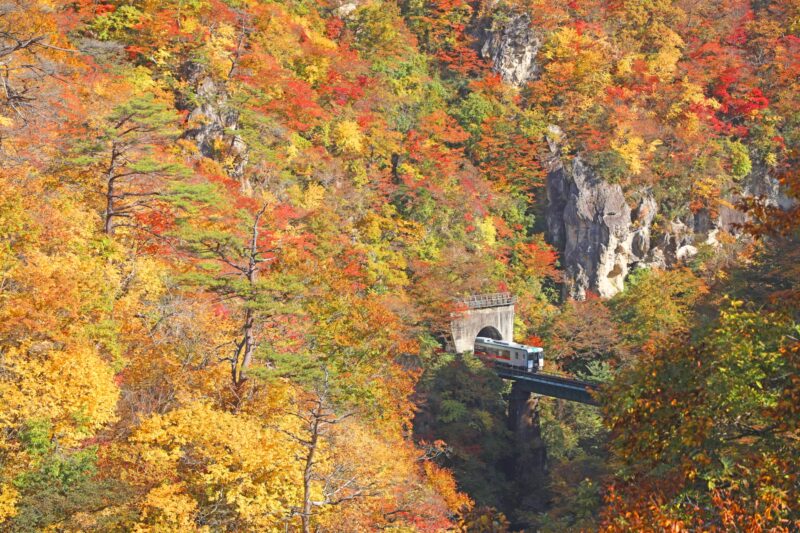
As its name suggests, the Oku-no-Hosomichi Yukemuri Line has four hot spring stations within the prefecture, and near the famous Naruko Onsen Station you can enjoy the spectacular view of Naruko Gorge
During the autumn foliage season, you can slow down and ride at a more leisurely pace at scenic spots
Naruko Onsen Station

There is a free foot bath called "Poppo no Yu" in front of the station building, where you can easily enjoy the famous bluish sulfur spring water with floating hot spring minerals
Why not take a stroll around the station and hot spring town looking at the Naruko Kokeshi dolls, or try painting a kokeshi doll at a kokeshi shop?
Information
- Facility name: Naruko Onsen Station
- Address: Kawarayu, Naruko Onsen, Osaki City, Miyagi Prefecture
- Phone number: 050-2016-1600
- Google Map Naruko Onsen Station
JR Ishinomaki Line (Kogota Station to Onagawa Station: 14 stations, 44.7 km)

With Ishinomaki Station as the dividing line, you can enjoy the different scenery from the train window, such as the rural landscape in the Kogota direction and the coastline of Mangokuura in the Onagawa direction
Recommended points of the JR Ishinomaki Line!

During the Great East Japan Earthquake, Onagawa Station was destroyed by the tsunami and there were rumors that the line would be closed, but a new station was built inland and operations resumed
Onagawa Station is served by the first train going up and the last train going down directly from Ishinomaki Station on the Senseki Tohoku Line
Ishinomori Manga Museum (Ishinomaki Station)

Named "Mangattan" by the late local manga artist Shotaro Ishinomori, it is built on an island in the old Kitakami River that resembles Manhattan Island, and features exhibits of original drawings from his works and other attractions
The "manga" in the facility's name was proposed by Ishinomori
During the Great East Japan Earthquake, the exhibits were washed away by the tsunami, but thanks to encouragement from all over the country, the museum was restored 1 year and 8 months later
Information
- Facility name: Ishinomori Manga Museum
- Address: 2-7 Nakase, Ishinomaki City, Miyagi Prefecture
- Phone number: 0225-96-5055
- URL:Ishimori Manga Museum
- Google Map Ishinomori Manga Museum
Mangokuura (Watanoha Station to Urajuku Station)

Between Watanoha Station and Urajuku Station, the calm waters of Manjuura Bay spread out before your window
This is an inland sea where delicious oysters grow and the sunsets are beautiful
Information
- Name: Mangokuura
- Google Map Mangokuura
JR Kesennuma Line (Maeyachi Station to Yanaizu Station: 6 stations, 17.5km)

The entire line used to be a railway, but now it is a BRT bus service from Yanaizu Station to Kesennuma
The section between Yanaizu Station and Kesennuma Station was severely damaged in the Great East Japan Earthquake, and plans to restore the railway were abandoned. Instead, the line was revived as the Kesennuma Line BRT, with buses running on a dedicated road that used to be the original railway line
From Maeyachi Station, there are direct trains to Kogota Station via the Ishinomaki Line
Recommended points of the JR Kesennuma Line!
The view from the train window on the railway section is of a vast rural landscape, and the BRT section runs along the coast, but the section with a view of the sea is shorter than it was in the railway era due to the presence of a series of huge seawalls
However, traces of its former existence as a railway can still be seen, such as tunnels and platform remains
Kitakatsu Maguroya Tanakamae Branch (Kesennuma BRT, Fudonosawa Station)
Many repeat customers come to try the Kamatoro Steak, a fragrantly grilled swordfish belly that is juicy, fatty yet light, and you can eat as much as you want
They also serve tuna innards, making this a must-try restaurant for tuna lovers
Information
- Facility name: Kitakatsu Maguroya Tanakamae store
- Address: 1-3-18 Tanakamae, Kesennuma City, Miyagi Prefecture
- Phone number: 0226-24-7010
- URL:Kitakatsu Maguroya Tanaka-mae Store
- Google Map Kitakatsu Maguroya Tanakamae Store
Routes connecting Sendai, the City of Trees, with the countryside
Both lines are used for commuting to work or school in the Sendai area, and once you leave the city, you can experience the atmosphere of a local line
JR Senseki Line (Aoba-dori Station to Ishinomaki Station: 33 stations, 49.0 km)

Although it runs mostly underground in central Sendai, it does not run directly onto the Sendai Municipal Subway
This is the only line that stops at Matsushima-Kaigan Station, making it a popular means of transportation for sightseeing in Matsushima
JR Senzan Line (Sendai Station to Uzen-Chitose Station: 18 stations, 58.0 km)

After passing Ayashi Station, a bedroom community of Sendai City, the mountain gradually becomes deeper and the line transforms into a local line running through mountainous areas
JR Joban Line (Nippori Station to Iwanuma Station: 80 stations, 343.7 km)

It is the longest line in Japan that is not called a "main line," and it separates from the Tohoku Main Line at its starting point, Nippori Station, and merges with it at its terminus, Iwanuma Station
JR Tohoku Main Line (Tokyo Station to Morioka Station: 150 stations, 535.3 km)

This was once the longest railway line in Japan, stretching from Ueno Station to Aomori Station, but now there are no overnight trains departing from Ueno, and there are no direct trains from Tokyo to Morioka
JR Senseki Tohoku Line (Sendai Station to Ishinomaki Station: 21 stations, 48.5km)

This line connects the Senseki Line and the Tohoku Main Line, taking advantage of the advantages of each line, and fulfills local requests to shorten the travel time between Sendai and Ishinomaki
Other local lines you should ride in Miyagi Prefecture
The Abukuma Express Line, which runs from Fukushima, is also a valuable means of transportation in the southern part of the prefecture
Abukuma Express Line (Fukushima Station to Tsukigi Station: 24 stations, 54.9 km)

This is a third-sector line that we introduced as a local line in Fukushima, and some recommended spots along the Miyagi prefecture line include the JAXA Kakuda Space Center in Kakuda and the German-style craft beer shop Sennan Shinken Factory


summary
In the past, the Kurihara Rural Railway was the most representative local line in Miyagi
Nicknamed "Kuriden," this cute, single-car train ran through the countryside and was popular, but was sadly discontinued in August 2010
Today, you can see the old train cars at the Kuriden Museum in Kurihara City

Tohoku Region Local Line Series



I'm a former Edoite (Tokyoite) who loves Morioka and the six prefectures of Tohoku, and I'm a big fan of history, gourmet food, travel, sports, alcohol, and choral singing.
I'll introduce you to interesting things, delicious food, and great places in Tohoku!
Please support NEFT's article creation!
NEFT gathers and publishes articles about the history, culture, and tourism information of various regions in Tohoku
If you enjoyed this article, we would be grateful if you would consider supporting our future interviews, article creation, and website management
*Clicking "Tip" will open the tip sending screen for the external service "codoc"
Other articles

Enjoy the exquisite Kitakata ramen! A popular ramen restaurant in Fukushima Prefecture...

"Mogami Safflower" certified as a Japan Heritage and Japanese Agricultural Heritage [Yama...

[Sendai City, Miyagi Prefecture] "Future Forest Sendai 2023": Large flowerbed "...

Enjoy a blissful drink at Takahata Winery! Carefully selected wines...

[Aomori Prefecture] Let's go on a clay figurine tour! Highlights and spots...

Located next to ancient ruins... and furthermore, Arahaba-ki, which is associated with Minamoto no Yoshiie...

[Iwate Prefecture] Jomon Flame: Fujisawa Noyaki Festival 2022 to be Held! Original...

Osaki Kodo, a farmland that lives with water and has been certified as a Globally Important Agricultural Heritage System...

What is Kudo Pan, beloved by the people of Aomori Prefecture? Introducing the classic and best-selling products

[Onahama, Iwaki City, Fukushima Prefecture] Opening of Onahama Marine Bridge...

The Thousand Buddhas at Daimanji Temple's Kokuzoson in Mukaiyama are the origin of the name of the Sendai area.
