


Neither an express train nor an electric railway!? Bandai Express Electric Railway [Fukushima Prefecture]

There was a railway company and railway line called Bandai Kyuko Dentetsu. The
name is reminiscent of a certain company that deals in toys, but it is not a fictional railway that appears in toys.
a major characteristic of it was that , despite its name, it was neither an "express" nor an "electric railway."
It was opened as a railway line for transporting sulfur ore
In the central part of Inawashiro Town, Fukushima Prefecture, there was once a mine where sulfur ore could be extracted. This mine, called Numajiri Mine, was located on the western slope of Mount Adatara, and it is said that the Aizu Domain and the Nihonmatsu Domain competed for control of the mine during the Edo period
In the early 20th century, sulfur was a valuable resource, and a railway was planned to transport sulfur ore from Numajiri.
As a project of the Yama Railway Division of the Nippon Sulfur Company, the line opened in 1913. Initially, it was operated with horses pulling passenger and freight cars. While
the company operating the line was officially called Nippon Sulfur, the line was generally known as the Numajiri Railway or Numajiri Light Railway. In this article, we will refer to this line as the Numajiri Railway from now on

The Numajiri Railway's operating section was 15.6 km long, running from Kawageta Station to Numajiri Station (which was apparently called Ohara Station from its opening until 1923) located to the north-northeast, with nine stations along the way.
Although the current JR Ban'etsu West Line also runs through Kawageta Station, the Numajiri Railway's track gauge (distance between two rails) was 762 mm, which is narrower than the Ban'etsu West Line's 1,067 mm, making it impossible to run trains directly from Kawageta Station to the Ban'etsu West Line.

The 762mm gauge was commonly used for a type of railway called a narrow-gauge railway. Due to the narrow track width, the transport capacity and maximum speed of trains were lower than those of conventional railways. The Numajiri Railway was no exception; it was a peaceful railway, to put it mildly, with small trains, nicknamed "miniature trains" or "matchboxes," plowing along at a leisurely pace
The emergence of steam locomotives and gasoline-powered railcars
The Numajiri Railway initially opened as a line where horses pulled the carriages, but it was soon switched to being pulled by steam locomotives, which greatly increased its transport capacity (compared to the horse-drawn era). In 1929, gasoline-powered railcars (vehicles that run on engines that burn gasoline, like automobiles) were also introduced with an eye on transporting tourists
The Numajiri Railway, which thrived thanks to the transportation of sulfur and the influx of spa-goers and skiers to hot springs such as Numajiri Onsen and Nakanosawa Onsen, reached its peak from the early Showa period through the war.
In 1945, the legal classification of the Numajiri Railway was changed from a tramway (similar to a streetcar) to a local railway (a local private railway), and the operator was renamed the Nippon Sulfur Numajiri Railway Department.
Decline due to increased use of petroleum
In the post-war 1950s, petroleum began to replace coal, which had been the main energy resource until then. However, as petroleum became widespread, sulfur oxides contained in factory smoke and automobile exhaust fumes developed into pollution problems. Therefore,desulfurization was carried out during the refining of crude oil, and large quantities of sulfur were obtained.
As sulfur, a by-product of petroleum refining, became available on the market, the sulfur produced at the Numajiri Mine could no longer compete on price. The Numajiri Railway, whose main source of income was the transportation of sulfur ore from the Numajiri Mine, began to suffer financially. This
shift in energy was also reflected in the Numajiri Railway's rolling stock, and it was in the 1950s that diesel locomotives, which run on light oil, were introduced. At a time when diesel locomotives were still rare throughout Japan, this can be considered a pioneering initiative.
"Express Electric Railway" even though there are no express trains or electric trains
With its finances deteriorating, the Numajiri Railway decided to shift its focus from transporting sulfur ore to tourism in Ura-Bandai
Nippon Sulfur, which operated the Numajiri Railway, absorbed its subsidiary Numajiri Kanko in 1964 and renamed it Nippon Sulfur Tourism Railway . In 1967, it was renamed again to Bandai Express Electric Railway . At least in name, it had become a respectable local private railway.
And the unfortunate thing was that the only thing that was impressive was the name
Naturally, railway companies with "Dentetsu" (electric railway) in their name usually operate electric trains.
Currently in Japan, there are numerous companies operating electric trains, primarily in the Kanto and Kansai regions, whose names include "Dentetsu" or "Electric Railway."
Even in the Tohoku region, companies with "Dentetsu" in their name that operated electric trains existed in the past, such as the Towada Kanko Dentetsu in Aomori Prefecture and the Hanamaki Dentetsu in Iwate Prefecture (although the Towada Kanko Dentetsu company still exists, it ceased railway operations in 2012. See the article below for details).


However, even after the Numajiri Railway's operator was renamed Bandai Express Electric Railway, it continued to operate using diesel locomotives and other similar vehicles.
This was because they lacked the equipment to supply electricity to electric trains.
Furthermore, express trains that skipped intermediate stations were not introduced. The 15.6km journey from Kawageta Station to Numajiri Station still took about 48 minutes—a speed so slow that even a moped could beat it—and this remained completely unchanged even after the company name change. The name "Express Railway" did not reflect the reality at all
It is said that on this point, a person in charge at Bandai Express Railway insisted, citing the diesel railcar (passenger car that runs on diesel fuel) introduced in 1968, that "this vehicle is an electric train because it is equipped with a generator (used to power the lights, etc.), and it is an express train because it is two minutes faster than a train pulled by a diesel locomotive."
The train shown in the video on the NHK website appears to be a diesel railcar, known as the "express train." Since diesel railcars only ran for less than a year, this footage is truly valuable
>> [Fukushima Prefecture] Bandai Express Railway (Numajiri Railway) | Era | NHK Archives
In reality, the name Bandai Express Railway was a reflection of a plan that could be described as the manager's delusion.
In order to enhance the Numajiri Railway's function as a tourist railway,to one daychange the Numajiri Railway's track gauge to match that of the Ban'etsu West Line, and further electrify the Numajiri Railway in the same way as the Ban'etsu West Line, which was able to run electric trains in 1967, thereby enabling through service between the Ban'etsu West Line and the Numajiri Railway.
With the electrification of the Ban'etsu West Line, the express train "Bandai" ran on the line, connecting Ueno Station and Kitakata Station. If the Bandai Express Railway's plan for gauge conversion and electrification had been realized, it might have been possible to detach some of the "Bandai" train cars and run them on the Bandai Express Railway, attracting passengers from the Tokyo metropolitan area to Numajiri. The Numajiri Railway could certainly have been transformed into a railway that resembled the Bandai Express Railway. However, considering the company's financial situation at the time, this plan was simply too unrealistic
Sudden bankruptcy and railway line closure
Just one year after changing its name to Bandai Express Railway, in 1968, Bandai Express Railway suddenly filed for bankruptcy protection under the Corporate Reorganization Act . As a result of the company's bankruptcy, train operations were suspended, and the railway was officially abolished the following year, 1969
Incidentally, and this is nothing more than a coincidence, in the Tohoku region, in Aomori Prefecture, there was a railway called the Nanbu Railway (not the Nanbu Railway in the Tokyo metropolitan area, or the current JR Nanbu Line) that suspended train operations due to the Tokachi-oki earthquake in 1968 and was officially abolished the following year, 1969. The
Nanbu Railway was originally called the Gonohe Electric Railway, but in the end, it never ran electric trains until it was abandoned, which is another strange coincidence with the Bandai Express Electric Railway.
Other companies that used "electric railway" in their name but never actually operated trains, like Bandai Express Railway and Gonohe Electric Railway, include Mito Electric Railway in Ibaraki Prefecture, Zenkoji Hakuba Electric Railway in Nagano Prefecture (which still exists today as a company handling transportation by car, etc.), and Awa Electric Tramway in Tokushima Prefecture. However, these are few examples. Naturally, they are extremely rare
Nearly 60 years have passed since the bankruptcy of the Bandai Express Railway, but the station building of Numajiri Station, its terminus, still remains.
In addition, one diesel locomotive and two passenger cars that were used by the Bandai Express Railway are preserved at the Inawashiro Green Village theme park in Inawashiro Town.
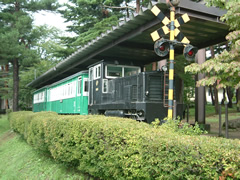
(Quoted from:Facility Guide | @Inawashiro [Green Village] Inawashiro Town Promotion Public Corporation)
A monument commemorating the Numajiri Light Railway is located in front of Kawageta Station on the Ban'etsu West Line
Information <Former Numajiri Station Building>
- Name: Former Numajiri Station Building
- Location: Numajiri, Higashihei, Wakamiya-mura, Inawashiro-machi, Yama-gun, Fukushima Prefecture 969-2751
Google Map
Information <Inawashiro Green Village>
- Name: Inawashiro Green Village
- Address: 344-4 Higashinakamaru, Oaza Nagata, Inawashiro-machi, Yama-gun, Fukushima Prefecture 968-3283
- Phone number: 0242-65-2150
- URL Facility Information | @Inawashiro [Green Village] Inawashiro Town Promotion Public Corporation
Google Map
Popular song "The Highland Train Goes On"
There is a popular song that is said to be modeled after the Numajiri Railway
The Highland Train Goes On), released in 1954 and sung by the late singer Atsuo Okamoto .
The lyricist, the late Toshio Oka (later renamed Toshio Oka), was from Fukushima Prefecture and said that he wrote the lyrics forthis song recalling the Numajiri Railway. The "Five-Colored Lake" mentioned in the lyrics is undoubtedly none other than the Goshikinuma Lakes, located north of Inawashiro Town.

Meanwhile, the composer, the late Yuji Koseki, was from Fukushima City. He composed the music while imagining the Swiss high-altitude railways. When
Oka, who wrote the lyrics, heard Koseki's composition, she was astonished that it was completely different from what she had imagined, saying, "It sounds like Switzerland or Austria." However, she wasn't disappointed; on the contrary, she was overwhelmed with joy.
"Kogen Ressha wa Iku" (The Highland Train Goes On) has become a representative song for both Oka and Koseki. Since 2009, the 100th anniversary of Koseki's birth, it has been used as the departure melody on the conventional line platform at JR East's Fukushima Station.
The lyrics of this song are inscribed on the Numajiri Light Railway Memorial in front of Kawageta Station, and a monument inscribed with the song has also been erected near Nakanosawa Onsen, one of the hot spring resorts accessible from Numajiri Station.
Furthermore, the NHK serial drama "Yell," which aired in the first half of 2020, features a composer modeled after Koseki as the protagonist, and there is an episode in which "Kogen Ressha wa Iku" is played.
The Bandai Express Railway was a small private railway that disappeared about 60 years ago, but there are still a few traces left to prove its existence
Information <The Highland Train Goes On - Song Monument>
- Name: Highland Train Going On - Song Monument
- Address: 2855-171, Koya Numajiriyama Ko, Inawashiro-machi, Yama-gun, Fukushima Prefecture 969-2752
Google Map

A former railway engineer and current freelance writer who has loved trains since childhood, his dream is to make train travel his career
Please support NEFT's article creation!
NEFT gathers and publishes articles about the history, culture, and tourism information of various regions in Tohoku
If you enjoyed this article, we would be grateful if you would consider supporting our future interviews, article creation, and website management
*Clicking "Tip" will open the tip sending screen for the external service "codoc"
Other articles

Sake, miso, wasabi flavors... soft serve ice cream available at roadside stations in central Iwate Prefecture...

Popular temples and shrines recommended for first visits of the year in Fukushima Prefecture...

From diesel express trains to Shinkansen trains... The history of the "Tsubasa" [Autumn...

[Fukushima Prefecture] Ramen made with Aizu Mountain Salt is delicious! Souvenir...
![Daito-ryu Aikijujutsu [Part 2]](https://jp.neft.asia/wp-content/uploads/2026/01/aiki_tkd03-300x300.jpg.webp)
Did Aikido originate in Aizu? Daito-ryu Aikijujutsu and Martial Arts...

Experience the romance of the Taisho era! 5 popular gourmet foods at Ginzan Onsen, Yamagata Prefecture

From one to nine, "place names with 'to' in them" [Ichinohe and Ninohe edition]...

What is Katanuma? | A lagoon in Naruko Onsen where even fish cannot live...

A parade of life-sized papier-mâché kokeshi dolls! The annual kokeshi festival...

Refreshing taste created by fresh hops! Hop Japan...

[JR East Pass Travel: Explanation - Preparation] I'm off! Train...
