

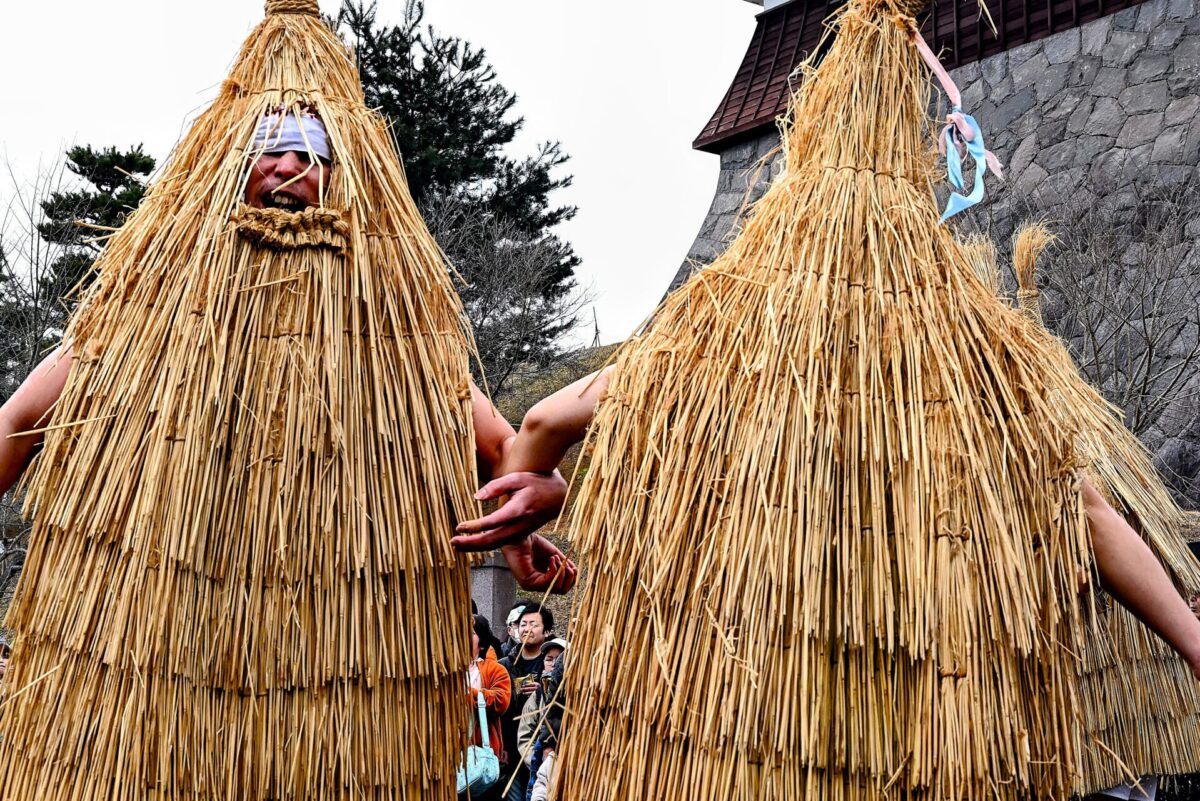
The "Kase-dori," a divine incarnation wearing a straw cloak, is part of a fun folk event in Kaminoyama City, Yamagata Prefecture, accompanied by the enthusiastic shouts of "Kakkakka!"

What is Kase-dori?
Kasedori is a folk event held annually on February 11th in Kaminoyama City, Yamagata Prefecture. It was originally a "visitation ceremony for the New Year's god" and was held during the Little New Year (there are various theories, but it is generally considered to be the period from January 14th to 16th).

As the name "New Year's God's Visit Ceremony" suggests, this event has the characteristics of a visiting deity , exemplified by the Namahage of Oga. Participants wear a cone-shaped straw cloak called a "kendai" to transform into an incarnation of the god (Kase-dori) , and parade through various parts of the city chanting "Kakkakka, Kakkakka!", praying for a bountiful harvest, fire safety, business prosperity, and family safety.
There are various theories about the origin of the name, including "Kasegi-dori" (meaning "profitable bird"), which is related to business prosperity, and "Kasei-dori" (meaning "fire-preventing bird"), which is related to fire prevention
"Celebratory water," "hand towel wrapping," and auspicious "straw"
According to legend, during a great fire in the Edo period, "fire-eating birds appeared to fly through the sky and spread the flames." Therefore, residents and spectators along the route pray for protection from fire by dousing the Kase-dori (support birds) with water called "celebratory water" using buckets and ladles
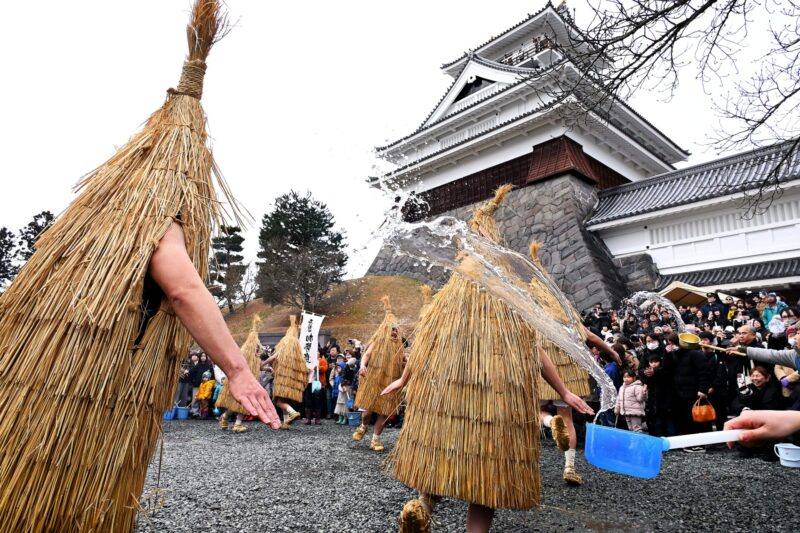
Incidentally, a kendai woven from straw usually weighs 4kg to 6kg, but when it absorbs water, its weight increases to about 10kg to 12kg
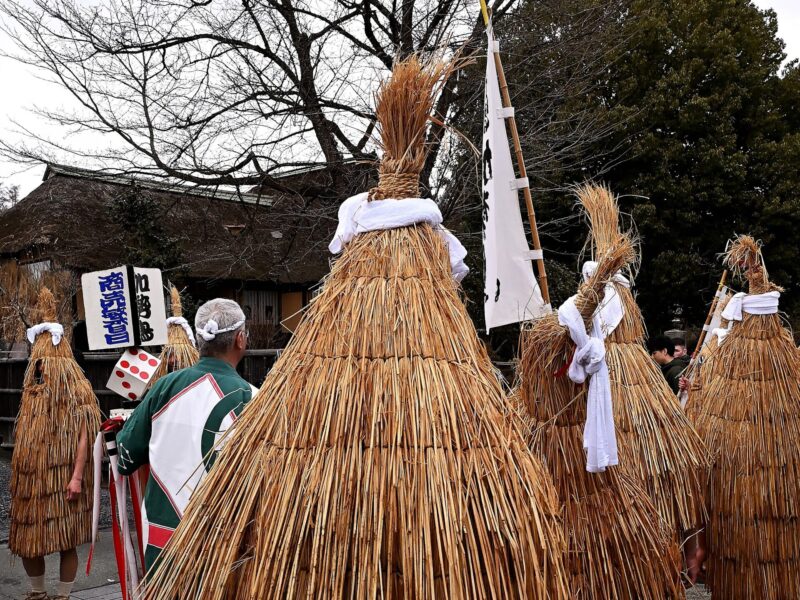
Furthermore, tying a new hand towel or towel to the head of the Kase-dori (a type of festival float) is a way to pray for "family safety" and "business prosperity ," and the straw that falls off the Kendai (another type of festival float) also has auspicious properties; it is said that if you tie it in a girl's hair, her hair will become black and beautiful
The History of Kase-dori
Imperial support and town support
In its early stages, the Kase-dori (support birds)"Gozen-kase"and"Machikata-kase." Records indicate that "Gozen-kase" began around the Kan'ei era of the Edo period (1624 to 1644).
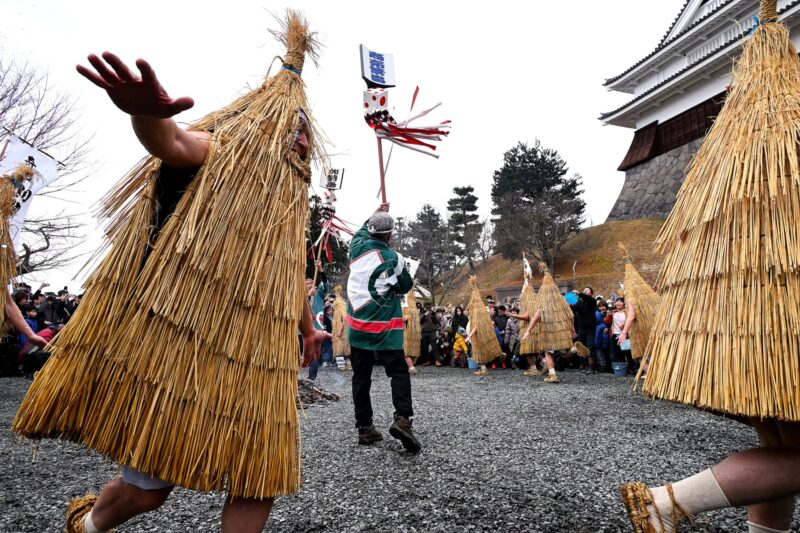
before the lord) is said to have been a tradition where, on the 13th day of the lunar new year each year, three young men from Takano Village (present-day Takano or Takanohara, Kaminoyama City, Yamagata Prefecture) who were permitted to enter Kaminoyama Castle would perform a Kasei-dori dance before the lord. They would then be doused with water using buckets and ladles, just as they are today, and rewarded with sake and one kanmon (a unit of currency).

The town's support ceremonywas held every year on the 15th day of the lunar new year. Young men gathered from the surrounding villages and went from house to house in the town lined with merchant houses, listening to the wishes of the residents and in return offering gifts, sake, and rice cakes.
Although there are no clear records of the origins of the townspeople's support, the fact that they were summoned before the lord to perform suggests that the lord wanted to see the support birds and called them, so it is thought that this practice may have existed in the townspeople even before the lord's support
Interruption during the Meiji period
In the Meiji period , the practice of "assisting the lord" was abolished as it was deemed an "event that was considered important during the old feudal domain era ."
While there are no clear records of the specific laws or administrative measures that led to its abolition, the Meiji period was a time when anti-Buddhist movements, moral regulations, and festival control were implemented nationwide, so it is thought that this was a consequence of those events
The practice of townspeople providing assistance for fire prevention continued as a custom, but it was eventually abolished in 1896 (Meiji 29), and the history of the Kase-dori (firefighting bird) was completely interrupted for about 60 years thereafter
A preservation society was formed during the Showa period and continues to this day
The catalyst for its revival was the creation of the new Kaminoyama City through the merger of towns and villages in 1954 (Showa 29) , and it was revived by volunteers in 1959 (Showa 34), five years after it was first planned.
However, since approximately 60 years had already passed since the breeding season ended, no one had actually seen a Kase-dori bird, and it is said that the revival was a trial-and-error effort
Subsequently, in 1986 (Showa 61),the Kamiyama City Folk Event Kase-dori Preservation Societywas formed,the Warabi-za Theater Company, the dances and the accompanying drum and flute music were created, leading to the present day.
Current Kasetori
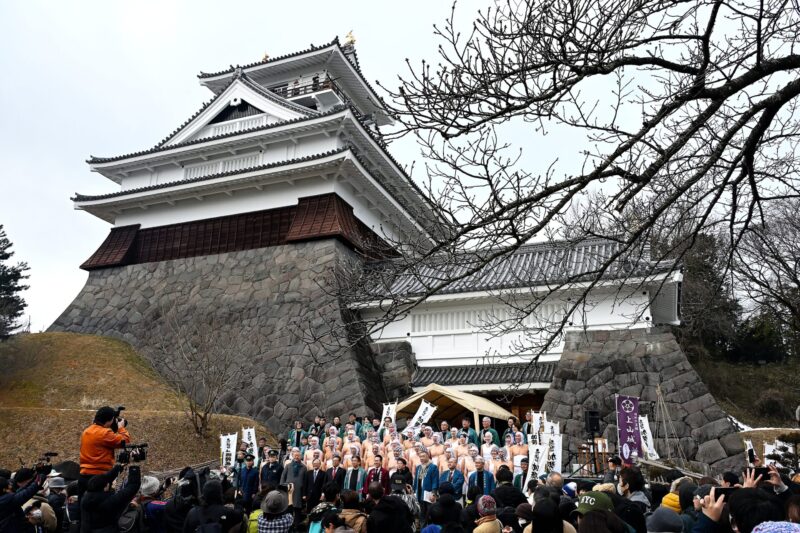
The current Kase-dori
- Prayer ceremony (Shinto ritual) at the plaza in front of the main gate of Kaminoyama Castle
- Dance performance in front of the main gate of Kaminoyama Castle
- Parade through Kaminoyama city
The process involves recreating both the "royal support" and the "town support" in this manner
The "Kaminoyama City Parade" involves the Kase-dori being divided into multiple groups, so if you visit Kaminoyama City on that day, you can encounter the Kase-dori everywhere
Kasedori<Information>
- Name: Kamiyama folk event “Kasedori”
- Venue: Kaminoyama Castle and Kaminoyama city
- Date: February 11th
- Event time: Around 10:00 AM to 3:00 PM
- URL: A Trip to Yamagata – Kaminoyama City Folk Events: Kase-dori

Traveling around the Tohoku region, I enjoy drinking delicious sake and exploring the local history, traditions, and customs. I write articles based on my interests. I'm currently interested in folk performing arts, local toys, and folk beliefs
Please support NEFT's article creation!
NEFT gathers and publishes articles about the history, culture, and tourism information of various regions in Tohoku
If you enjoyed this article, we would be grateful if you would consider supporting our future interviews, article creation, and website management
*Clicking "Tip" will open the tip sending screen for the external service "codoc"
Other articles

[Part 1] The Date family's "food" strategy! Masamune's legacy passed down...

[Shonai Region, Yamagata Prefecture] A beloved restaurant in the Shonai region that warms both body and soul...

A rock shaped like a demon's hand? Mitsuishi, a place packed with Iwate's roots...

What is Ennen, a rare and precious performing art that remains in the modern world? | Ke...

Sendai City History and Folklore Museum | Photo report of Rekimin Autumn Festival 2025...

The museum where the footsteps of Antarctic explorer Nobu Shirase remain...

[Yamagata Prefecture] 5 Recommended Beaches in Yamagata Prefecture! The coastline is the longest in Tohoku...

What is Iizaka Town's "Uso Kae Festival"? A prayer to turn misfortune into lies...

Scary stories and slightly sad stories... "Michinoku Otoko" is a place where many stories remain...

[Yonezawa City, Yamagata Prefecture] Snow Lantern Festival | A mystical experience unique to snow country...

The Chidokan Domain School and Chido Museum are the best spots for historical dramas in the Shonai region!.
