

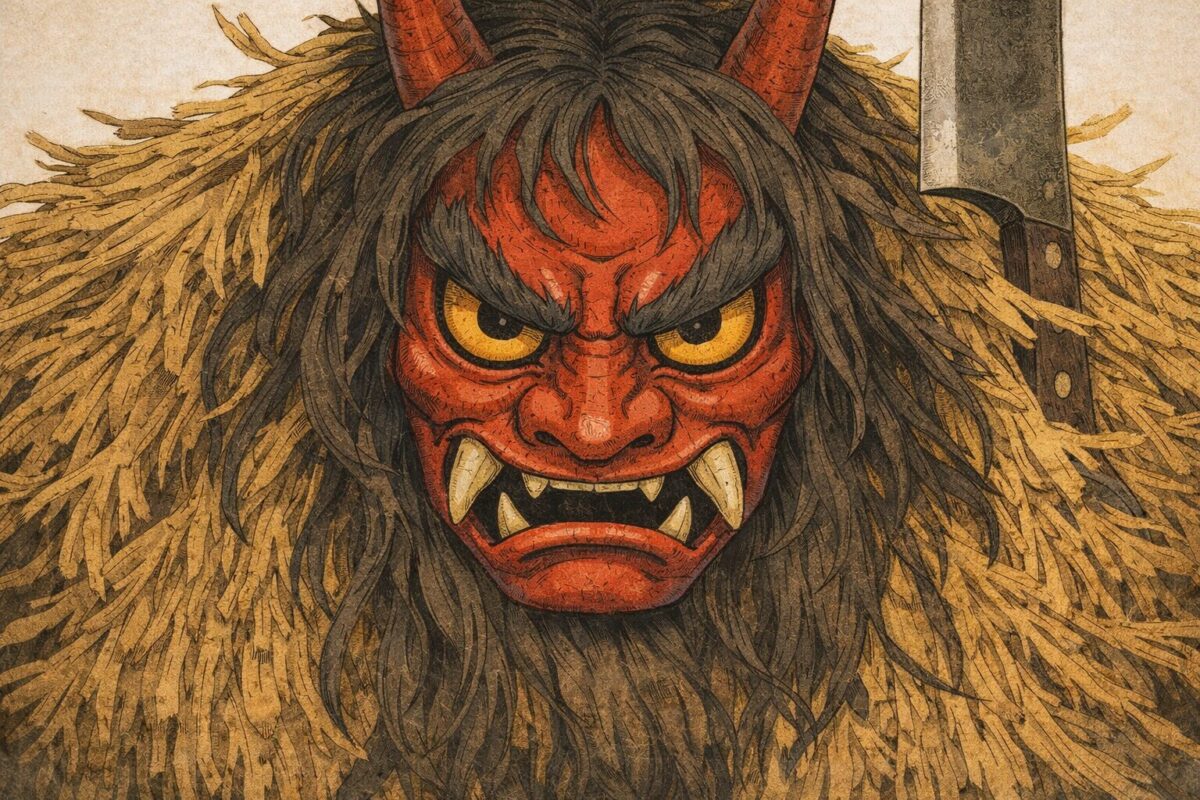

"Any crying children here?" The Namahage of Oga, Akita, is known nationwide as a folk event representative of the Tohoku region
...But did you know that there are actually many gods all over the country who, although they may have different appearances and names, fulfill similar roles?
They are collectively called visiting deities (raihoshin)
What is a visiting deity? A "god" in the form of a demon
A visiting deity is a folklore term that refers to a deity that comes to human settlements from the mountains, seas, or other worlds at the turn of the year or the turning of the seasons
- Wearing masks and costumes
- Visiting the houses
- Check out how people live
- Exorcise disasters and bestow good fortune
This characteristic is not only common to Namahage but also to folk events all over Japan
The important point is that the visiting deities are "gods," not "demons." Their terrifying, demon-like appearances or bizarre, straw-covered forms are not meant to frighten people, but rather to visibly manifest non-human beings
Why does it appear on "Koshogatsu"?
The timing of the appearance of visiting deities varies slightly from region to region, but in Tohoku, they are concentrated from New Year's Day to around January 15th (Little New Year)
Little New Year is considered "another New Year's Day" that celebrates the first full moon of the year.
- Be aware of the beginning of farming
- An important day to take down New Year's decorations and pray for peace in the new year
Because of this meaning, it has come to be seen as "the turning point when the year truly begins to move."
At these important junctures, people needed to welcome the gods and have them check that their lives were going properly, and it is said that visiting gods played this role
Why visit houses instead of shrines?
One of the key characteristics of visiting deities that should not be overlookedthey visit each individual household.
This is thought to have been done with the idea that the gods would personally visit each "house" that made up the town or village, check on each family member living there, admonish lazy people, pray for fire prevention, and pray for happiness and peace, in order to start the year on a good note
Visiting deities remaining in various parts of Tohoku
From cute to terrifying, there are a variety of visiting gods throughout Tohoku
Fukudawara Korogashi andKapakapa(Inakadate Village, Aomori Prefecture)

In the Little New Year's event called "Fukudawara Korogashi" (Rolling the Lucky Rice Bale ) that is passed down in and around Inakadate Village, Aomori Prefecture , children dress up as Daikokuten (the god of wealth) and go from house to house. When invited into the entrance, they throw the lucky rice bales they are carrying into the house and sing, "They've come in, they've come in, the lucky rice bales have come in," praying for good health and safety for the family.
In households where someone is in their unlucky year , a doll called "Kapakapa," made from carrots or similar materials, is placed in front of the entrance to pray for protection against bad luck
It is said that what were originally separate customs were eventually combined into one event, and rather than being a frightening figure that warns, they are characterized as visiting gods that directly bring good fortune
Link:Hirakawa City Tourism Association, Aomori Prefecture – Kapakapa Fukudawara Korogashi
Oga Namahage (Oga City, Akita Prefecture)

When discussing the visiting deities of Tohoku , the "Namahage of Oga" is an indispensable figure .


It is said that the name Namahage originated from the act of "namomihagi" (peeling off the raw body), which refers to the act of peeling off the namomi (brown bruises from low-temperature burns) that appear on lazy people who spend all their time warming themselves by a kotatsu or irori during the winter off-season for farming, as they would scold them for spending too much time in the fire.
At first glance, it has a frightening, demon-like appearance, shakes doors, shouts loudly, and even carries a kitchen knife, making it a symbol of fear
However, in reality, it is said that the purpose of this deity is not to instill fear, but to provide warnings and admonitions against laziness, and to bring about good health and abundant harvests
Therefore, when Namahage visit a home, food and alcohol are prepared and they are treated with courtesy
Link:Namahage of Oga
Suneka in Yoshihama (Ofunato City, Iwate Prefecture)

The "Yoshihama no Suneka," a deity from Yoshihama, Sanriku-cho, Ofunato City, Iwate Prefecture, is a grotesque visiting deity clad in a mask and straw cloak. The masks come in a variety of forms, including those of animals, insects, and human figures.
Since ancient times, the Little New Year has been considered a day when sacred beings beyond human comprehension come and go. On such a day, Suneka appear, going from house to house, rattling the abalone shells hanging from his waist and brandishing a knife to scare children. His purpose is said to be to pray forgood health and ward off evil spirits, and the householders offer Suneka mochi (rice cakes) and monetary gifts as a form of hospitality.
The custom is very similar to the Namahage of Oga, and while the name Namahage is said to originate from "namomihagi" (stripping away the flesh) , the name Suneka is said to originate from the act of "sune no kawahagi" (stripping the skin off the shins) of stripping the skin off the shins of lazy people .
Link:Ofunato City Official Website – UNESCO Intangible Cultural Heritage "Yoshihama no Suneka"
Kasedori (Kaminoyama City, Yamagata Prefecture)

The "Kase-dori" festival in Kaminoyama City, Yamagata Prefecture , is a ceremony to pray for business prosperity, a bountiful harvest, and protection from fire.
By donning a straw cloak called a "kendai" that covers the entire body, they embody the Toshigami-sama "Kasetori," a deity of the year who is believed to celebrate the year's abundance through the voice of a god who comes from a distant land during the Little New Year.
It is said that in the past there was a "Gozen Kasei" performance at the castle and a "Machikata Kasei" performance within the town, and nowadays the procession recreates this, starting with a dance performance in front of a bonfire set up in front of Kaminoyama Castle, and then proceeding to parade through the town
As the Kasedori bird vigorously sings "Kakkakka no Kakkakka!", people enthusiastically pour water called "iwai-mizu" (celebration water) onto it, praying for fire prevention
Link:Yamagata Prefecture Official Tourism Website – Kasetori
The water-spraying "Fire Man" and "Okame" of the Yonekawa River (Tome City, Miyagi Prefecture)

The "Yonekawa no Mizukaburi" (water splashing of Yonekawa) , a tradition in Yonekawa, Towa-cho, Tome City, Miyagi Prefecture , is a fire prevention ritual that has been performed for over 800 years. When people in their unlucky year participate, it also has the meaning of warding off evil.

Furthermore, on that day, separate from the group that pours water over themselves to pray for protection against fire, two people dressed as Hyottoko and Okame go around to the houses in the district collecting congratulatory gifts
Hyottoko and Okame are "visiting deities who bring good fortune." Hyottoko is written as "fire man," so he is considered a temporary form of the fire god, and Okame is considered his partner deity.
Okame carries a bucket on a balance pole, and Hyottoko, dressed in an ink-dyed monk's robe, quietly parades through the town ringing a bell
Link:Tome City Official Website – UNESCO Intangible Cultural Heritage "Yonekawa Water Splashing"
Higan Lion (Aizuwakamatsu City, Fukushima Prefecture)

The "Higan Shishi" dance, a tradition passed down in the Aizu region of Fukushima Prefecture , features three lion dancers (the lead lion, the male lion, and the female lion) wearing lion masks, performing a dance to the accompaniment of flutes and drums to pray for the eradication of disease, a bountiful harvest, and the safety of the family.
As the name "Higan" suggests, this festival is held not during the New Year but primarily around the spring equinox (Spring Equinox). It has the characteristics of a visiting deity, as it involves going from house to house, warding off misfortune, and bringing good fortune
In addition to the "Aizu Higan Shishi" in Aizuwakamatsu City , this visiting deity ritual has been passed down in various regions of the Aizu area, including the "Nishikatsu Higan Shishi" in Aizumisato Town and the "Shimoshiba Higan Shishi" in Kitakata City
Link:Aizu Festival Association Official Website – Aizu Higan Shishi
summary
Various visiting gods appear from the New Year to early spring
They appear for a variety of purposes, from simply bringing blessings to being strict with us, giving us warnings and admonitions, and guiding us in the right direction in life
At the root of this may lie the hopes of the people of the Tohoku region, a harsh region that has long been cut off by snow, who were hoping for happiness in the new year
[Reference Book]A Pictorial Guide to Japan's "Visiting Deities" You Can Only See Once a Year – Seishun Publishing
Traveling around the Tohoku region, I enjoy drinking delicious sake and exploring the local history, traditions, and customs. I write articles based on my interests. I'm currently interested in folk performing arts, local toys, and folk beliefs
Please support NEFT's article creation!
NEFT gathers and publishes articles about the history, culture, and tourism information of various regions in Tohoku
If you enjoyed this article, we would be grateful if you would consider supporting our future interviews, article creation, and website management
*Clicking "Tip" will open the tip sending screen for the external service "codoc"
Other articles

[Yurihonjo City, Akita Prefecture] Japan's three largest Hase Kannon statues can be found in this...

How do you address people in Tsugaru dialect? "Odo," "Oga," "Appa," etc.

[Fukushima City, Fukushima Prefecture] A summer tradition in Fukushima City, Fukushima Prefecture! Japan's No. 1...

All cities and towns in Iwate Prefecture, the hometown of players Ohtani and Roki Sasaki...

What is the legend of Hachirotaro? Three stories that even locals don't know much about...

[Hanamaki City, Iwate Prefecture] 1.4m deep! Japan's longest standing bath. A nostalgic...

Kitakata (Fukushima Prefecture): A town of storehouses with over 4,000 surviving storehouses

[History of Hachirogata Reclamation ③] The land is below sea level...water is our lifeline...
![What are the Mogami Eight Shields? [Part 2]](https://jp.neft.asia/wp-content/uploads/2026/04/my_ic02-300x300.jpg.webp)
[Part 2] The Mogami Eight Shields, a coalition of local lords in Dewa Province...

Were there ancient lion species in Aomori Prefecture? A shocking discovery in January 2026...

It began with the Tozawa clan during the Sengoku period and was founded by the Ashina clan during the Edo period.
