This site is an online media that delivers all sorts of trivia about the six Tohoku prefectures, from sightseeing and gourmet spots to local customs, history, and more
The castellan of Odate Castle, a subsidiary castle of the Kubota Domain, was the Satake Nishi family
During the Edo period, Odate City played an important role as a frontline base for the Kubota Domain (Akita Domain), partly because the neighboringregionKazunothe Nanbu Domain(Iwate Prefecture and parts of Aomori Prefecture).
In the early Edo period, there were constant disputes with the Nanbu clan over the border, and the border was ultimately determined by the Edo Shogunate
In Odate, there was Odate Castle, a branch castle of the Kubota Domain, and in 1610,Satake Yoshinobu, a cousin ofOba Yoshinari, was appointed as the castle lord.
The Koba familythe third castle lordruled Odate until the Meiji era, withthe Satake Nishi family, and was well-liked by the people.
Odate Castle Map Collection: Akita Prefectural Museum
Odate was completely burned down during the fierce fighting of the Boshin War
The storm of the Meiji Restoration blew through the calm Kubota domain
The domains of the Tohoku region opposed the new government established by the Satsuma, Choshu, and Tosa domains. As a result,the Ouetsu Reppan Alliancewas formed, consisting of all the Tohoku domains plus six domains from Hokuriku (present-day Niigata Prefecture). From April to the intercalary April of 1868 (May to June in the Gregorian calendar), armed clashes erupted between the allied forces, including the Aizu and Shonai domains, and the new government forces, plunging the region into civil war. This marked the beginning of the Tohoku front of the Boshin War.
At first, the battle was back and forth, but as time passed, the new government forces began to gain the upper hand. Although the allied forces had been united, some domains were persuaded by the new government forces to leave the alliance. The Kubota domain was one of them, and joined the new government forces along with the neighboring domains of Kameda, Honjo, and Yajima
The allied forces, enraged by the defection of the Kubota clan and others, viewed the Kubota clan as an enemy and launched an offensive against them, led by the Shonai clan from the south and the Nanbu clan from the east. Odate in particular came under attack from the powerful Nanbu clan, and the entire town was set ablaze, burning down not only Odate Castle and the castle town, but also the rural areas
The Kubota clan's forces were retreating further and further west and were on the verge of death, but the new government sent in reinforcements and they were able to push back the allied forces just before reaching their base, Kubota Castle
This civil war, also known as the Akita War, was a part of the Boshin War, and ultimately ended with the victory of the new government forces, but it left a tragic scar on Odate. Among these, there is one building that miraculously survived without being burned down: the main hall of Odate Hachiman Shrine
"Hachiman-sama," the guardian deity of the Satake clan for generations
The main gate of Iwashimizu Hachimangu Shrine, a national treasure located in Yawata City, Kyoto Prefecture, is the headquarters of Hachiman, worshipped as the guardian deity by the Satake clan
The Satake clan originallyHachiman Taro Yoshiie's younger brother,Minamoto no Shinra Saburo Yoshimitsuthat took place in Oshu. For this reason, they worshipped Hachiman, the god of war.
In Hitachi Province (Hitachi-Ota City, Ibaraki Prefecture), which was the domain of the Satake clan before it was transferred to Akita, Baba Hachiman Shrine (Baba-cho, Hitachi-Ota City) was built in 1161, receiving a branch of the spirit from Iwashimizu Hachiman Shrine in Kyoto (Yawata City, Kyoto Prefecture, a National Treasure), and in 1417 Wakamiya Hachiman Shrine (Miyamoto-cho, Hitachi-Ota City) was built, receiving a branch of the spirit from Tsurugaoka Hachiman Shrine in Kamakura (Kamakura City, Kanagawa Prefecture), and these were used as places of prayer for the Satake clan
When the Satake clan was transferred to Akita in 1602, they brought with them the spirits of Baba Hachiman Shrine and Wakamiya Hachiman Shrine, and enshrined them within Kubota Castle
Within Kubota Castle grounds were the "Shohachiman-sha(Small Hachiman Shrine)" and the "Large Hachiman Shrine)." The main hall of the Shohachiman-sha, built in 1819, has now been relocated to the Iyataka Shrine in Senshu Park and is used as its main hall (designated as an important cultural property by Akita Prefecture).
The two Hachimangu shrines within Odate Castle are designated as important cultural properties of Japan
When Yoshinari Oba was assigned to Odate Castle, he enshrined Hachiman as the guardian deity, in accordance with the custom of the Satake clan
In 1687, the fourth castle lord, Yoshitake Satake, built two shrines, Sho Hachimangu and Wakamiya Hachimangu, within the castle grounds and made them the main guardian shrines protecting Odate. Sho Hachimangu enshrines a branch spirit of Iwashimizu Hachimangu, and Wakamiya Hachimangu enshrines a branch spirit of Tsurugaoka Hachimangu
The main shrines of Sho Hachimangu Shrine and Wakamiya Hachimangu Shrine are built side by side in one place, with Sho Hachimangu Shrine on the left and Wakamiya Hachimangu Shrine on the right
The building, which was built in 1687, remains intact and is currently the main hall of Odate Hachiman Shrine, enshrined within a roofed structure that was built to protect the two main halls
The main hall buildings, which are lined up like a pair, are designated as Important Cultural Properties of Japan as valuable shrine architecture from the early Edo period. The two buildings are identical in construction, in a traditional shrine style known as "kokerabuki-nagare-zukuri waui-ken kohaitsuki" (see notes)
The two buildings are decorated with various carvings and patterns, and each building has a different decoration
Remarks
Kakibuki: A traditional Japanese roofing method, where "kaki" (柿) means boards or pieces of wood. Several pieces of wood are layered and fastened with bamboo nails, then laid from the bottom up. The roofing material can be cypress, cedar, or hinoki, but when hinoki is used, it is called hiwadabuki (cypress bark roofing).
Nagare-zukuri: A common style of roof found in Shinto shrines, where the front of the roof extends further downwards than the back, resembling an eaves. It is said to have been perfected during the Heian period.
Asquare room supported by four pillars. The distance between the pillars is called "ikken," and the width is not necessarily one ken (1.8m).
Front porch: A place where worshippers perform their prayers, located beneath the overhanging roof of a nagare-zukuri style roof.
Public transportation: Approximately 20 minutes by bus from Odate Station on the JR Ou Main Line or Hanawa Line, then approximately 3 minutes from the Homei High School bus stop
By car: Approximately 30 minutes from Towada IC on the Tohoku Expressway
Google Map
The main building of Torigata Hall was remodeled and expanded on the foundation of a private house from the Edo period
During the Boshin War, most of Odate's buildings were burned down, but there is one valuable building that escaped the disaster, along with Odate Hachiman Shrine
The "Torikata Kaikan Main House" is the main house of the Torigata family, who served as village headmen (kimoiri/kimoiri/caretakers) in the former Hanaoka town (Hanaoka-cho, Odate City), located north of the castle town of Odate Castle, since before the Edo period.
The building is said to have been constructed in the mid-Edo period, and when the Torigata family created a new garden on the property in 1936 (Showa 11), it was moved (in its current state) to the current location of Torigata Kaikan
After that, the old main house was expanded and remodeled and used as the main house of the Torigata family for a while, but in 1951 (Showa 26) it was donated to the former Hanaoka town and is now open to the public as the Torigata Hall
TorigataKaikanthe 17th head of the Torigata family.Ryuzo Torigata(1877-1952),
The former main house has been renovated to incorporate a Kyoto-style appearance while leaving the foundations and pillars intact, and the added sections use fine woods such as Yakusugi cedar. The total floor area is approximately 791 m² (approximately 240 tsubo). The Former Torigata Family Residence has been designated a tangible cultural property of Akita Prefecture
Ryuzo Torigata was a doctor of medicine who studied serology at the University of Bern in Switzerland after graduating from Kyoto Imperial University (Kyoto University). He invented the open thoracotomy and contributed to the improvement of pulmonary tuberculosis surgery
Torigata Kaikan Garden is a typical Kyoto-style strolling garden with a pond in the early Showa period
Another highlight of Torikata Kaikan is itsstrolling garden with a pondKyoto-style
The garden is centered around a pond of approximately 377 square meters (approximately 115 tsubo), and visitors can enjoy the garden while strolling around the pond. The garden is equipped with a thatched teahouse, a teahouse waiting area, and an gazebo, and is beautiful in every season
Torigata Hall <Information>
Facility name: Torigata Hall (former Torigata family residence)
Address: 156 Neishimo, Hanaoka-cho, Odate City, Akita Prefecture
Phone number: 0186-46-1009
Opening hours
April to October: 9:00-17:00 (last entry at 16:30)
November to March: 9:00-16:00 (last entry 15:30)
Admission fee: Free
Closed: Mondays (or the following day if Monday is a public holiday), New Year's holidays (December 29th to January 3rd)
Public transportation: From Odate Station on the JR Oo-u Main Line or Hanawa Line, take the Hokuyo Junior High School Line bus (via Tsunagizawa) for approximately 30 minutes and get off at the Torigata Kaikan-mae bus stop
By car: Approximately 10 minutes from Odate Kita IC on the Akita Expressway
Google Map
A historical building representative of Odate City, built during the Meiji period
Although Odate City has lost many historical buildings due to major fires and other events since the Meiji era, it stillHokuroku Orthodox Church" (Akita Prefecture Designated Tangible Cultural Property) and the samuraigate of the Nagakiretains valuable structures such as
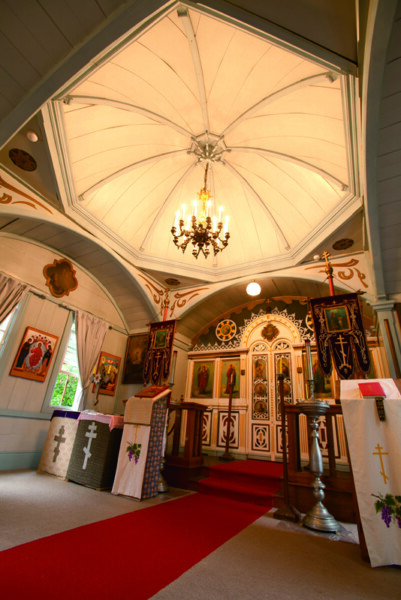
The oldest wooden Byzantine-style church in Japan, the Kitaka Orthodox Church of Christ, was built on a private estate using private funds
"Kita-Shika Orthodox Church, a wealthy farmer and devout Christian,Ichinosuke Hatakeyamawas built in 1892 (Meiji 25) byMagata Gospel Church. It was originally called the
It is currently part of the Morioka Orthodox Church andMagata Shoshinjo Fukuin Daisei-dois used as the
Inside the Byzantine-style church, constructed from Akita cedar,Rin Yamashitayou'll find an icon (a religious painting/designated as a tangible cultural property of Odate City) by
My love of travel led me to work for a travel magazine some time ago, and now I work as a travel writer for an online publication. I have visited all 47 prefectures in Japan, focusing on the Tohoku region, and I enjoy soaking in hot springs and experiencing traditional Japanese culture, including old townscapes, lifestyles, and performing arts and crafts




")


![Daito-ryu Aikijujutsu [Part 2]](https://jp.neft.asia/wp-content/uploads/2026/01/aiki_tkd03-300x300.jpg.webp)


![Daito-ryu Aikijujutsu [Part 1]](https://jp.neft.asia/wp-content/uploads/2026/01/aiki_tkd01-300x300.jpg.webp)


