This site is an online media that delivers all sorts of trivia about the six Tohoku prefectures, from sightseeing and gourmet spots to local customs, history, and more
Kesennuma Oshima Island floats off the coast of Kesennuma City, Miyagi Prefecture. Near Tanaka Beach on its eastern shore, there is a Jizo (guardian deity) shrine known as "Michibiki Jizo" (Guiding Jizo)
Besides the belief that the Michibiki Jizo guides the souls of the deceased to paradise, there is also a legend that a mother and child witnessed a mysterious sight in front of the Jizo the day before the great tsunami struck, and the memory of the tsunami that actually hit the Sanriku coast has been passed down as a folktale
This time, we will introduce the legend of the "Guiding Jizo" that still remains on Kesennuma Oshima Island, and the circumstances surrounding the reconstruction of the Jizo hall after the Great East Japan Earthquake
What is the "Guiding Jizo" of Kesennuma Oshima?
The Michibiki Jizo is a Jizo statue enshrined near Tanakahama beach on Kesennuma Oshima Island
This Jizo Bodhisattva is believed to guide the souls of the dead to paradise and has long been revered by the local people, sharing similar characteristics with Mount Osore in Aomori Prefecture
Furthermore, there is a legend on Kesennuma Oshima that "the souls of those who die visit the Michibiki Jizo the day before their death," and the following legend about the Michibiki Jizo related to the great tsunami has been passed down based on this
The souls of the villagers that appeared before the Jizo statue
Michibiki Jizo
Once upon a time, a mother and child living on Kesennuma Oshima Island passed by the Michibiki Jizo statue at dusk
Then, a large number of villagers began to appear one after another in front of the Jizo statue. Among them were not only people, but also cows and horses
What the mother and child saw were the souls of the people and livestock living on the island as usual
There is a legend that the souls of those who are about to die come to the Michibiki Jizo (Guiding Jizo) the day before their death to say goodbye. Therefore, the mother felt great anxiety when she saw the scene before her
When the mother and child returned home, they told the father what had happened. However, the father didn't believe them right away and dismissed it, saying they must have been tricked by something
The next day, a massive tsunami struck the island
Michibiki Jizo
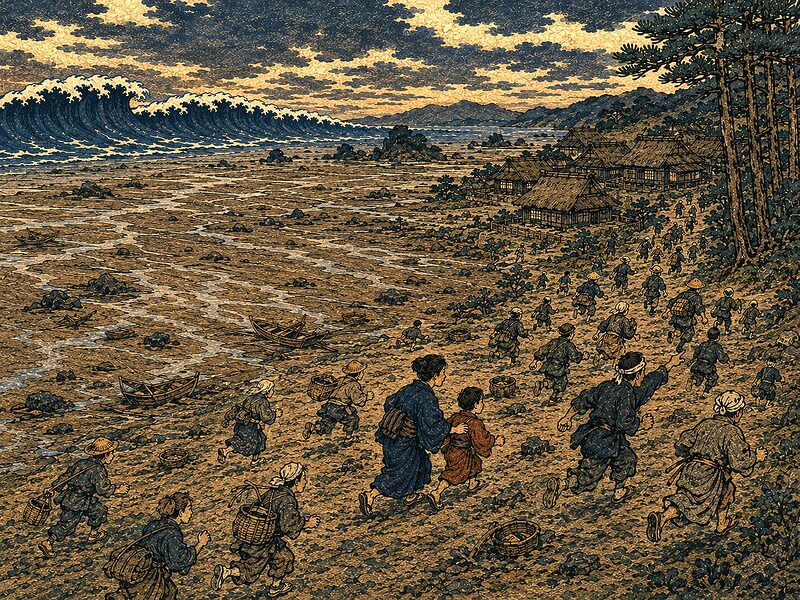
The next day, the tide receded on the beach more than I had ever seen before
Many villagers went out to the beach to gather seaweed and other things. However, even though it was time for the tide to come back in, the seawater did not return for quite some time
Soon, a massive tsunami will surge in from the far out at sea
The mother and child, noticing something was wrong, quickly fled to higher ground with the father and narrowly escaped harm. Meanwhile, it is said that many villagers and their livestock were swept away by the tsunami
It was then that the mother and child realized that the people they had seen the previous day in front of the Michibiki Jizo were the souls of those who had lost their lives in the tsunami
Information board for the "Guiding Jizo" located at the site
An information board installed at the site states that 61 villagers and 6 cows and horses died in this tsunami
Rather than the Michibiki Jizo (guiding Jizo) predicting the occurrence of the tsunami itself, it has been passed down through generations as a Jizo that, by showing the souls of those who would die the following day, ultimately warned mothers and children of the impending danger
Is the folktale based on the 1896 Meiji Sanriku tsunami?
As mentioned at the beginning, the legend of the "Guiding Jizo" is sometimes presented in connection with the "Meiji Sanriku Tsunami" that occurred on June 15, 1896 (Meiji 29)
This day corresponds to the 5th day of the 5th month in the old lunar calendar, which is also the day of the Tango no Sekku (Boys' Festival). According to the Sendai Regional Meteorological Observatory of the Japan Meteorological Agency, the Meiji Sanriku Earthquake occurred at around 7:32 p.m. on that day, with its epicenter approximately 200 kilometers east of Kamaishi City, Iwate Prefecture, and its magnitude is estimated to be between 8.2 and 8.5
On the other hand, the tremors felt along the coast were weak, around magnitude 2 to 3, and some areas did not feel any significant shaking. However, about 30 minutes after the earthquake, a massive tsunami hit the Sanriku coast
The tsunami resulted in 21,959 deaths and missing persons, mainly in Iwate and Miyagi prefectures, and the maximum run-up height was estimated at 38.2 meters, causing immense damage that will go down in the history of tsunami disasters in Japan
In the folktale, the villagers go out to the beach when the tide is unusually low, without any warning of a major earthquake. This description mirrors the characteristics of the Meiji Sanriku earthquake, where a massive tsunami occurred despite the relatively small shaking
There is limited documentation to confirm when the legend of "Michibiki Jizo" originated and how it evolved into the story we know today
Therefore, rather than concluding that it is "a story that directly records the actual Meiji Sanriku tsunami," it would be more appropriate to consider it as a folktale that conveys the memory and lessons of the tsunami
Also broadcast on "Manga Nihon Mukashibanashi" (Japanese Folk Tales in Manga)
The folktale of the Guiding Jizo was also featured in the TV anime "Manga Nihon Mukashibanashi" (Japanese Folk Tales)
The story of "Michibiki Jizo" (Guiding Jizo) was broadcast nationwide on October 29, 1977 (Showa 52), and many people likely became familiar with the name when this folk tale, which had been passed down in a region of Tohoku, was broadcast across the country
There are some differences between the story depicted in the program and the local traditions that have been passed down through generations. Folktales can change in detail depending on the storyteller and the time period in which they were recorded, so one storyline is not necessarily the only version
Nevertheless, the common lesson in all these stories is to move away from the sea and escape to higher ground if you see an unusually low tide
The "Guiding Jizo" statue that was swept away in the Great East Japan Earthquake
The three wooden Jizo statues enshrined in this area were swept away along with the temple hall by the massive tsunami caused by the Great East Japan Earthquake on March 11, 2011
According to the local information sign, the "Michibiki Jizo" (Guiding Jizo) was enshrined as the tutelary deity of the Shirahata Takashi family's home. After learning of its history, the Kesennuma Oshima Tourism Association offered to rebuild the statue at the home of the family that inherited it. With the cooperation of Maki Watanabe of the Sanriku Shinpo newspaper and support from all over the country, the reconstruction was realized
The new temple was built by Omi Construction, a family of temple carpenters in Ayabe City, Kyoto Prefecture, with a history spanning three generations. The temple, built in Ayabe City, was transported by large truck to Kesennuma Oshima and erected at its current location
For the reconstruction, donations poured in from all over the country, and in particular, a fundraising campaign was held by citizens in Ayabe City, Kyoto Prefecture. The circle of donors grew to about 3,000 people, and messages from the citizens of Ayabe who donated are placed inside the temple as a "time capsule."
The three newly placed wooden Jizo statues were created by Yuki Onodera, who hails from Kesennuma Oshima. Onodera lost his father when he was in elementary school and began carving Buddhist statues in junior high school to support his family. He kindly took on the task of creating the statues while he was still in university
Furthermore, in order to raise funds for reconstruction, 5,000 copies of "The Guiding Jizo Picture Book," based on folk tales, were produced. Although self-published, it almost completely sold out, and the proceeds also supported the reconstruction
A sign explaining the circumstances surrounding the construction of the Michibiki Jizo (guiding Jizo statue)
Stone Buddha discovered after reconstruction
The reconstructed temple grounds house three newly created wooden Jizo statues, as well as several stone Buddha statues
According to an article in the Kahoku Shimpo dated May 12, 2014, in July 2013, three stone Buddha statues that had been swept away by the tsunami caused by the Great East Japan Earthquake were discovered among the rubble remaining near the Jizo Hall
According to reports from 2014, a total of nine stone Buddha statues were enshrined there, including the six that were added during the reconstruction and the three that were found among the rubble
Memories of the tsunami remain near the beautiful Tanaka Beach
Tanaka Beach near Michibiki Jizo
Tanakahama, located on the eastern coast of Kesennuma Oshima, boasts beautiful sandy beaches and coastal scenery, and is also known as a filming location for the TV drama series "Okaeri Mone." The Jizo hall where the Michibiki Jizo is located is about a 5-minute walk from Tanakahama
The presence of a Jizo statue, which conveys the horrors of tsunamis, near a place overlooking the calm sea, reflects the deep relationship between the sea, which brings abundant blessings but sometimes causes great disasters, and the people who have lived along the Sanriku coast
The legend of the Guiding Jizo not only serves as a fascinating folktale to be enjoyed, but it has also played a role in passing down the lesson from generation to generation: when you sense something unusual happening at sea, do not hesitate to flee
Warning
Swimming is prohibited at Tanaka Beach due to rip currents. Please do not enter the water and enjoy strolling around and the scenery while taking sufficient safety precautions
Michibiki Jizo – <Information>
Name: Michibiki Jizo
Address: 33 Sotohata, Kesennuma City, Miyagi Prefecture
Inquiries: Kesennuma City Tourism Association Oshima Branch
Phone: 0226-28-3000
Access by car: Approximately 9 minutes from the Urashima-Oshima Interchange on the Sanriku Expressway
Public transportation: Approximately 13 minutes on foot from the "Uranohama" bus stop on the Kesennuma City Bus Oshima Line
I'm a member of the Neft editorial team. I love alcohol, music, and travel, and on weekdays I indulge in drinks after work, and on weekends I travel to nearby places whenever I have free time.
My goal is to one day travel abroad to explore connections with Tohoku for a Neft feature! I work hard every day towards that goal.







![What are the Mogami Eight Shields? [Part 2]](https://jp.neft.asia/wp-content/uploads/2026/04/my_ic02-300x300.jpg.webp)
