


The best time to visit the Hachimantai Aspite Line is about a month after it reopens following its winter closure!

The Hachimantai Aspite Lineis a mountain drive that traverses a plateau area spanning Akita and Iwate prefectures, centered around Mount Hachimantai (1,613m above sea level), the highest peak in the Hachimantai volcanic group.
Hachimantai is located within the Towada-Hachimantai National Park and is a plateau area at an altitude of 1,000m to 1,500m where many volcanoes are concentrated, including Hachimantai itself, as well as Yakeyama (1,366m), Obukadake (1,544m), and Chausudake (1,578m). In addition to its magnificent scenery, the area is also attractive for the hot springs scattered throughout the national forest
The Hachimantai Aspite Line, which is closed to traffic during the winter due to snow on both the Iwate Prefecture side and parts of the Akita Prefecture side.

The Hachimantai Aspite Line is approximately 27 km long, encompassing both the Akita and Iwate prefectures. On the Akita side, it runs from National Route 341, which connects Kazuno City to Tamagawa Onsen and Lake Tazawa, to the Iwate prefectural border. On the Iwate side, it connects the prefectural border to Hachimantai City (Gozaisho Gate) in Iwate Prefecture
During the winter months (around November to mid-April), it is possible to travel from the entrance on National Route 341 on the Akita Prefecture side to the vicinity of Goshogake Onsen, but the rest of the Akita Prefecture side and the entire Iwate Prefecture side become impassable, making it impossible to travel between the Akita and Iwate prefectures
"Dragon" Private Transfer Service (Reservation Only) - Reservation Details
- Online reservations: NPO Combigore Hachimantai
- Phone number: 090-2449-2418
- Payment method: Cash only
- Reception hours: 9:00-16:00
- Official URL:Fully reservation-only private shuttle service "Dragon-go" Combigore Hachimantai
A towering snow wall stretching for over 20km | The "Snow Corridor" of the Hachimantai Aspite Line」

The highlight of the Hachimantai Aspite Line in early spring is around mid-April when snow removal is complete and the entire line is fully open (the opening date varies depending on the amount of snowfall), with snow walls stretching for over 20km on both sides of the road. Depending on the amount of snow, these walls can reach heights of over 10m
For those who want to see the "Snow Corridor" as soon as possible, we recommend the section from the Akita Prefecture entrance to the vicinity of Goshogake Onsen. Although the amount of snowfall is less, you can see walls of snow over 3 meters high. While you're there, why not enjoy a relaxing bath at Goshogake Onsen, which is open all year round?
While it is possible to travel on the Hachimantai Aspite Line with normal tires, some areas in the surrounding region are not adequately cleared of snow. It is safer to use winter tires during the early spring season
Google Map
Goshogake Onsen is a famous hot spring where it is said that "a patient with a leg disability who arrived on horseback walked back home."

Goshogake Onsen is a single-inn hot spring located in a national forest at an altitude of approximately 1,000m on the eastern side of Yakiyama. It is said that the hot spring water has been in use since the mid-Edo period. It was highly regarded as a famous hot spring and was known as " Goshogake, where you come on horseback and leave on wooden clogs ."
Ashida are geta (wooden clogs) with slightly raised soles that prevent the hem of a kimono from getting dirty in muddy areas. The hot springs of Goshogake were so renowned for their therapeutic effects that guests with foot problems who arrived on horseback could return home wearing their geta after their treatment. In 1881 (Meiji 14), the inn was established as a therapeutic hot spring resort
The spring water is a simple sulfur spring with a temperature of 87.9°C and a pH of 3.02. It is a weakly acidic hot spring and is said to be effective for gastrointestinal diseases, neuralgia, lower back pain, knee arthritis, rheumatism, diabetes, and atopic dermatitis
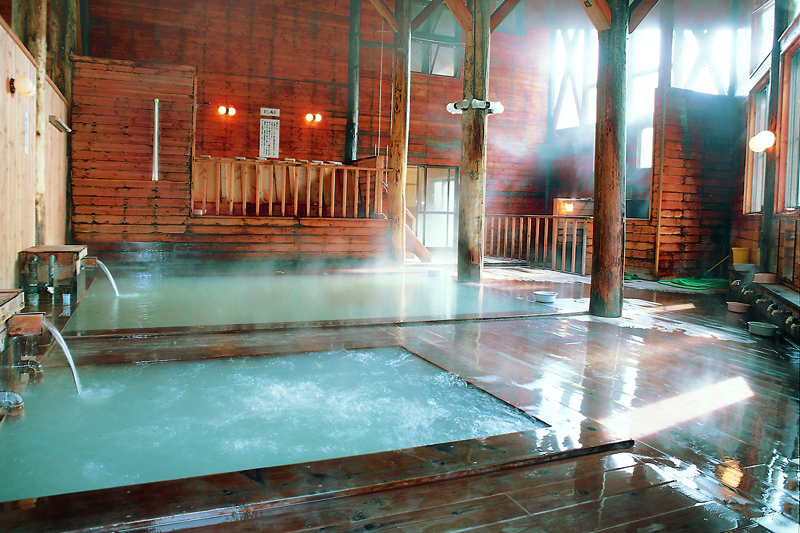
The inn has a regular guesthouse section and a therapeutic bathing section for those seeking hot spring treatments. The therapeutic bathing section features ondol, which uses geothermal energy to heat the floors. Ondol is a highly effective bathing method that warms the body from the core and promotes metabolism, and it can also be used for day trips to the hot springs
The large public bath features seven types of hot springs, including a mud bath, a volcanic bath, and a steam bath, allowing you to fully enjoy the Goshogake Onsen
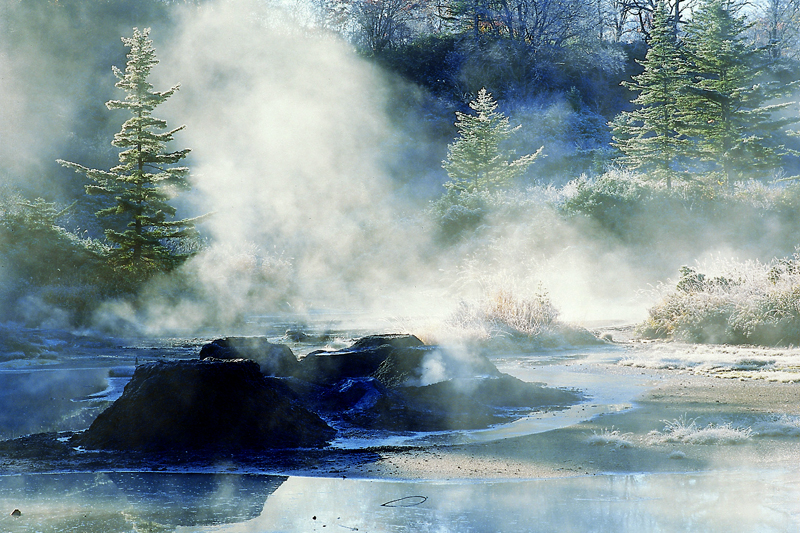
Near Goshogake Onsen is the Goshogake Nature Research Trail (closed in winter), centered around the "Oyunuma" (Great Hot Spring Marsh), where high-temperature water gushes from the bottom and steam rises profusely, allowing you to experience the living earth with your whole body.
Goshogake Onsen<Information>
- Facility name: Goshogake Onsen
- Location: Within the Kumazawa National Forest, Hachimantai, Kazuno City, Akita Prefecture
- Phone number: 0186-31-2221
- Opening period: All year round
- Spring water type: Simple sulfur spring
- Day-use bathing: Available year-round. *Please check the official website or call for details regarding closing days, which vary depending on the season
- URL:Goshogake Onsen
Google Map
Hachimantai Kogen Hotel is a natural hot spring inn that is ideal as a base for exploring Hachimantai from spring to autumn

HachimantaiKogen Hoteloperates as a dedicated accommodation facility for ski camps at Akita Hachimantai Ski Resort, located about a 10-minute walk from Goshogake Onsen, during the winter season. In the green season, it is a popular hotel that serves as a base for exploring the surrounding plateau.
One of the attractions of the Hachimantai Kogen Hotel is that it has two different natural hot springs. The springs are a simple hot spring and an iron-containing simple hot spring, and both are free-flowing from the source. Both are nearly neutral in pH, with the iron-containing simple hot spring used in the separate indoor baths for men and women, and the simple hot spring used in the open-air bath attached to the indoor baths. The benefits of both springs include relief from neuralgia, muscle pain, joint pain, frozen shoulder, paralysis, bruises, sprains, chronic digestive diseases, hemorrhoids, cold sensitivity, post-illness recovery, fatigue recovery, and general health improvement
The open-air bath features tile patterns in the style of Spanish architect Gaudí, offering a unique bathing experience. The guest rooms are Japanese-style, and guests can enjoy creative Japanese cuisine featuring local ingredients
Akita Hachimantai Ski Resort is open from mid-November to early May
Hachimantai Kogen Hotel <Information>
- Facility name: Hachimantai Kogen Hotel
- Location: Kumazawa National Forest, Hachimantai, Kazuno City, Akita Prefecture
- Phone number: 0186-31-2011
- Opening period: All year round
- Spring water quality: Iron-containing simple hot spring, simple hot spring
- Day-use bathing: Available year-round
- Admission fee: Adults 600 yen, Children 300 yen
- Official URL:Hachimantai Kogen Hotel
Google Map
With an abundant supply of hot spring water, the open-air bath is incredibly liberating. We're looking forward to the reopening of "Fuke-no-Yu" in the spring

"Fukenoyu Onsen" is a single inn located in a national forest about 3.7 km uphill from "Goshogake Onsen" towards the summit of Mt. Hachimantai via the Hachimantai Aspite Line. It has a long history and is said to be the oldest hot spring in Hachimantai, having been discovered about 400 years ago.
The hot springs are of two types: simple sulfur springs (hydrogen sulfide type) and simple hot springs. The water supply is abundant, and it flows continuously into the five open-air baths and the large public bath
The open-air bath (called a "notenburo" at Fuke-no-Yu) is mixed-gender (a wooden-framed bath with a rock bath and a barrel bath), and there are also separate wooden-framed baths for men and women, as well as separate large public baths for men and women, each with its own open-air bath. You can enjoy a 360-degree panoramic view from the notenburo, a unique pleasure only available at Fuke-no-Yu, which is surrounded by nature

The spring water temperature varies depending on the source, as there are three different springs, but all are over 80°C, which is too hot for bathing, so water is added. The water is said to be effective for neuralgia, rheumatism, infertility, gynecological diseases, hernias, fatigue recovery, gastrointestinal diseases, skin diseases, atopic dermatitis, and post-operative recovery, and is especially known as the "fertility spring."
The inn is a two-story wooden building with a retro main building and a new building that was rebuilt in 2000. In addition to Japanese-style rooms, there are also Japanese-Western style rooms available
"Fuke no Yu" is only open during the green season and is closed from early November to late April due to snowfall
Fuke no Yu <Information>
- Facility name: Fukenoyu Onsen
- Location: Within the Kumazawa National Forest, Hachimantai, Kazuno City, Akita Prefecture
- Phone number: 0186-31-2131
- Spring water type: Simple sulfur spring (hydrogen sulfide type) and simple hot spring
- Day trip bathing: Available
- Opening period: late April to early November
- Official URL:Japan Association for the Preservation of Secret Hot Springs – Fuke-no-yu
Google Map
Mid-May to early June... The mysterious "Dragon Eye" is difficult to predict when it will appear

The " Dragon Eye " appears in the small crater lake called Kagami-numa around late May, when the snow has melted .
Kagami-numa, a small, round crater lake about 50 meters in diameter, is nestled in a national forest near the Iwate Prefecture border along the Hachimantai Aspite Line. The "Dragon Eye" only appears for about three days between mid-May and early June. Moreover, its appearance depends on the amount of snowfall and weather each year, making it unpredictable. Local governments and visitor centers release information regularly, but it's often inaccurate. However, the感動 (deep emotion) felt by those who happen to witness it is an irreplaceable experience
This phenomenon occurs when a large amount of snowmelt flows into the swamp from winter to spring, lifting the central part with buoyancy and creating an island-like structure. As it gets warmer, the snow in the center begins to melt, completing the "dragon's eye" shape

Kagami-numa, a crater lake that opens up in the middle of a dense national forest. A fleeting work of art only seen in early spring: the "Dragon Eye."
Dragon Eye <Information>>
- Name: Dragon Eye
- Period: Varies between mid-May and early June
- Information: Hachimantai Visitor Center
- Phone number: 0186-31-2714 (early April to early November)
- Official URL:Kazuno Official Tourism Site "Traveling Kazuno" - Dragon Eye
Google Map

My love of travel led me to work for a travel magazine some time ago, and now I work as a travel writer for an online publication. I have visited all 47 prefectures in Japan, focusing on the Tohoku region, and I enjoy soaking in hot springs and experiencing traditional Japanese culture, including old townscapes, lifestyles, and performing arts and crafts
Please support NEFT's article creation!
NEFT gathers and publishes articles about the history, culture, and tourism information of various regions in Tohoku
If you enjoyed this article, we would be grateful if you would consider supporting our future interviews, article creation, and website management
*Clicking "Tip" will open the tip sending screen for the external service "codoc"
Other articles

The retro-style "Marukan Building Grand Dining Hall" is a representative landmark of Hanamaki...

[Iwaki City, Fukushima Prefecture] The amount of hot water is the largest in Fukushima Prefecture.

Hiraizumi, a sake brewery founded in the Muromachi period, is a roman...

Recommended for rainy days! Enjoy fluffy fun at Kamo Aquarium...

[Date City, Fukushima Prefecture] A journey around the sacred mountain of power spots...

[Mt. Chokai-Tobishima Geopark: Nikaho (1)] Alongside Matsushima...

[Akita] A panoramic view of the Kubota Castle ruins! Akita Prefectural Museum of Art and...

A soothing sight during the rainy season! The beautiful hydrangeas at Daibutsu Park...

Walking around the town is fun! Take a stroll and experience the retro atmosphere...

[Morioka City, Iwate Prefecture] Enjoy the view of Morioka from above! The city...

[Miyagi] A famous cherry blossom spot in Japan's first gold-producing region! Wakui Castle Ruins (Shiroyama...
