


"Place names with 'to' in them" from 1 to 9 [Mito Edition] Mito, the birthplace of the Nanbu clan, is a city of famous places, historical sites and cats

Sannohe District, located further north along National Route 4 from northern Iwate Prefecture and beyond the border with Aomori Prefecture, is the birthplace of the Sannohe Nanbu clan and a region deeply connected to the Morioka Domain.
In the early Kamakura period, Nukanobu County was awarded to Nanbu Mitsuyuki of Kai Province as a reward for his military achievements in the Oshu War, in which Minamoto no Yoritomo destroyed the Oshu Fujiwara clan
As a result, the Nanbu clan moved to Sannohe County (Sannohe Town and Nanbu Town) and made it their base, where their family temple and ancestral graves still remain to this day


Sannohe was the center of the "Nambu territory until the crescent moon was full"

The Nanbu territory was so vast at its peak that it was said, "Even if you walked through it every day, it would take as many days as it takes for the crescent moon to become a full moon."
Sannohe Castle was the center of the Nanbu domain until the Edo period, when the Nanbu clan moved their base to Morioka Castle, and many famous places and historical sites related to the Nanbu clan remain in Sannohe Town and the neighboring Nanbu Town
In addition, Sannohe Town has been the site of many Jomon period ruins and artifacts excavated, and is also famous as the birthplace of manga artist Noboru Baba, author of the popular modern picture book "11 Cats."
The cat drawn by Baba is considered the town's symbolic character, and the official website of Sannohe Town features the catchphrase "Sannohe Town, a town of 11 cats who all join forces."
National Historic Site "Sannohe Castle Ruins" and Historical Museum "Onkokan" (Prefectural Shiroyama Park)

Located almost in the center of Mito town, this sturdy mountain castle uses the Mabuchi River and Kumahara River as natural moats and was built by Nanbu Harumasa, the 24th head of the Nanbu clan

Currently, it is known as Aomori PrefecturalShiroyama Park. The magistrate's gate, the main gate (which was relocated elsewhere), and the rear gate are designated tangible cultural properties of Sannohe Town. Within the park is the Nukabe Shrine, where Nanbu Mitsuyuki, the ancestor of the Nanbu clan, is enshrined.

In 1967 (Showa 42), the historical museum "Onkokan" was built, and the castle-like building was completed, creating an atmosphere reminiscent of a castle.

However, when the ruins of Sannohe Castle were designated as a "national historic site" on March 15, 2022 (Reiwa 4), the government requested that this castle tower-like structure be removed, as it was not based on historical fact
Shiroyama Park〈Information〉
- Facility name: National Historic Site Sannohe Castle Ruins Shiroyama Park
- Location: Umenaijonoshita, Sannohe-machi, Sannohe-gun, Aomori Prefecture
- Phone number: 0179-22-2739
- Museum opening hours: 9:00-16:00
- Closed: Mondays, the day after public holidays, and during the winter season from December 1st to March 31st of the following year
- URL:Mito Town Official Website
Google Map
Sannohe Daijingu Shrine is popular for its stained glass and mascot characters
The enshrined deity is Amaterasu Omikami, and the shrine is affectionately known locally as " Shinmei-sama " or " Tohoku's Ise-sama ." It is believed to grant all kinds of wishes, and the shrine is known for "wish fulfillment."
The shrine is unusual in that it uses beautiful stained glass in its buildings and lanterns, and its original cat-themed characters, "Mikonyan" and "Catherine," are popular for their cuteness.
Sannohe Daijingu Shrine <Information>
- Relocation name: Sannohe Daijingu Shrine
- Facility location: 43 Suwanai, Doshincho, Sannohe-machi, Sannohe-gun, Aomori Prefecture
- Phone number: 0179-22-2501
- URL:Mito Grand Shrine Official Website
Google Map
Roadside Station Sanhe

"11 Cats," they also sell Sannohe senbei, a type of Nanbu senbei cracker.
These rice crackers have a lighter texture than the Nanbu rice crackers from Ninohe and Morioka, and come in a variety of flavors, including sesame. The thin outer parts of the rice crackers, known as "senbei no mimi," are popular as a quick and easy-to-eat snack

Direct from the farm are apples, cherries, grapes and other fruits from Sannohe Town and Nanbu Town, and there are farms around the town where you can enjoy picking these fruits, and garlic is also sold as a famous local product
the restaurant "Mito Shokudo Hakusan," we recommend the local specialty, "Kawagani Hittsumi (suiton)."
Roadside Station Sannohe <Information>
- Facility name: Roadside Station Sannohe
- Address: 39-1 Kawamorita Amakubo, Sannohe-machi, Sannohe-gun, Aomori Prefecture
- Phone number: 0179-22-0600
- Business hours: 9:00-17:00
- URL:Michi-no-Eki Sannohe Official Website
Google Map
The Nanbu clan originated in Nanbu Town, next to Sannohe Town

The area encompassing Shojuji-date in Nanbu -cho, along with the surrounding Baba - date and Heragasaki-date , is known as Motosannohe-jo .
This place, close to Shojuji Temple, the family temple of the Nanbu clan, was the castle of the Sannohe Nanbu clan for approximately 200 years, from the 11th head of the clan, Nobunaga, to the 24th head, Harumasa

However, during the reign of Harumasa, the castle was burned down by a vassal who had a grudge against him, and his castle came to be mirrored as Sannohe Castle
Later, Shojuji Temple was moved to Morioka and became the family temple of the Nanbu family along with Tozenji Temple, but the other family temple, Sankoji Temple, remains in Nanbu Town
In addition, three areas - Honsannohe Castle, the area around Sankoji Temple, and the area around the local shrine, Honsannohe Hachimangu Shrine - have been designated as national historic sites
Heads of the Nanbu clan rest at Sankoji Temple
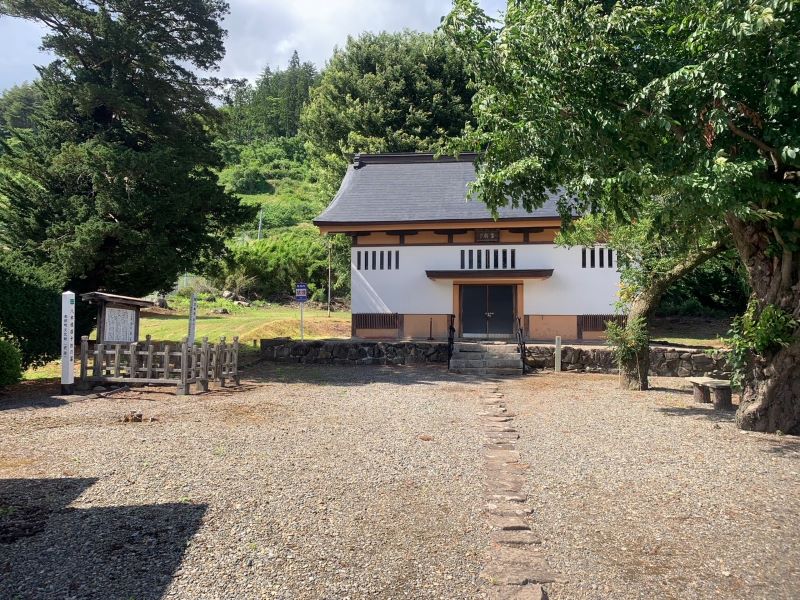
Sankoji Temple , the family temple of the Nanbu clan , houses the mausoleums and graves of the following heads of the family.
- the second head of the family,Nanbu Sanemitsu.
- the 26th headandhis wife (a town-designated tangible cultural property).
- The mausoleum of Nanbu Toshinao, the 27th head of the family (a prefectural cultural property).
- The mausoleum of Nanbu Toshiyasu , the fourth son of Toshinao who died young (a nationally designated important cultural property).

The mausoleum of Nanbu Toshiyasu is completely covered by a roofing hall, similar to the Konjikido in Hiraizumi, and to view it you must make a reservation in advance by phone with the information center at the Shojuji Temple Ruins Historic Site (fees apply)

Please note that the Sankoji Temple grounds are off-limits to tourists
Sankoji Temple <Information>
- Facility name: Sankoji Temple
- Facility location: 60 Komukai Shojuji, Nanbu-machi, Sannohe-gun, Aomori Prefecture
- Phone number: 0179-23-3773
Google Map
Shojuji Temple Ruins Information Center
- Facility name: Shojuji Temple Ruins Information Center
- Facility location: 81-2 Komukai Shojuji, Nanbu-machi, Sannohe-gun, Aomori Prefecture
- Phone number: 0179-23-4711
- Business hours: 9:00-16:30
- Closed: December 29th to January 3rd
- URL:Nanbu Town Official Website
Google Map
summary
Sannohe has a deep connection with the Nanbu clan and is known for having many famous places and historical sites
A car is convenient for visiting these widely scattered historical sites, but there is also public transportation available, such as the Aoimori Railway, which connects to Aomori Station and Morioka Station through a partnership with the IGR Iwate Galaxy Railway
Special feature on "place names with 'to' in them" from 1 to 9



I'm a former Edoite (Tokyoite) who loves Morioka and the six prefectures of Tohoku, and I'm a big fan of history, gourmet food, travel, sports, alcohol, and choral singing.
I'll introduce you to interesting things, delicious food, and great places in Tohoku!
Please support NEFT's article creation!
NEFT gathers and publishes articles about the history, culture, and tourism information of various regions in Tohoku
If you enjoyed this article, we would be grateful if you would consider supporting our future interviews, article creation, and website management
*Clicking "Tip" will open the tip sending screen for the external service "codoc"
Other articles

Motsuji Temple, a World Heritage Site with Japan's oldest garden, the Pure Land Garden...

[Iwate] Feel nostalgic! Morioka Station Retro...

Kandachi horses are grazing at the foot of Shiriyazaki Lighthouse, the northernmost point of Honshu...

The Hashino Iron Mine, a World Heritage Site in Kamaishi City, Iwate Prefecture, is a produc...

[Part 2] Masumi Sugae's walk along the Oga Peninsula – along the coast...

Autumn is the season for sightseeing! Can you climb Mt. Yamadera even if you're not very fit?

What is Hachinohe's local dish "Ichigo-ni"? From its history to its name...

[Iwate Prefecture during the Boshin War] What decisions did the Morioka Domain and Ichinoseki Domain make?

[Yamagata] Ginzan Onsen: A popular hot spring resort with a Taisho era feel

Haguro, as depicted in the 38th chapter of the manga "That's Journey"...

[Tohoku] Strange festivals in Tohoku!? 6 festivals that will surprise people from other prefectures...
