This site is an online media that delivers all sorts of trivia about the six Tohoku prefectures, from sightseeing and gourmet spots to local customs, history, and more
Innai district, Yuzawa City, Akita Prefecture. This quiet mountain village once flourished as the town of the Innai Silver Mine , known as the "largest silver mine in the Orient."
Today,Kanayama Shrine, but it was once the center of faith in the mining town, where thousands of miners prayed for safety and prosperity during breaks from their daily work.
Innai Mine, once known as "the best in the Orient"
The Innai Silver Mine was discoveredin 1606.It is said to have begun when a man named Murayama Sohei and his companions found a silver vein in the mountains. Subsequently, it came under the control of the Kubota Domain (Akita Domain), and development began, with mining being carried out under the direct control of the domain.
Primarily producing gold and silver, it boasted the largest production volume in Japan throughout the Edo period. During the Tenpo era (1830s), when technology advanced, it experienced a golden age known as the "Tenpo boom," producing over 1,000 kan (approximately 3.75 tons) of silver annually.
A map of the Innai Silver Mine from the Tenpo period on site
At its peak, the mining town was bustling with miners, craftsmen, merchants, and monks, andits population reached over 15,000 at itsに達したとも伝えられ、久保田城下をも凌駕するその繁栄ぶりは"the capital of Dewa,"and the gold and silver produced there became a major pillar supporting the domain's finances.
The Faith that Protects the Silver Mine - The Founding of Kanayama Shrine
Kanayama Shrine is said to have been founded in 1609, shortly after the development of the silver mine began, when it was first enshrined to pray for "safe mining and the prosperity of the ore vein."
The plaque of "Yamajinja Shrine"
Initially, a small shrine was built near the mining site in the mountains and worshipped under the name "Mountain Shrine." It is said that the shrine was located in its current location in 1760.
Plaque bearing the name "Kanayamahiko no Mikoto"
The enshrined deities areKanayamahiko-no-Okami and Kanayamahime-no-Okami,. These two deities have been worshipped since ancient times as the guardian deities of artisans involved in blacksmithing, casting, and mining.
Furthermore, mountain worship linked to the mountain god is deeply rooted, and it is believed that miners hoping for protection inside the mine visited Kanayama Shrine and prayed, "so that the mountain god would not dislike me" and "so that no accidents would occur."
Modernization and mine closure after the Meiji period
After the Meiji Restoration, Innai Silver Mine was taken over by a private company after being under government control, and the introduction of Western mining and refining techniques led to a resurgence in activity. However, the collapse of the silver price at the end of the Meiji period led to a decline in profitability, and the scale of the mine was drastically reduced.
Mining continued on a small scale even into the Showa era, but the mine finallyclosed in 1954.This brought to an end the history of the Innai Silver Mine, which had lasted for approximately 350 years.
Shrines and stone monuments within the grounds of Kanayama Shrine
Many people left and the mining town rapidly fell into decline, but Kanayama Shrine alone continued to be protected by the local people. Within the shrine grounds remain votive monuments, stone lanterns, and prayer stones for the safety of the mining industry, all of which convey the deep faith of the time.
Current Kanayama Shrine
Kanayama Shrine still stands on the hilltop where the Innai Silver Mine once stood. According to the information board on-site, the shrine building was built by the Kubota clan in 1830 (Bunsei 13) during the late Edo period.
On-site information board at Innai Silver Mine "Kanayama Shrine"
During the mine's heyday, when it was bustling with visitors, he was worshipped as the "guardian deity of the mountains and mines," and now he is worshipped as the "god of prosperous business, bountiful harvests, and traffic safety."
Torii gate of Kanayama Shrine
The entire area of the former Innai Silver Mine site, including the Kanayama Shrine, shows no trace of its former prosperity, giving the impression that it is "beginning to be swallowed up by the mountains."
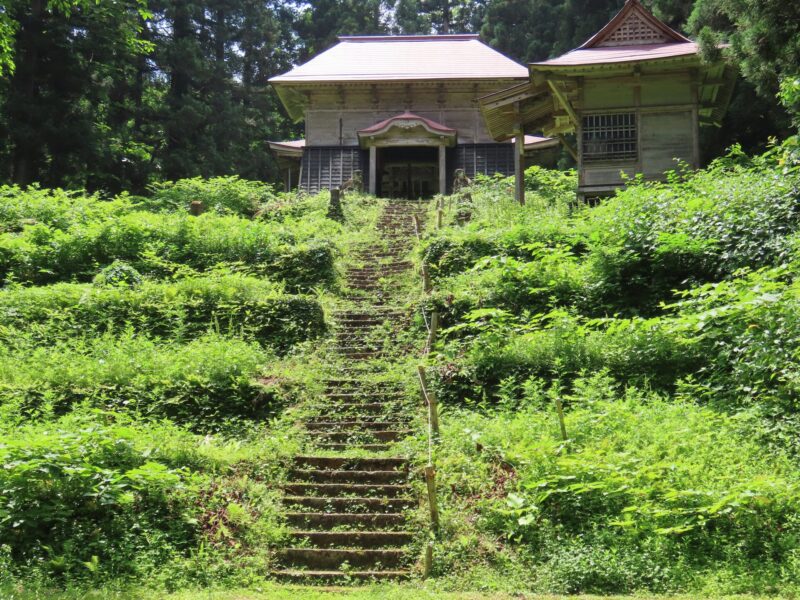
The grassy approach to Kanayama Shrine
The overgrown grass on the approach to the shrine and the moss-covered, weathered lion statues show that there is very little foot traffic at present.
Kanayama Shrine's mountain gate and lion dogs
In addition, the area around the shrine is dotted with mine entrances, stone monuments, and remnants of former mining facilities, and is designated as the Akita Prefecture Historic Site"Innai Silver Mine Ruins." However, in recent years, sightings of wild animals, including bears, have become frequent, so extreme caution is necessary when exploring the area.
Kanayama Shrine's worship hall
At the Innai Silver Mine Foreigners' House (museum), located next to Innai Station on the Ou Main Line, close to the Innai Silver Mine ruins, you can see mining tools, ore, and photographic materials from that time.
Kanayama Shrine <Information>
Name: Kanayama Shrine
Address: 40 Uehonmachi, Innai Ginzancho, Yuzawa City, Akita Prefecture, 019-0113
Traveling around the Tohoku region, I enjoy drinking delicious sake and exploring the local history, traditions, and customs. I write articles based on my interests. I'm currently interested in folk performing arts, local toys, and folk beliefs