This site is an online media that delivers all sorts of trivia about the six Tohoku prefectures, from sightseeing and gourmet spots to local customs, history, and more
The Japanese crayfishis a species endemic to Japan, inhabiting clean rivers and lakes with low water temperatures in Hokkaido, Aomori Prefecture, Iwate Prefecture, and Akita Prefecture.
Odate City isthe southern limit of the Japanese crayfish populationsaid to be"crayfish habitat"is designated as a national natural monument (region) as athe "crayfish habitat"is working on a project to restorethe Odate Local History Museumthese are currently on display at
Several habitats for Japanese crayfish have been found in Odate City, but their locations have not been made public
Originally, the only crayfish found in Japan was the Japanese crayfish (Cranius nihonensis), so in ancient times, there was no specific name for it; it was simply called a crayfish
In kanji,砂利蟹it's written asSo, a crayfish is a "crab that lives in gravel"(Wikipedia and other sources also list alternative theories; please refer to them).
Crayfish were imported from the United States for food and have proliferated
Crayfish escape from bullfrog farm and spread across the country
Until recently, Japan only had Japanese crayfish, but around 1927,American crayfishwere imported from New Orleans, USA, to be used as feed for farming bullfrogs, which were used for food.
The American bullfrog is also native to America and was imported to alleviate the shortage of food resources during the Taisho and early Showa periods. However, it did not become established as a food source, and farming ceased before the Pacific War
The bullfrog farm was abandoned, and along with the remaining bullfrogs, the American crayfish also multiplied rapidly due to their strong reproductive ability, eventually escaping the farm and quickly expanding their habitat
American crayfish can survive in harsh conditions
Currently, American crayfish can be found all over Japan, from Hokkaido to Okinawa. They are about 15 cm long, red or reddish-brown in color, and are found in abundance in freshwater rice paddies and waterways, and can survive in any poor quality water
In 2023,a conditionally specified invasive alien species, and it became prohibited to release it into ponds or other bodies of water without permission, or to sell, distribute, buy, or import it (keeping it as a pet or giving it away for free is not prohibited).
The signal crayfish was imported from Canada for consumption and is gradually expanding its habitat
There is another invasive species of crayfish in Japan.Uchida crayfish)and mainly inhabits Hokkaido.
The signal crayfish (Uchida crayfish) is a species of crayfish found in Canada and the northern United States, growing up to about 15 centimeters in length. It has a greenish-brown color
In 1926, the Ministry of Agriculture, Forestry and Fisheries imported them for food, and successful aquaculture was achieved in Lake Mashu, Hokkaido. However, they were not successful as a food source, and due to their strong reproductive capacity and aggressive nature, they became feral and spread throughout Hokkaido
Their aggressive nature, often involving cannibalism, poses a threat to Japanese crayfish and other native aquatic animals in Japan. In the 2000s, they were confirmed to be living in Chiba Prefecture, as well as Fukushima, Tochigi, Nagano, and Shiga Prefectures
The signal crayfish (Pacifastacus leniusculus)a specified invasive alien speciesis designated as"Japan's 100 Worst Invasive Alien Species."are included in
Attacked by the American crayfish from the south and the signal crayfish from the north, the Japanese crayfish is on the verge of extinction
Japanese crayfish are about 4 to 7 cm long, and are smaller than American crayfish and signal crayfish, which can grow up to 15 cm, with rounded shells and bodies with little waist. Their basic color is brown, but this can vary depending on the individual, and it can sometimes be difficult to distinguish them from other crayfish
The Japanese crayfish has a very gentle temperament and does not attack other crayfish. Moreover, its habitat is narrow, ranging from northern Tohoku to Hokkaido, and its reproductive capacity is low, so it is being invaded by aggressive invasive species and is facing the threat of extinction
If you happen to find a Japanese crayfish while strolling around,the Odate Local History Museumplease report it to
The Odate Local History Museum exhibits the historical heritage and traditional crafts of Odate and promotes conservation activities for natural monuments
which continues its conservation and breeding activities for the Japanese crayfish,The Odate Local History Museumhouses a large collection of materials, historical artifacts, and traditional crafts related to the ancient history, agriculture, forestry, mining, and nature of the Odate region. Some of these items are on display and available for learning.
which are said to have originated in the Odate region"magewappa" (bentwood boxes). Numerous examples are on permanent display, including magewappa unearthed from Heian period ruins, as well as everyday items and works of art.
Odate Local Museum <Information>
Facility name: Odate Local Museum
Address: 1 Shishigamori, Shakanai, Odate City, Akita Prefecture
The Odate regionthe Shirakami Mountains, a World Heritage Site, and was once covered with beech forests and natural Akita cedar forests. It is said that the production of bentwood boxes using Akita cedar became widespread during the Edo period when the Satake Nishi family, who were the castle lords of Odate Castle in the Kubota Domain (Akita Domain), encouraged it as a side business for lower-ranking samurai.
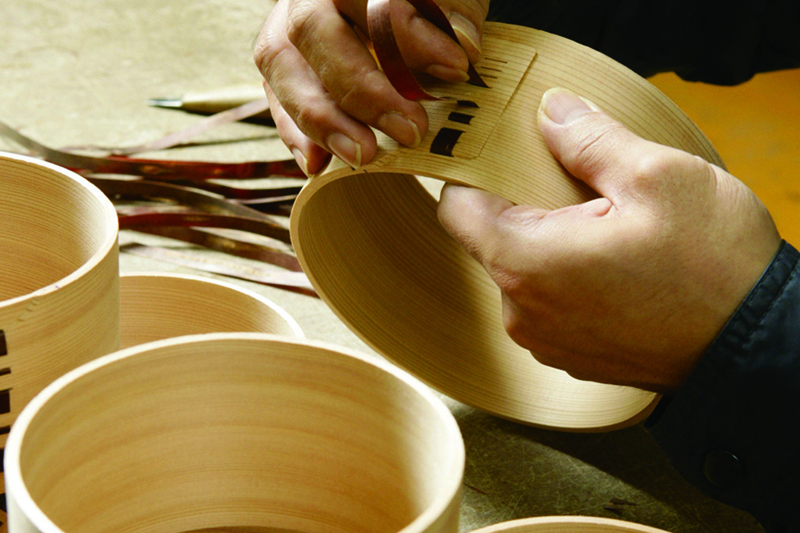
Thin strips of cedar bark are peeled off and soaked in hot water, then bent once softened and finally sewn with wild cherry bark to secure the pieces in place. Today, bento boxes are the most popular product, but back then, various everyday items such as trays and ladles were also made
Magewappa, a type of bentwood box that is even sung about in the Akita Ondo folk song, was designated a national traditional craft in 1980. While it takes some time, there are workshops in the city where you can experience making your own magewappa. Those interestedthe Odate Magewappa Cooperative Associationshould contact
Odate Magewappa Cooperative Association <Information>
Odate Magewappa Cooperative
Address: 5-A Nakamachi, Odate City, Akita Prefecture
My love of travel led me to work for a travel magazine some time ago, and now I work as a travel writer for an online publication. I have visited all 47 prefectures in Japan, focusing on the Tohoku region, and I enjoy soaking in hot springs and experiencing traditional Japanese culture, including old townscapes, lifestyles, and performing arts and crafts




![What day is it today? Tohoku Edition [0829]](https://jp.neft.asia/wp-content/uploads/2026/03/0829-150x150.png.webp "[What day is it today? | Tohoku Edition] What day is August 29th?")


![What are the Mogami Eight Shields? [Part 1]](https://jp.neft.asia/wp-content/uploads/2026/04/my_ic01-300x300.jpg.webp)
