This site is an online media that delivers all sorts of trivia about the six Tohoku prefectures, from sightseeing and gourmet spots to local customs, history, and more
During the Edo period, Yurihonjo City was divided into three domains: the Yashima Domain , the Kameda Domain , and the Honjo Domain , and it flourished as a port of call for Kitamae-bune (northern trade ships) .
During the Meiji Restoration, the three domains, along with the Kubota Domain (Akita Domain), were caught up in a civil war with the Shonai Domain, which supported the former Edo Shogunate, as part of the new government forces, and suffered great damage
During the Boshin War, the Yajima clan was on the front line of the new government forces, fighting fierce battles with the neighboring Shonai clan, which supported the former shogunate, and at one point even set fire to their own camp and surrendered the castle
The castle town was almost completely burned down during that time. However, the new government forces later rallied and overwhelmed the former Shogunate forces, and the Yajima Domain was revived. When the feudal domains were abolished and prefectures were established, it became Yajima Prefecture, which was soon merged into Akita Prefecture
The Yajima Domain's castle, with its 10,000 koku of rice, was called Hachimori Castle, but at the end of the Edo period, the koku was reduced to 8,000 koku, and as a result, domains with less than 10,000 koku could not call their castles "castles," and so they came to be called Hachimori Jin'ya
After being burned down during the Boshin War, Yamori Jin'ya was rebuilt as the Yajima Domain's headquarters, but unfortunately it can no longer be seen
However, bullet holes fired by the Shonai clan during the Boshin War remain in the pine trees, reminding us of the fierce fighting that took place during that time. The site of Hachimori Castle (Hachimori Jin'ya) is a historic site in Yurihonjo City known as the "Hachimori Castle Ruins."
Public transportation: From JR Uetsu Main Line Ugo-Honjo Station, take the Yuri Kogen Railway Chokai Sanroku Line for approximately 39 minutes, get off at Yajima Station, and walk for approximately 5 minutes
By car: Approximately 10 minutes from Honjo IC on the Nihonkai Tohoku Expressway
Google Map
Kameda Domain - Amasagi Village, a Historical Site Preservation Village that collects buildings and historical materials remaining in the domain
"Amasagi Village," a historical site preservation and tradition village, is a tourist spot built at the foot of the hill where Kameda Castle once stood, bringing together the history and culture of the 20,000-koku Kameda Domain.
Within the village, samurai residences and thatched-roof farmhouses, designated as cultural properties of Yurihonjo City, have been relocated. Visitors can also observe demonstrations of traditional crafts at facilities that exhibit historical materials and tools, such as the " Iwaki Historical and Folk Museum ," the " Abe Yonezo Art Museum ," and the " Hall of Farm Work ."
The Tensagi Castle , built in the style of a castle tower (a replica castle tower built to resemble a typical castle tower), serves as an observation deck, offering panoramic views of the town below Kameda Castle.
Tensagi Village<Information>
Facility name: Amasagi Village, a village of historical preservation and tradition
Address: 92-2 Kamedacho, Kameda, Iwaki, Yurihonjo City
Public transportation: Take the city community bus from Ugo-Kameda Station on the JR Uetsu Main Line for about 10 minutes and get off at the Kameda Branch Office bus stop, or take a taxi from Ugo-Kameda Station
*City-run community buses are not in service on weekends, holidays, or during the New Year holidays
By car: Approximately 3 minutes from Matsugasaki Kameda IC on the Nihonkai Tohoku Expressway
Google Map
The Kameda Castle Sato Yasohachi Museum of Art, restored on the site of Kameda Castle
The " Kameda Castle Sato Yasohachi Art Museum " is located on a hill not far from " Tensagi Village " and is a reconstruction of the residence of Iwaki Yoshitaka , the first lord of the Kameda domain (who later became the adopted son of Satake Yoshinobu , the first lord of the Kubota domain, and succeeded to the Satake family, becoming the second lord of the Kubota domain and taking the name Satake Yoshitaka ), built on the site of the former Kameda Castle.
The museum houses and displays works of art and other items collected by three generations of the Sato family, which were donated to the city by the late Yasohachi Sato, a prominent figure in Yurihonjo City
Kameda Castle Sato Yasohachi Museum of Art <Information>
Facility name: Kameda Castle Sato Yasohachi Museum of Art
Address: 4 Takagi, Shimohebita, Iwaki, Yurihonjo City, Akita Prefecture
Phone number: 0184-74-2500
Opening hours
March to October: 9:00 to 17:00
November to February: 9:00 to 16:00
Admission fee: 210 yen for adults, free for students and preschoolers
Closed: Mondays (or the following day if Monday is a public holiday)
Public transportation: Take the city community bus from Ugo-Kameda Station on the JR Uetsu Main Line for about 10 minutes and get off at the Kameda Branch Office bus stop, or take a taxi from Ugo-Kameda Station
*City-run community buses are not in service on weekends, holidays, or during the New Year holidays
By car: Approximately 4 minutes from Matsugasaki Kameda IC on the Nihonkai Tohoku Expressway
Google Map
Honjo Domain - Honjo Castle Site "Honjo Park" where many remains and artifacts from the castle were discovered during excavation surveys
The Honjo Domain's castle, Honjo Castle (also known as Ozaki Castle and Tsurumai Castle), was burned down during the Boshin War when the domain's lord himself set it on fire
In the mid-Meiji period, the site was turned into a park (Honjo Park), but unfortunately no buildings related to the castle remain. Subsequent archaeological excavations have uncovered remains of buildings, plates, bowls, and other artifacts within the grounds
HonjoParkis a popular park for relaxation, overflowing with greenery and flowers, and especially during cherry blossom season, attracting many citizens.
The various feudal domains based in Yurihonjo City prospered through water transport on the Koyoshigawa River , which flows through the central part of the Yuri region and into the Sea of Japan
The ports at the mouth of the Koyoshi River were frequently visited by Kitamae ships, which conducted large-scale trade by traveling back and forth across the Sea of Japan, and Ishiwaki Port on the north shore and Furuyuki Port on the south shore were bustling with activity.
Ishiwaki Port was under the jurisdiction of Kameda Domain, and Furusetsu Port was under the jurisdiction of Honjo Domain, and it is said that Yajima Domain, located south of Honjo Domain, also used Ishiwaki Port
Furusetsuminato Port in the Meiji era, bustling with Kitamae ships. Japanese Photograph Album (1912) Collection: National Diet Library
In the Meiji era, Ishiwaki Port and Furusetsu Port became increasingly prosperous as Japan modernized, and trade with Kitamae ships reached its peak in the mid-Meiji era
After that, with the development of roads and the advancement of land transportation, water transport rapidly declined. In 1922 (Taisho 11), Yurihonjo Station on the Uetsu Main Line opened, and Ishiwaki Port and Furusetsu Port ceased to function as distribution hubs
Ishiwaki Port(Ishiwaki) andKoyukiPort (Koyuki-cho) retain ruins and old buildings from the time when they prospered from Kitamae ships, and their tranquil townscape is perfect for a stroll.
Ishiwaki Minato/Furuyuki Minato <Information>
Facility name: Ishiwaki Port and Furusetsu Port
Location: Ishiwaki and Furusuki, Yurihonjo City, Akita Prefecture
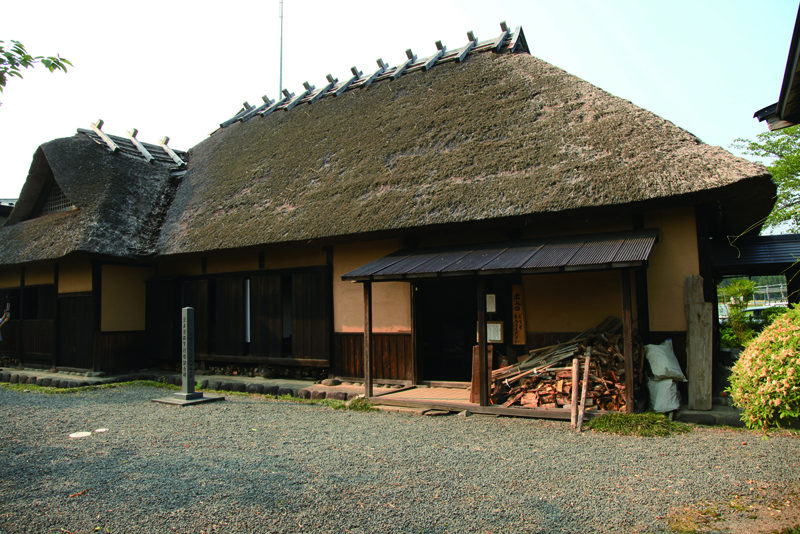
While Yurihonjo City was devastated during the Boshin War, and there are not many buildings remaining from the Edo period, theTsuchida Residence, is a nationally designated Important Cultural Property as a building that preserves the old farmhouse architectural style of the Yuri region.
The Tsuchida family residence is located within the territory of the Yajima domain, but it was spared from the ravages of war because it was a little distance from Yajima Castle (Hachimori Castle). The exact date of the building's construction is unknown, but its structure and construction methods strongly suggest that it was built by the first generation Seizaemon (died in 1678)
The building's structure is a thatched-roof farmhouse in the curved-roof style common in the Tohoku region,a centralgate-style entrance on the south-facing curved section. While most curved-roof farmhouses use the curved section as a stable (for livestock), the Tsuchida family's house uses it as a guest room. The layout and other features are remnants of medieval samurai residences, suggesting that the family was of higher status than other farmers, perhaps like a minor lord in the area.
TheTsuchida Residenceis considered to be the oldest surviving farmhouse in Akita Prefecture and is an extremely valuable building. It is open for viewing.
Tsuchida Family Residence <Information>
Facility name: Tsuchida Family Residence
Address: 9 Ainowadate, Yajimacho Motomachi, Yurihonjo City, Akita Prefecture
Phone number: 0184-56-2364
Opening hours: 9:00-16:00
Admission fee: High school students and above: 200 yen (500 yen with matcha and sweets)
Public transportation: From JR Uetsu Main Line Ugo-Honjo Station, take the Yuri Kogen Railway Chokai Sanroku Line for approximately 39 minutes, then get off at Yajima Station and walk for approximately 20 minutes or take a taxi for approximately 5 minutes
By car: Approximately 10 minutes from Honjo IC on the Nihonkai Tohoku Expressway
Google Map
Chokaisan Wooden Toy Museum, housed in the wooden school building of the former Ayukawa Elementary School
The old elementary school building, built in the mid-Showa era, has been restored with a new mission. The three wooden school buildings and indoor playground (gymnasium) remain as they were when they were first built, and the voices of children can once again be heard in the classrooms
" Former Ayukawa Elementary School " was established in 1954 (Showa 29) as Ayukawa Junior High School , but was relocated in 1970 (Showa 45) when Ayukawa Junior High School was merged with Yuri Junior High School
Ayukawa Elementary School moved there and became an elementary school, and the school used the same building as when Ayukawa Junior High School was first founded for about 50 years.However, in 2004 (Heisei 16), Ayukawa Elementary School was merged with Yuri Elementary School and relocated, and the school was forced to close
Although the former Ayukawa Elementary School no longer has an owner, the wooden school building, which inherited the architectural style from the end of the Meiji period to the Taisho period, has been carefully preserved as a treasured item for the local people
In 2012, the gymnasium, north school building, central school building, and south school building were registered as national tangible cultural properties, giving them a new place to play
The "Chokaisan Wooden Toy Museum" opened in 2019 (Reiwa 1), utilizing the three school buildings and the indoor gymnasium as they were.
One school building and the gymnasium are equipped with safety-conscious toys and large playground equipment made from locally sourced wood, creating a safe space for children to play (fee required). The other two buildings house a restaurant/cafe (KitchenCafe Kino), a rest area, and an exhibition room featuring folk art and other items from the Yuri region (free of charge).
Public transportation: From JR Uetsu Main Line Ugo-Honjo Station, take the Yuri Kogen Railway Chokai Sanroku Line for approximately 12 minutes, then get off at Ayukawa Station and take the shuttle bus for approximately 5 minutes
By car: Approximately 10 minutes from Honjo IC on the Nihonkai Tohoku Expressway
My love of travel led me to work for a travel magazine some time ago, and now I work as a travel writer for an online publication. I have visited all 47 prefectures in Japan, focusing on the Tohoku region, and I enjoy soaking in hot springs and experiencing traditional Japanese culture, including old townscapes, lifestyles, and performing arts and crafts