


Ouchi-juku is located in Shimogo-machi, Minamiaizu-gun, Fukushima Prefecture . It is famous as one of Fukushima's tourist attractions because of the sight of old thatched-roof houses lined up along the road.
If you walk a little way off the main street of Ouchijuku onto a side street, you will find a beautiful shrine shrouded in silence, far removed from the hustle and bustle of the tourist area.
Ouchijuku and Takakura Shrine
Ouchi-juku is a post town on the Aizu-Nishi Kaido road that was established around 1643 during the Edo period. It is located at the eastern end of a small basin at an altitude of around 658m, surrounded by the Ou Mountains

Although it gradually lost its status as a post town with the spread of railways during the Meiji era, the traditional post town scenery with its rows of thatched-roof houses has been passed down through generations, and in 1981 it was designated as an Important Preservation District for Groups of Traditional Buildings
Since then, it has developed into a tourist destination that attracts many tourists, and continues to do so to this day
Takakura Shrine, dedicated to Emperor Mochihito
Takakura Shrine is the guardian shrine of seven neighboring villages, including Ouchi-juku, and is said to be a shrine dedicated to Prince Mochihito, the third son of Emperor Go-Shirakawa

Its exact origins are unknown, but its founding dates back to the time of the Genpei War
Following the political upheaval of 1179 , which began with Taira no Kiyomori's coup d'état and the imprisonment of Emperor Go-Shirakawa, Prince Mochihito, fearing that the imperial court would be controlled by the Taira clan, plotted to overthrow the Taira in 1180 and issued "Prince Mochihito's Imperial Decree."
He himself"Prince Saisho"and attempted to raise an army, but his plan was exposed to the Taira clan early on, and he suffered a defeat in battle against the pursuing army that was sent to punitive the army.
According to the commonly known historical fact, Emperor Mochihito lost his life here, but according to a legend passed down in Ouchi-juku, he secretly escaped from the battlefield, escaped along the Tosando road, and arrived in Ouchi-juku
Afterwards, Emperor Mochihito stayed in this place for a while, but when the Taira clan learned of his survival, they sent pursuers
Just as Emperor Mochihito was about to fall into the hands of his pursuers, lightning suddenly struck nearby, causing the pursuers to flinch. Taking this as a divine message that they should not kill Emperor Mochihito, they secretly escaping to Echigo, where Takakura Shrine was founded to enshrine Emperor Mochihito
Incidentally, Emperor Mochihito was also known as Sanjo-no-miya or Takakura-no-miya because his residence was in Sanjo-Takakura, Kyoto. It is believed that the name of Takakura Shrine originates from this
Takakura Shrine, where you can experience the mystical atmosphere shrouded in silence
Ouchijuku, including Takakura Shrine, has been designated as an Important Preservation District for Groups of Traditional Buildings.

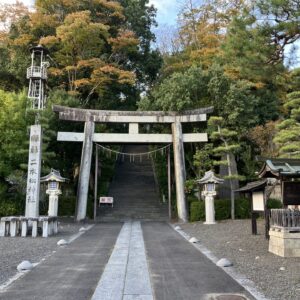
Anyone who has visited this place will have seen the large torii gate. This is the first torii gate of Takakura Shrine. Pass through this gate and continue walking towards the mountain in front of you

After walking for about five minutes, you will see the second torii gate of Takakura Shrine on your right. Go through this gate and then climb a small mountain path

The approach to the shrine is beautifully maintained and made of stone. Apparently, people use this stream as a chozuya (purification fountain) to purify their hands

The third torii gate of Takakura Shrine. Once you pass through here, the worship hall is right in front of you

The hall of worship is a massive structure with a strong presence, and the only sound you can hear is the sounds of nature. As it was nearing evening, the light of the setting sun filtered through the trees, creating a truly mystical space

Behind the premises is a large cedar tree that is said to be about 800 years old, measuring 56m in height and 4.3m in circumference at chest height. At the time, it was off-limits because a hornet's nest had apparently been found there..
Ouchijuku has become a major tourist destination and is always bustling with tourists, but Takakura Shrine is a power spot where you can escape the hustle and bustle and experience a mystical atmosphere. If you're visiting Ouchijuku, be sure to visit it as well
Takakura Shrine <Information>
- Name: Takakura Shrine
- Address: Ouchi, Shimogo-machi, Minamiaizu-gun, Fukushima Prefecture, 969-5207
- Phone number:
- Official URL:
Google Map

Traveling around the Tohoku region, I enjoy drinking delicious sake and exploring the local history, traditions, and customs. I write articles based on my interests. I'm currently interested in folk performing arts, local toys, and folk beliefs
Please support NEFT's article creation!
NEFT gathers and publishes articles about the history, culture, and tourism information of various regions in Tohoku
If you enjoyed this article, we would be grateful if you would consider supporting our future interviews, article creation, and website management
*Clicking "Tip" will open the tip sending screen for the external service "codoc"
Other articles

[Fukushima] Hidden gems! Born from Fukushima's abundant nature...

Top 10 Wineries in Northern Yamagata Prefecture! Gassan, Zao, and the Sea of Japan...

[Akita] Enjoy nature to the fullest! 4 recommended driving courses!

Haguro, as depicted in the 38th chapter of the manga "That's Journey"...

Looking forward to the new overnight express train connecting the Tokyo metropolitan area and the Tohoku region!

[Part 2] Japan's first nautical chart, "Map of Kamaishi Port in Rikuchukoku" and the discovery of Kamaishi...

Osawa Onsen, a hot spring resort with a 200-year history, offers a self-catering experience! [Iwate...
![Daito-ryu Aikijujutsu [Part 2]](https://jp.neft.asia/wp-content/uploads/2026/01/aiki_tkd02-300x300.jpg.webp)
Did Aikido originate in Aizu? Daito-ryu Aikijujutsu and Martial Arts...

A railway that doesn't operate? The past and present of Towada Kanko Dentetsu...

The scent of bamboo brings back memories! Inawashiro Town's retro Japanese sweets "Sasa...
Walking around the town is fun! A casual spot for a snack near JR Nihonmatsu Station...
