


The core of the theory that Aomori Hiba is the strongest is "hinokitiol," which is found only in Aomori Hiba in Japan

Aomori hiba has proven its superiority as a building material, being used in many places, including the Chusonji Konjikido Temple in Hiraizumi (Hiraizumi Town, Iwate Prefecture), which has remained unreconstructed for over 900 years, Hirosaki Castle, which was built in the early Edo period, and Dazai Osamu's birthplace, Shayokan, which was built in 1907 (Meiji 40).However, it also provides us with another wonderful benefit: its fragrance
The scent emitted by trees is the greatest weapon for self-defense

Each tree has its own refreshing scent, but the most representative is probably Hinoki (Japanese cypress). Its scent is loved by the Japanese people and is widely used in buildings, fixtures, bathtubs, and more. Aomori Hiba has an equally soothing scent, which is also very good for your health
In nature, trees grow in the same place from the moment they sprout. No matter the weather, they cannot escape even if they are attacked by pests. For this reason, they have evolved to have strong roots, round trunks, and leaves and branches that can withstand the force of wind and rain. Furthermore, to protect themselves against the intrusion of pests and other plants, they produce their own fragrant compounds to keep enemies away
Each tree has its own unique scent
The scents of trees have evolved uniquely over the long history of the Earth, depending on the environment in which they have grown, and the components of that scent vary greatly depending on the species. Some trees have a strong scent, while others have almost no scent at all. A typical example of a tree with a strong scent is the camphor tree. Its scent has been described as "refreshing and refreshing to the nose," and it has extremely strong insecticidal properties, so it is used as camphor in the moth repellent for clothing
Aomori Hiba is also a tree with a strong fragrance. However, the components of its fragrance are not the same as those of camphor trees, cypress trees, or cedar trees. Each tree has its own unique composition that characterizes it. The fragrance components of trees are contained in the leaves and woody parts and are called essential oils
Phytoncide means "a substance that plants use to kill foreign enemies that attack them."
Fragrances react to our sense of smell as they evaporate and float in the air. Essential oils are liquid, and each component has a different temperature (boiling point) at which it evaporates and turns into a gas. We sense the scent first from those with a low boiling point, and even in the forest, where temperatures fluctuate depending on the day, season, and weather, the scent we perceive will differ depending on the condition. In a wooden bathroom, where temperatures are higher, components that do not evaporate in nature are also present, resulting in a more complex scent
Of course, there are scents that are good for the human body and those that are bad for it (such as hydrogen sulfide), but the scents that trees give off are called "phytoncides," and their refreshing scent soothes people when they are taking a forest bath or bathing in the bath. The word "phytoncide" actually comes from the Greek words "phyton" (plant) and "cide" (something that tries to kill)
The scent of Aomori Hiba has a soothing effect as well as a calming and health-promoting effect
The scent of Aomori Hiba is stronger than the soft scent of the well-known Japanese cypress, and feels a little stimulating. It is a scent unique to Aomori Hiba that not only has a healing effect, but also has health benefits such as a sedative effect and lowering blood pressure. *Reference: Summary notes of a lecture by Professor Tanida Kai, Graduate School of Tokyo University, 2003
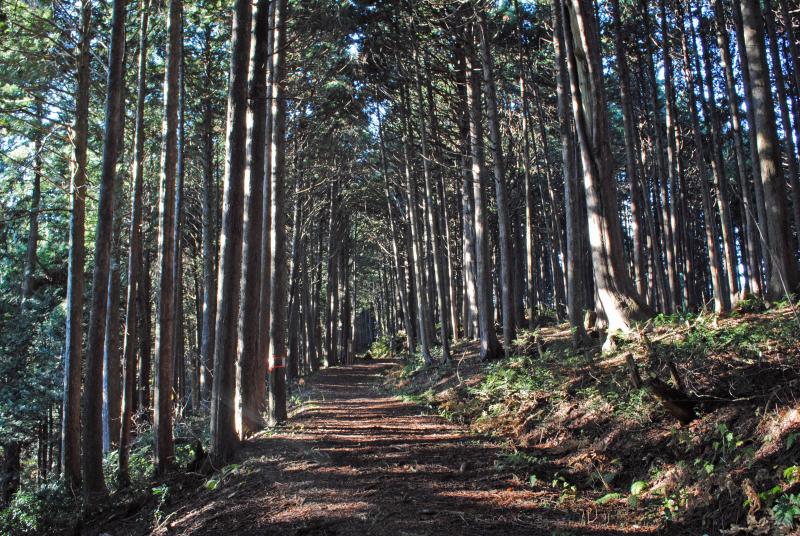
"Tenbozan" - Aomori Hiba Forest where you can enjoy forest bathing bathed in phytoncides

Chobosan is a low mountain at the base of the southern Tsugaru Peninsula, about 143 meters above sea level, and is a recommended hiking course for forest bathing, with a well-maintained walking trail through a dense forest of Aomori hiba. The entire area has been designated as the "Chobosan Natural Recreation Forest," and in addition to the natural forest of Aomori hiba, there is also artificial forestry of Aomori hiba, Japanese cypress, and cedar, which were planted nearly 100 years ago, as well as a forest mixed with broadleaf trees such as beech, allowing you to enjoy a variety of phytoncides

There are no steep slopes to the summit, and from the observation deck at the summit, which is about 19 meters high, you can enjoy a panoramic view of Mutsu Bay and Mt. Hakkoda
Chobozan is closed for the winter from mid-November to late April and early May. Closure and reopening dates vary depending on the year, so please check
- Aomori Forest Management Office: Phone number 017-781-0131
- Viewing Mountain/Bonsu Mountain Natural Recreational Forest Protection Management Council Secretariat (Aomori City Agricultural Forestry Division): Phone number 0172-62-1146

Choboyama Natural Recreation Forest Information
- Facility name: Chobosan Natural Recreation Forest (Recreation Forest)
- Location: Uchimanabe National Forest, Uchimanabe, Aomori City, Aomori Prefecture
- Contact:
- Aomori Forest Management Office: Phone number 017-781-0131
- Viewing Mountain/Bonju Mountain Natural Recreation Forest Protection Management Council Secretariat (Aomori City Agricultural Forestry Division): Phone number 0172-62-1146
- *Closed for winter from mid-November to late April and early May
- *Bear sightings are becoming more frequent. Please be careful and carry bells, whistles, bear repellent spray, etc., and refrain from traveling alone. Also, be careful of hornets
- Choboyama Natural Recreation Forest
- access:
- Public transportation: Approximately 20 km from Shin-Aomori Station on the Tohoku/Hokkaido Shinkansen and Ou Main Line; approximately 20 km from Aomori Station on the JR Ou Main Line and Aoimori Railway; approximately 15 km from Kanagi Station on the Tsugaru Railway (no bus connections available)
- By car: Approximately 20km from Aomori IC on the Tohoku Expressway
Google Map
The strength of Aomori Hiba has been proven through experiments
The scent of Aomori Hiba comes from a combination of many essential oils, each of which has an important protective role to play. This is what makes Aomori Hiba strong and long-lasting
Let us introduce how durable Aomori hiba is based on materials from the Aomori Prefectural Federation of Forestry Associations
■ Termite-resistant
In an experiment using Formosan subterranean termites, which are known to be highly susceptible to damage, black pine and cypress, which are considered relatively resistant to termites, were heavily damaged, but Aomori hiba was not damaged at all (according to an experiment conducted at Miyazaki University in 1996). The secret to this is the presence of essential oils that not only repel termites but also kill them
■ Not easily spoiled
Wood gradually decays due to mushrooms and various wood-decaying fungi, but after comparing more than 10 types of wood, an experiment conducted by the Aomori Forestry Bureau in 1962 showed that Aomori Hiba was the strongest
■ Keeps mold away
When mold was applied to the cut surface (the surface when cut) of seven types of wood commonly used as building materials, including Aomori Hiba, Hinoki, Cedar, and Beech, and left at room temperature for 10 days, the Aomori Hiba demonstrated antibacterial properties, with no mold growing around it (based on an experiment conducted by the Aomori Prefectural Industrial Research Institute)
Hinokitiol protects Aomori Hiba

This material, said to be one of the strongest in Japan, is largely due to a component called "hinokitiol" contained in Aomori Hiba. Because "hinokitiol" has the word "hinoki" in its name, it is often thought to be contained in Japanese cypress (hinoki/Japanese cypress), but in fact, among Japanese trees, it is found almost exclusively in Aomori Hiba
So why is it called "hinoki" thiol? It is a compound discovered in the 1930s from the Taiwan cypress, a plant of the cupressaceae family, and was extracted by Nozoe Tetsuo, who was a professor at the Imperial University of Taiwan at the time. Since it was discovered in Taiwan cypress, it was named "hinokitiol," but it was later discovered that it is not found in Japanese cypress, which led to the name becoming difficult for Japanese people to understand
Hinokitiol is extracted as a natural ingredient with strong antibacterial and antiseptic properties, and is used for deodorizing, disinfecting, and insect repellent. Typical applications include cosmetics, toothpaste, and scalp care products, and its fragrant components are also highly popular in aromatherapy
The strength of Aomori Hiba has been used in the "Tsubozawa Wooden Embankment Group" to prevent flooding

There is a historical structure that clearly demonstrates the anti-termite, anti-rot, and antibacterial properties of Aomori hiba: the Tsubokezawa Wooden Embankments
The "Tsubozawa Wooden Dams" are a group of dams (weirs) built from the Taisho to Showa eras. Dams are small dam-like structures that are installed to block the force of powerful water currents and prevent flood damage, and in modern times they are generally made of reinforced concrete, which is resistant to water and pressure
Tsubogazawa is a mountain stream located in a national forest in Goshogawara City, almost in the center of the base of the Tsugaru Peninsula. The soil in this area is very weak against water, and it has long been feared by local residents as a violent stream

In 1916 (Taisho 5), a dam was planned to be built in Tsubogoshisawa as a flood prevention measure, but due to the lack of a transportation route from the foot of the mountain and the geological condition not being strong enough to support concrete, it was decided to build it out of wood, and Aomori Hiba, which is water-resistant and grows abundantly in the area, was chosen as the material. Six dams were built at the time
Six more embankments were added between 1953 and 1958, bringing the total to 12. The current state of the embankments is detailed in a report on a survey and progress observation conducted by the Tsugaru Forest Office in 2020
According to the report, "Of the six units manufactured in 1916, only one was washed away, leaving the remaining five. The condition of the units is that "the components at the water-impacting section have become thinner due to wear, the connections have loosened, some have fallen out, and the sleeves are damaged, but they still function as they were intended." ("Tsubogezawa Hiba Wooden Embankment - Current Status in 2020 and What We Learned from Observations," Mogi Yuta, General Staff Member, Kanagi Branch, Tsugaru Forest Management Office)

Six of the Showa-era structures have some damage in the sleeves, but the components are not worn down and remain in the same condition as when they were first constructed. Over the 100 years since Taisho 5, the structures have been hit by numerous floods and mudslides, but although only one Taisho-era structure has been lost, the rest are still functioning as they should, even if not perfectly. This case once again confirms the advanced construction techniques and the strong water resistance of Aomori Hiba
Tsubozawa Wooden Embankment Group Information
- Facility name: Tsubokezawa Wooden Embankments
- Location: Iizumeyama National Forest, Goshogawara City, Tsubogazawa River Basin
- Contact: Tsugaru Forest Management Office Kanagi Branch
- Phone number: 0173-53-3115
- URL:Tsubomozawa Wooden Embankment Group
- *As this is not a tourist spot, access information will be omitted

My love of travel led me to work for a travel magazine some time ago, and now I work as a travel writer for an online publication. I have visited all 47 prefectures in Japan, focusing on the Tohoku region, and I enjoy soaking in hot springs and experiencing traditional Japanese culture, including old townscapes, lifestyles, and performing arts and crafts
Please support NEFT's article creation!
NEFT gathers and publishes articles about the history, culture, and tourism information of various regions in Tohoku
If you enjoyed this article, we would be grateful if you would consider supporting our future interviews, article creation, and website management
*Clicking "Tip" will open the tip sending screen for the external service "codoc"
Other articles

Fire Prevention Tiger Dance | A dance that expresses the wish to protect the town from strong winds and fires...

What is the Kitamuki Kannon statue? – The hidden temple of Ogatsu, Akita...

[Miyagi Prefecture] Sendai International Airport, the gateway to Tohoku, is a souvenir paradise...

The local train and bus between Morioka and Miyako have been competing for 40 years...

The Golden Legend of Mutsu Province | Wakuya Town, said to be Japan's first gold-producing region...

A nationally famous mountain worship site that symbolizes life, death, and rebirth...

A journey unraveling the history of Uesugi Yozan, lord of the Yonezawa domain...

Let's go meet the big, fluffy Akita dogs! [Akita...].
The deer dance is a unique and fascinating story that will make you enjoy the dance even more...
[Tohoku Autumn Foliage Driving Map: Aomori Edition] Recommended Driving...

[Semboku City, Akita Prefecture] "The man-made autumn leaves of Kakunodate" and "Self-made...
