


Who is the ancient god "Arahabaki"?
"Arahabaki"is a deity that was worshipped mainly in the Tohoku and Kanto regions of Japan. It is believed to have existed since ancient times, butit does not appear in Japanese mythology (Kojiki and Nihon Shoki).
Therefore, it is thought to be a deity originating from the local beliefs of ancient Japan, from the Tohoku region to the Kanto region. However, because it is so ancient and, as mentioned above, not mentioned in any documents, its true identity and origin remain unknown to this day
From the Middle Ages onward, the name appears in shrine histories and records using various spellings such as "荒脚巾," "荒覇吐," "荒吐," and "荒波々幾." However, it is highly likely that these are kanji characters that were assigned later, and it is considered most appropriate to refer to it using the katakana spelling "ARHABAKI."
There are various theories regarding "what kind of god it is." Some of them are listed below
The legend of the god of feet and travel
This theory suggests that it originated from the fact that the kanji characters "脚巾" were later assigned to "habaki" (leg guards)
Habaki refers to the practice of wrapping straw or cloth around the shins and tying it with string to allow for easier movement during travel or work. It is believed that this is why the deity came to be worshipped as a god associated with "feet."
The term "feet" is sometimes broadly interpreted as "lower body," and the deity is identified with "Konsei-sama" (金勢様/金精様) , a god modeled after the male phallus
Snake God Theory
in "Arahabaki"an archaic word for snake, and "hahaki" means either "snake tree" or "dragon tree."
Furthermore, this is linked to the "Hahaki-no-kami" enshrined in the southeast of the Inner Shrine of Ise Grand Shrine , and there is a theory that the prefix "to manifest" was later added to "Hahaki-no-kami, " resulting in "Arahabaki-no-kami ."
The theory of the guardian deity
At the Arahagihaba Shrine in Tagajo City, Miyagi Prefecture,the "Sai no Kami theory"is told.
Sai no Kami refers to " a god of folk belief enshrined at village boundaries and crossroads to prevent disasters, epidemics, and evil spirits from entering a territory," and is also known as Dosojin .
This theory suggests that "Arahabaki" was enshrined in Tagajo, which was a base for the imperial court to subdue the Emishi, in order to protect Tagajo from Emishi invasions
The Emishi God Theory
One theory that stems from the "Sai no Kami theory" of Tagajo is the "Emishi (Ainu) god theory."
The traditional policy of the imperial court to govern the Emishi was said to be "to control the Emishi with the Emishi," and it is also said that the intention was to demoralize the Emishi by enshrining their god, "Arahabaki," as a guardian deity protecting Tagajo Castle along the Emishi invasion routes.
The theory that he is the ancestral deity of ironmaking
"ara"is an archaic word for iron, and that mountain ascetics who practiced iron production using mountain iron sand and collected other minerals incorporated the worship of the Arahabaki deity.
I'm not sure if this is related to this theory, but in Aizuwakamatsu City, Fukushima Prefecture, there is an Arahabaki Shrine whose name is written as "荒鎺神社" with the kanji characters for "metal" and "ancestor"
The theory of sexual deities related to the ancient Ainu language
This theory, told by an Ainu chief in Kutchan (a town in Abuta District, Hokkaido), originates from the fact that in the ancient Ainu language, "Kunato" means male genitalia and "Arahabaki" means female genitalia
The Arahaba-ki = Shakoki Dogu is a false image that spread from forged documents

If you search for "Arahabaki" on the internet, you will find several descriptions stating that the Shakoki Dogu (goggle-eyed clay figurine ) unearthed from sites such as the Kamegaoka ruins in Tsugaru City , Aomori Prefecture, is the figure of Arahabaki. However, the origin of this information is said to be based on descriptions in an ancient historical text called the Tsugaru Sotosangunshi.
However, this "Tōtsugaru Gaisan-gunshi" is considered to be a forgery , and the image of the Shakoki Dogu (goggle-eyed clay figurine) being Arahabaki, which spread based on this description, is also incorrect
In other words, its appearance, origin, and what kind of god it isall unknown, and"Arahabaki"is passed down through generations.
Arahabaki Co., Ltd. in Aomori Prefecture
The area around Lake Jusan in Goshogawara City, Aomori Prefecture, was once the base of the Tsugaru Ando clan, who claimed descent from the Abe clan, and flourished around the port city of "Jusan-minato."
There are several shrines in this area that are said to have enshrined the ancient deity "Arahabaki." However, some of their origins are suspected to have been influenced by the "Tōtsugaru Gaisan-gunshi," which is considered a forged document, so the traditions cannot be taken at face value as historical fact
This article explores the mysteries of the Arahaba-ki faith prevalent around Lake Jusan, using clues such as the relationship between the Abe and Ando clans, the traces remaining in the area, and connections to Jomon period ruins, by visiting places like the Arai-Isozaki Shrine and the Ainai Shinmei Shrine


Arahabaki Company, Iwate Prefecture
Tannaiyama Shrine, located in Towa-cho, Hanamaki City, Iwate Prefecture, is an ancient shrine said to have been founded about 1200 years ago, and enshrines Tanichihiko-no-kami, the pioneering god of this area, as its main deity
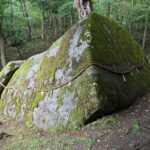
At the very back of the temple grounds sits the massive stone known as "Tannai-ishi," named after the ancient deity "Arahabaki." It is said that this megalith was an object of worship even before the deity Tanichihiko was enshrined there, and it later received syncretism with Buddhism and reverence from the Oshu Fujiwara clan and the Nanbu clan
This article explores Tannaiyama Shrine, a place where the history of rock worship, ancestor worship, and the syncretism of Shinto and Buddhism is condensed, and introduces the megalith of Arahaba-no-Okami and the cultural artifacts remaining on the shrine grounds
Arahabaki Co., Ltd. in Miyagi Prefecture
Arahabaki is a mysterious ancient deity that does not appear in the Kojiki or Nihon Shoki, and whose origins and divine nature remain unknown
Within Miyagi Prefecture, there are two Arahagihaba Shrines bearing this name: one in Tagajo City and another in Iwadeyama, Osaki City. In Tagajo, shoes and cloth are offered as votive offerings to the shrine as it is worshipped as the god of feet and travel, while in Iwadeyama, it has been worshipped as the tutelary deity and the "god of molluscum contagiosum."
On the other hand, the history and explanations are suspected to be influenced by the "Tōtsugaru Gaikō Sangunshi," which is considered a forgery. We will visit the two Arahaba Shrines and use the offerings and legends within the shrine grounds as clues to explore the commonalities and mysteries of the Arahaba worship that remains in the region


Arahabaki Co., Ltd. in Fukushima Prefecture
In Aizuwakamatsu City, Fukushima Prefecture, there are two Arahabaki shrines that differ in their spelling and characteristics
At the Arahagi Shrine in Kitamachi, the character "鎺," which means the metal fittings of a Japanese sword, and the surrounding ancient ruins suggest a connection to iron production. Meanwhile, at the Arahagi Shrine in Minatomachi, the enshrined deity is Kanayamahiko-no-Mikoto, and there is a legend that the shrine's name originates from the fact that it enshrines the shin guards left behind by Minamoto no Yoshiie
This article explores the mysteries of the two shrines in Aizu and the Arahaba-ki faith, using plaques, stone shrines, and local historical documents that remain at the site as clues
