

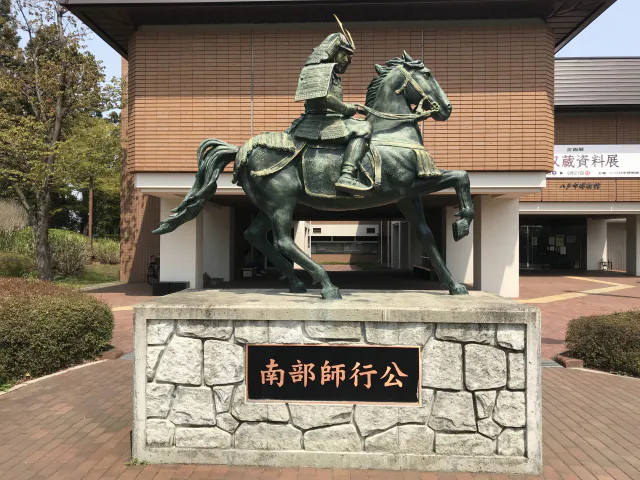
It's in the eastern part of the prefecture, but it's called the "Southern Region"!? This "Southern" is a person's name. [Aomori Prefecture]

In Aomori Prefecture, the term " Nanbu region " is sometimes used. However, this doesn't mean "the southern part of Aomori Prefecture" (although it does include areas in the southern part of Aomori Prefecture such as Hachinohe City). Rather, it refers to the eastern area of Aomori Prefecture
The origin of the name "Nanbu" (南) is actually quite simple. "Nanbu"doesn't mean "southern region," but ratherit's a person's surname.
What is the southern region of Aomori Prefecture?
The southern region of Aomori Prefecture refers to the eastern part of Aomori Prefecture.
The municipalities that make up the westernmost part of the Nanbu region are, from north to south, Noheji Town, Tohoku Town, Shichinohe Town, and Towada City in Kamikita District. The area west of thesethe Tsugaru region. In addition, Mutsu City on the Shimokita Peninsula and the towns and villages of Shimokita District (Oma Town, Higashidori Village, Kazamaura Village, and Sai Village)are sometimes distinguished as the "Shimokita region" and not included in the Nanbu region.
Aomori City, the capital and most populous city of Aomori Prefecture, is not included in the Nanbu region. In reality, the central city of the Nanbu region is Hachinohe City, which is the second most populous city in Aomori Prefecture
There are also terms related to the Nanbu region, such as the "Nanbu Jukan Railway Line," which was discontinued in 2002, the "Nanbu Railway Line," which was discontinued in 1968, and "Nanbu Bus," which operates in Hachinohe City and other areas


The name "Nanbu" (Southern Region) originates from the fact that it was a region ruled by the Nanbu clan, a powerful daimyo family, during the Edo period
Although there are "southern regions" in Iwate and Akita prefectures, they aren't commonly referred to as such, are they?
The territory ruled by the Nanbu clan during the Edo period was not limited to the eastern part of present-day Aomori Prefecture. They also held territories in central and northern Iwate Prefecture and parts of Akita Prefecture (around present-day Kazuno City and Kosaka Town in Kazuno District). In fact,the Nanbu clan's base in the early Edo period was Morioka, and their domain was. These regions were originally included in the "Nanbu region."
However, in Iwate Prefecture, compared to Aomori Prefecture, the area that was formerly the territory of the Nanbu clan is not often referred to as the "Nanbu region." In Iwate Prefecture, it is common to divide the prefecture into four areas: "northern Iwate," "central Iwate (or Morioka)," "southern Iwate," and "coastal."
However, there are instances where the central and northern parts of Iwate Prefecture are referred to as " Nanbu ," such as " Nanbu ironware " produced in Iwate Prefecture , or "Nanbu senbei" crackers eaten in both the southern and northern parts of Aomori Prefecture.


The history of the Nanbu clan
Where did the Nanbu clan, from whom the name of the eastern part of Aomori Prefecture originates, come from, and how did they become established in Aomori Prefecture and other parts of the Tohoku region?
The Nanbu clan originated in what is now Yamanashi Prefecture

The Nanbu clan is said to have been founded by Nanbu Mitsuyuki , a member of the Kai Genji clan, who was born in 1165 during the late Heian period . He began using the name Nanbu because he ruled the Nanbu territory in Kai Province.
The Kai Genji clan are descendants of Minamoto no Yoshimitsu, the third son of Minamoto no Yoriyoshi, who participated in battles such as the Later Three Years' War (Gosannen Kassen) that took place in what is now Akita Prefecture during the late Heian period. The most famous member of the Kai Genji clan is Takeda Shingen, a daimyo and warlord of the Sengoku period, meaning that the Nanbu clan shares the same ancestors as Takeda Shingen

The Nanbu domain of Kai Province corresponds to present-day Nanbu Town, Minamikoma District, Yamanashi Prefecture. The issue of Aomori Prefecture being "eastern but called Nanbu" originated from a place name that wasn't even in the Tohoku region
As a side note,Nanbu Town in Yamanashi Prefecture is actuallylocated at the southernmost tip of Yamanashi Prefecture (formerly Kai Province).
The Nanbu clan went to Oshu
The prevailing theory is that Nanbu Mitsuyuki,cooperated with Minamoto no Yoritomo, distinguished himself in battle during the conquest of the Oshu Fujiwara clan after the Minamoto clan's defeat of the Taira clan, and was thereforegranted territory in Oshu (the Tohoku region). However, it is unclear whether this is true, and even if it is, exactly what territory he was granted.
It is generally accepted that the Nanbu clan established a sphere of influence in Oshu around 150 years later, at the end of the Kamakura period. Nanbu Moroyuki, the great-great-grandson of Mitsuyuki, who built Nejo Castle (present-day Hachinohe City, Aomori Prefecture) in 1334, is one example of a person who is thought to have actually been based in Oshu

Expanding power during the Sengoku period

from the "Sengoku Period Exhibition," held by the Edo-Tokyo Museum and Morioka Museum of History and Culture, public domain, https://commons.wikimedia.org/w/index.php?curid=54919960
From the Nanboku-cho period onward, the Nanbu clan greatly expanded its power in Oshu. In particular, Nanbu Harumasa, who was born in 1517 during the Sengoku period and whose main base was Sannohe Castle (present-day Sannohe-cho, Sannohe-gun, Aomori Prefecture) , overwhelmed surrounding forces and expanded his territory. His territory extended to the entirety of present-day Iwate and Aomori prefectures and the northeastern part of Akita prefecture
that expresses the vastness of the Nanbu clan's territory: "Nanbu territory until the crescent moon is full." This means that even if you enter Nanbu territory when the moon is a crescent, it will be a full moon by the time you leave the territory, indicating that it is so vast that it would take about 12 days to walk across the entire territory.
The Tsugaru region was lost in a rebellion
Although the Nanbu clan was expanding its territory, its influence consisted of many branches, including the Sannohe Nanbu clan, the Nejo Nanbu clan, the Hachinohe clan, the Kunohe clan, and the Nitta clan. The Nanbu clan's power was not unified, as these branches sometimes cooperated and sometimes opposed each other
The head of the family, Nanbu Harumasa, had not had a son for a long time, and had designated his cousin Nobunao as his successor. However, when his long-awaited biological son was born (Harumasa was 54 years old at the time) , Harumasa began to resent Nobunao
During that period, in 1571, Ōura Tamenobu, who is said to be a member of the Nanbu clana rebellion in the Tsugaru region. Tamenobu took advantage of the fact that Harumasa was in conflict with Nobunao, and successively destroyed the surrounding powerful families, building up a large force.
The conflict between Harumasa and Nobunao continued, escalating to acts of violence such as mutual attacks. Ultimately, Harumasa and his son Harutsugu died in quick succession, and Nobunao succeeded him. Harutsugu was only 13 years old, and naturally, it is suspected that Harutsugu (or both Harumasa and Harutsugu) were assassinated by Nobunao
The territory that Tamenobu had seized was confirmed in 1589 by Toyotomi Hideyoshi, who had almost seized control of the entire country.Tamenobu's ownership of the Tsugaru regionwas officially recognized by the ruler of Japan. He also changed his surname from Oura to Tsugaru and became known as Tsugaru Tamenobu.
This not only guaranteed Tamenobu's territorybut also definitively confirmed the Nanbu clan's loss of the Tsugaru region. Throughout the Edo period, the Tsugaru regionwas ruled by the Tsugaru clan, who became the lords of the Hirosaki domain. This led to the current division of Aomori Prefecture into the Tsugaru region in the west and the Nanbu region in the east.
If Oura Tamenobu had not revolted, it is highly likely that the entire area corresponding to present-day Aomori Prefecture would have remained under the control of the Nanbu clan. In that case, even if Aomori Prefecture had been established in its current form during the Meiji era, the expression "Nanbu region" would not have been used to refer to a part of Aomori Prefecture, since the entire area would have been Nanbu territory. The term used to refer to eastern Aomori Prefecture would have been completely different from reality
The Nanbu clan during the Edo period
The Nanbu clan, plagued by constant internal conflicts, experienced further divisions during the Edo period
During the Edo period, the Nanbu clan moved their base from Sannohe to Morioka, and their territory became the Morioka Domain
However, later,the Hachinohe Domain gained independence from the Morioka Domain. Although it was called the Hachinohe Domain, most of its territory is now part of Iwate Prefecture.
The first lord of the Hachinohe Domain was a member of the Morioka Domain's lord's family, but it was not a branch domain of the Morioka Domain but was completely independent. It is said that some Morioka samurai, resentful of this ruling by the shogunate, even attempted to assassinate the Hachinohe Domain lord
Due to these circumstances, although both domains were ruled by the Nanbu clan, the Morioka and Hachinohe domains followed their own independent paths. Even during the Boshin War in the Meiji era, the two domains responded differently. The Morioka domain sided with the former shogunate, and after the war, its territory was confiscated and it was relocated to Shiroishi (present-day Shiroishi City, Miyagi Prefecture)

On the other hand, the Hachinohe Domain did not participate in the war and its territory was secured (albeit only for the three years until the abolition of the feudal domains and establishment of prefectures)

The fact that these two regions have developed independently may be why, today, the term "Nanbu region" generally refers to the eastern part of Aomori Prefecture, and does not include Iwate Prefecture (this is purely the author's speculation)
The conflict between Tsugaru and Nanbu
Because the Tsugaru clan gained control of the Tsugaru region through a rebellion by the Nanbu clan, it is saidthe Hirosaki Domain, ruled by the Tsugaru clan, and the Morioka Domain, ruled by the Nanbu clan,were bitter enemies throughout the Edo period.
It is said that in the mid-Edo period, the Hiyama Incident occurred, in which people who invaded Nanbu from Tsugaru and cut down cypress trees were killed by the Nanbu side
Later, an incident known as the Soma Daisaku Incident occurred, in which samurai from the Morioka domain attempted to attack the lord of the Hirosaki domain

During the Boshin War, the Tsugaru Domain submitted to the new government early on, and later launched the "Noheji War," attacking the Morioka Domain, which was supposed to have surrendered to the new government
Tsugaru and Nanbu had different climates, and the movement of people was divided by mountain ranges, which is said to have led to poor relations between them. Nevertheless, in the Meiji era,Aomori Prefecture was formed through the merger of the former Hirosaki Domain and the former Hachinohe Domain, among others.
When the feudal domains were abolished and prefectures were established in the area that is now Aomori Prefecture, prefectures were established by transferring the domains from the Edo period, such as Hirosaki, Kuroishi, and Hachinohe. However, these weresoon merged and unified into Hirosaki Prefecture.
The reasons cited for the merger, which disregarded the feud between Tsugaru and Nanbu during the Edo period, include the fact that Hirosaki Domain had submitted to the new government early on, making it well-liked by the government, and that Hirosaki Prefecture's economic power was far greater than that of other prefectures, leaving them with no choice but to merge into Hirosaki Prefecture
Although the prefectural office of Hirosaki Prefecture was located in Hirosaki,it was moved to Aomori, and the prefecture's namewas changed to Aomori Prefecture.
At the time, Aomori was merely a small port town, but due to its central location in the prefecture and the promising future of its port, the prefectural government was moved there. As expected, Aomori grew to become the largest city in Aomori Prefecture, surpassing Hirosaki and Hachinohe
Thus, the former territories of the Tsugaru clan and parts of the Nanbu clan became one prefecture, but the name of the Nanbu clan still remains in the form of area divisions within Aomori Prefecture

A former railway engineer and current freelance writer who has loved trains since childhood, his dream is to make train travel his career
Please support NEFT's article creation!
NEFT gathers and publishes articles about the history, culture, and tourism information of various regions in Tohoku
If you enjoyed this article, we would be grateful if you would consider supporting our future interviews, article creation, and website management
*Clicking "Tip" will open the tip sending screen for the external service "codoc"
Other articles
[Paleolithic Sites in Aomori Prefecture: Part 2] A Treasure Trove of Animal Fossils: "Shiri...

This is also a Kamakura. "Hey, Gongoro of Kamakura!"...

Mountain worship of the Dewa Sanzan mountains | Current happiness, peace after death, rebirth...

3 Recommended Local Train Lines in Aomori Prefecture! Enjoy the view from the train window!.

[Series 3: The Former Nine Years' War and the Later Three Years' War] The unrivaled strength of An...

[Photo Report of Aizu-Tajima Gion Festival: Part 2] Japan's No. 1 Bride...

Three Sengoku warlords from Miyagi Prefecture! Date Masamune, Katakura Kagetsuna, and Date Masazane
Arahagihaba Shrine in Tagajo | A shrine built to repel the Emishi (indigenous people of northern Japan)...

Sanriku performing arts come together in one place! Sanriku International Arts Festival 2025 "Brew...

[10 years since its discontinuation] JR's last express train! Between Aomori Station and Sapporo Station...

Aomori depicted in the 9th journey of the anime "That's Journey"...
